 Money


The Reserve Bank of India’s latest weekly statistical supplement reveals robust bank credit growth of 11.6% alongside shifting foreign exchange reserves.
Key points
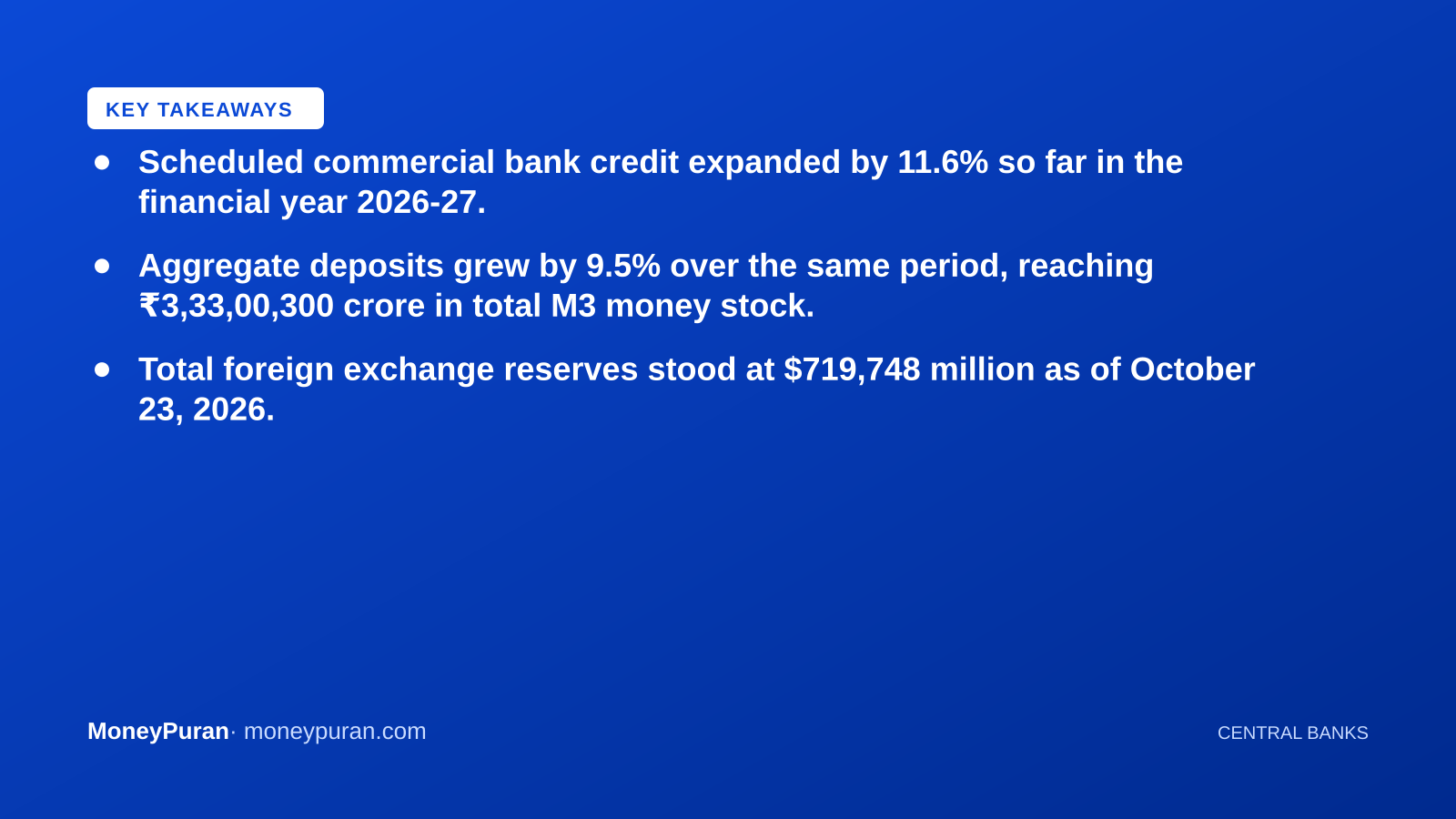
- Scheduled commercial bank credit expanded by 11.6% so far in the financial year 2026-27.
- Aggregate deposits grew by 9.5% over the same period, reaching ₹3,33,00,300 crore in total M3 money stock.
- Total foreign exchange reserves stood at $719,748 million as of October 23, 2026.
- RBI liquidity operations reflected net absorption across various dates through the Standing Deposit Facility.
The Reserve Bank of India (RBI) released its latest weekly statistical supplement, providing a comprehensive snapshot of India’s banking sector health, monetary aggregates, and foreign exchange reserves. The central bank’s data shows continued momentum in bank credit expansion, alongside active liquidity management through its Standing Deposit Facility and repo operations.
According to the RBI data for the fortnight ending October 15, 2026, aggregate deposits across scheduled commercial banks expanded by 9.5% in the financial year so far. Meanwhile, total bank credit grew by 11.6%, underscoring steady credit demand across non-food sectors. Total money stock, measured as M3, stood at ₹3,33,00,300 crore as of mid-October, reflecting stable monetary expansion across currency with the public and bank deposits.
Foreign Exchange Reserves and Liquidity Dynamics
The RBI report detailed movements in India’s foreign exchange reserves, which were recorded at $719,748 million (₹68,33,505 crore) as of October 23, 2026. Foreign currency assets formed the major chunk of these reserves at $593,205 million, while gold reserves stood at $103,150 million. On the liquidity front, daily operations by the central bank showed net liquidity absorption through the Standing Deposit Facility (SDF), balancing systemic liquidity conditions.
- Aggregate deposit growth: 9.5% in FY 2026-27
- Bank credit growth: 11.6% in FY 2026-27
- Total foreign exchange reserves: $719,748 million
- M3 money stock: ₹3,33,00,300 crore
What this means for investors
For Indian investors, the weekly statistical supplement serves as a vital health check on the domestic banking sector. Healthy double-digit credit growth coupled with stable deposit mobilisation generally points towards resilient economic activity and credit demand from corporate and retail borrowers. When commercial banks experience steady credit expansion, it typically supports top-line loan growth for lenders, though deposit competition remains a factor to watch for bank net interest margins.
Furthermore, tracking RBI liquidity operations and foreign exchange reserves helps investors gauge broader macroeconomic stability and interest rate trajectories. Net absorption of liquidity by the central bank indicates how surplus cash is managed within the banking system, influencing short-term yields and money market rates. Investors should monitor upcoming RBI bulletins to spot persistent shifts in credit-deposit ratios and liquidity deficits that could impact broader financial markets.
Frequently asked questions
What is the RBI weekly statistical supplement? It is a regular publication by the Reserve Bank of India detailing scheduled commercial bank business, money stock components, foreign exchange reserves, and central bank liquidity operations.
Why does credit growth matter for the stock market? Credit growth is a key indicator of economic momentum. Strong credit offtake usually benefits banking and financial stocks and signals active capital deployment across industrial and consumer sectors.
How do foreign exchange reserves affect the economy? Robust forex reserves provide a cushion against external shocks, help stabilise the Indian rupee against major global currencies, and maintain investor confidence in macroeconomic fundamentals.
This article is for information only and is not investment advice. Do your own research or consult a licensed adviser before investing.
Based on information published by Reserve Bank of India (RBI). Source: Reserve Bank of India (RBI). Spotted an error? corrections@moneypuran.com