 Money


Fresh rupee loan and term deposit rates moderated across scheduled commercial banks, according to Reserve Bank of India data.
Key points
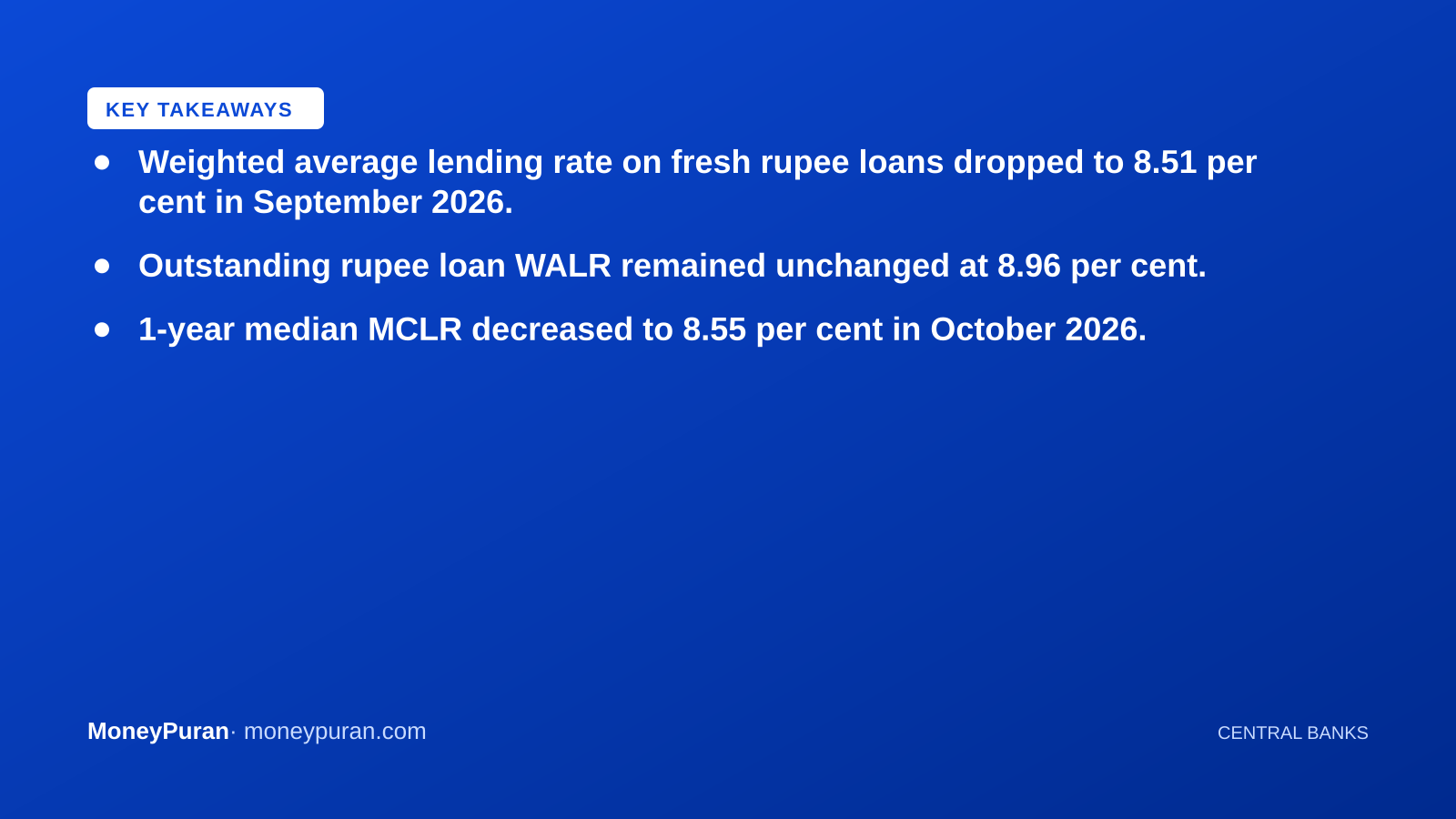
- Weighted average lending rate on fresh rupee loans dropped to 8.51 per cent in September 2026.
- Outstanding rupee loan WALR remained unchanged at 8.96 per cent.
- 1-year median MCLR decreased to 8.55 per cent in October 2026.
- Weighted average domestic term deposit rate on fresh deposits fell to 5.61 per cent.
Borrowing costs for fresh rupee loans edged lower across scheduled commercial banks, providing a subtle relief to retail and corporate borrowers. According to data released by the Reserve Bank of India (RBI), key benchmark interest rates for new credit contracted over the reporting months, even as legacy loan rates remained firmly anchored.
The central bank’s statistical compilation shows that the weighted average lending rate (WALR) on fresh rupee loans declined to 8.51 per cent in September 2026, dropping from 8.61 per cent in August. Concurrently, the 1-year median Marginal Cost of Funds based Lending Rate (MCLR)—a critical benchmark tying corporate and consumer loan pricing—slipped to 8.55 per cent in October 2026 from 8.61 per cent in the previous month.
Steady Outstanding Rates and Mixed Sectoral Trends
While new borrowers enjoyed lower pricing, existing borrowers saw little movement in their repayment burdens. The WALR on outstanding rupee loans of scheduled commercial banks held steady at 8.96 per cent in September 2026, showing no change from August. However, the RBI noted that both fresh and outstanding lending rates displayed mixed movements when broken down across individual economic sectors.
On the liability side, banks adjusted their deposit payouts downward. The weighted average domestic term deposit rate (WADTDR) on fresh rupee term deposits dropped to 5.61 per cent in September 2026, down from 5.67 per cent in August. Meanwhile, the WADTDR on outstanding rupee term deposits saw a negligible tick down, moving to 6.55 per cent from 6.56 per cent.
What this means for investors
For investors tracking Indian banking stocks, shifting lending and deposit rates directly influence Net Interest Margins (NIMs). When fresh deposit rates decline faster than outstanding lending rates, banks can sometimes protect their profitability, though lower fresh loan rates may compress overall yield on new asset creation.
Retail investors and depositors should monitor how individual lenders pass on these MCLR cuts to existing floating-rate borrowers. If benchmark transmission accelerates, loan growth in retail segments could see renewed momentum, impacting credit offtake figures reported by major commercial banks in upcoming quarters.
Frequently asked questions
What is the weighted average lending rate? It is the average interest rate charged by banks across all loans, weighted by the size of each loan.
Why do fresh loan rates and outstanding loan rates differ? Outstanding rates include older, legacy loans tied to older interest rate cycles, whereas fresh rates reflect the pricing of loans sanctioned in the current month.
This article is for information only and is not investment advice. Do your own research or consult a licensed adviser before investing.
Based on information published by Reserve Bank of India (RBI). Source: Reserve Bank of India (RBI). Spotted an error? corrections@moneypuran.com