 Money
Money

Latest Reserve Bank of India statistical data reveals robust credit expansion across scheduled commercial banks alongside rising aggregate deposits.
Key points
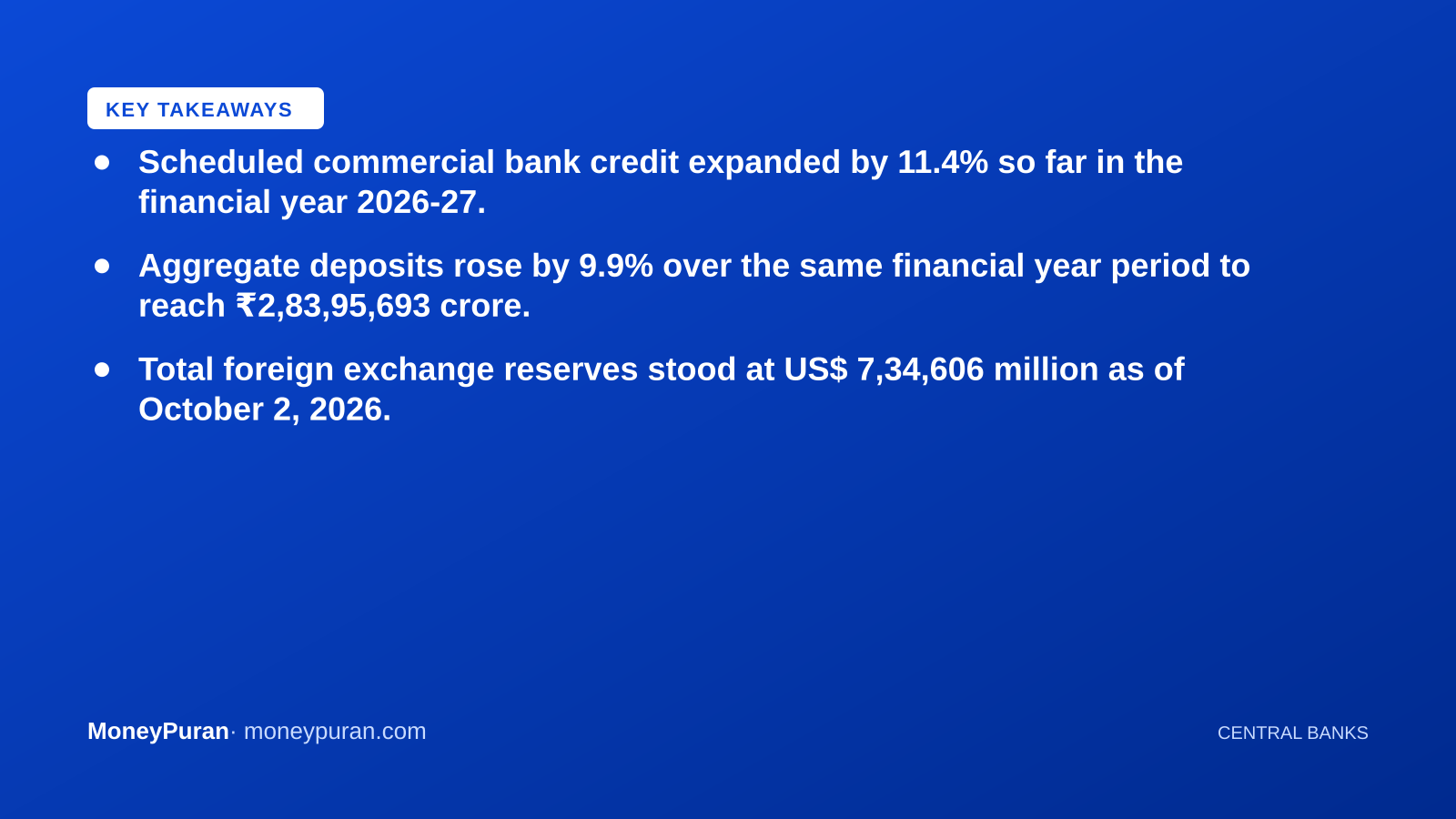
- Scheduled commercial bank credit expanded by 11.4% so far in the financial year 2026-27.
- Aggregate deposits rose by 9.9% over the same financial year period to reach ₹2,83,95,693 crore.
- Total foreign exchange reserves stood at US$ 7,34,606 million as of October 2, 2026.
Bank credit growth across scheduled commercial banks in India expanded by 11.4% during the current financial year, according to the latest weekly statistical supplement released by the Reserve Bank of India (RBI). The central bank figures highlight sustained lending momentum alongside steady gains in aggregate deposits across the domestic banking system.
Total bank credit to the commercial sector climbed to over ₹2.38 lakh crore, underpinned by strong non-food credit expansion. At the same time, aggregate deposits across scheduled commercial banks grew by 9.9% in the financial year so far, crossing ₹2.83 crore overall. Time deposits continued to capture the lion’s share of savers’ allocations compared to demand deposits, pointing to continued preference for term-deposit yields among retail and institutional depositors.
Foreign Reserves and Liquidity Overview
The RBI data also detailed India’s foreign exchange reserves, which registered at US$ 7,34,606 million (₹70,73,111 crore) as of October 2, 2026. Foreign currency assets formed the largest component of these reserves at US$ 604,747 million, while gold reserves stood at US$ 106,413 million.
On the liquidity front, operations managed through the Reserve Bank’s Liquidity Adjustment Facility reflected regular daily absorption via the Standing Deposit Facility and variable rate reverse repos, keeping systemic liquidity closely monitored during the reporting fortnight.
What this means for investors
For Indian investors, steady bank credit and deposit growth serve as key health indicators for the broader economy. Robust credit off-take generally signals healthy corporate capital expenditure, retail borrowing, and consumer demand, which directly supports earnings growth across cyclical and financial sectors listed on the NSE and BSE.
Conversely, strong competition for bank deposits can prompt lenders to maintain attractive interest rates on fixed deposits to fund credit expansion. Investors tracking banking stocks should monitor credit-deposit ratios and net interest margins to gauge how effectively individual lenders balance lending yields with funding costs.
Frequently asked questions
What does non-food credit growth signify? Non-food credit represents loans extended by banks to corporate entities, retail borrowers, and agriculture excluding food procurement advances, serving as a direct measure of economic activity.
How often does the RBI publish this data? The Reserve Bank of India publishes its weekly statistical supplement summarizing banking business, money stock, and foreign reserves on a regular weekly schedule.
This article is for information only and is not investment advice. Do your own research or consult a licensed adviser before investing.
Based on information published by Reserve Bank of India (RBI). Source: Reserve Bank of India (RBI). Spotted an error? corrections@moneypuran.com