 Money
Money
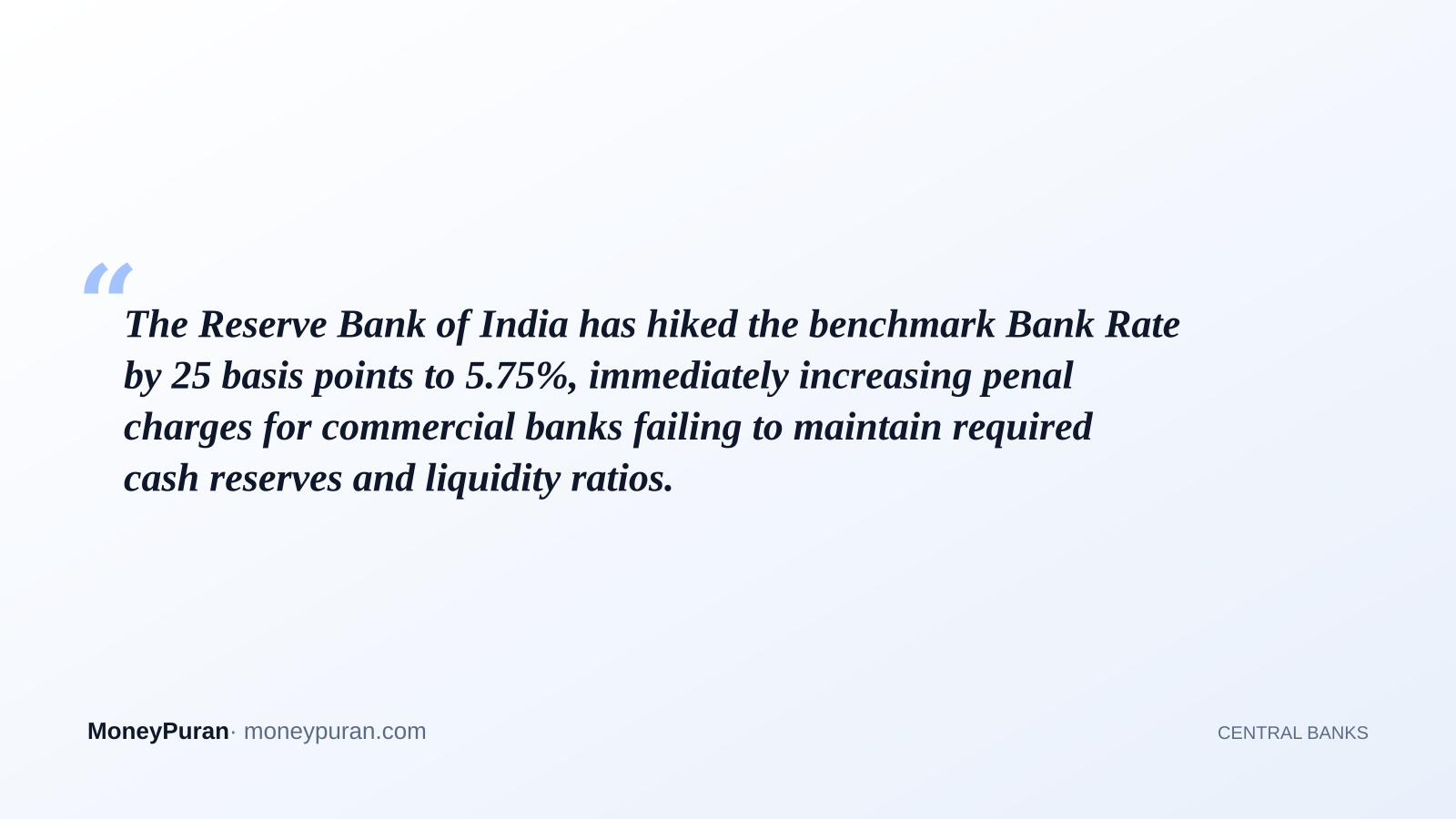
The Reserve Bank of India has hiked the benchmark Bank Rate by 25 basis points to 5.75%, immediately increasing penal charges for commercial banks failing to maintain required cash reserves and liquidity ratios.
Key points
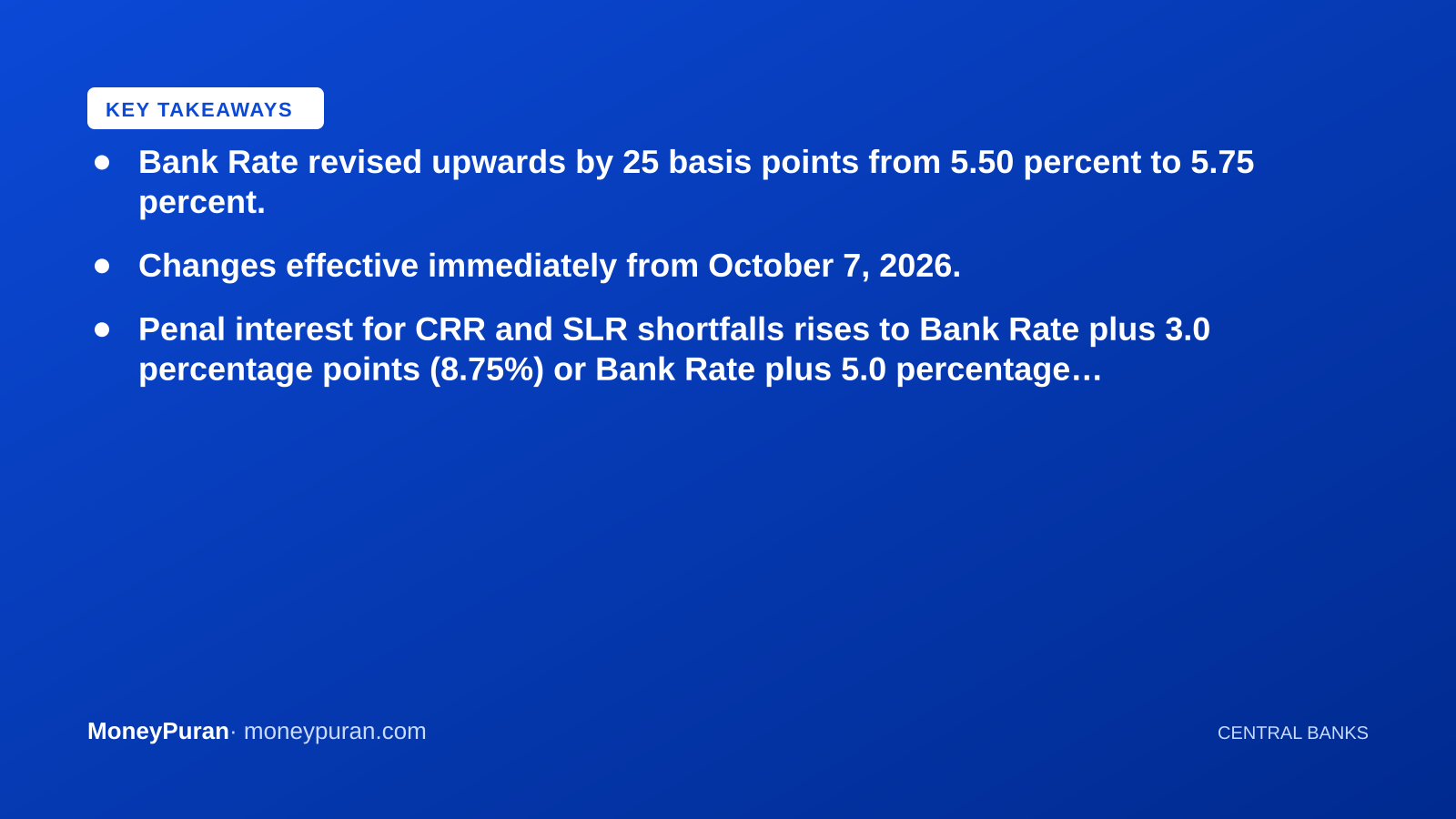
- Bank Rate revised upwards by 25 basis points from 5.50 percent to 5.75 percent.
- Changes effective immediately from October 7, 2026.
- Penal interest for CRR and SLR shortfalls rises to Bank Rate plus 3.0 percentage points (8.75%) or Bank Rate plus 5.0 percentage points (10.75%).
- Announced as part of the Monetary Policy Statement for 2026-27.
The Reserve Bank of India (RBI) announced an upward revision of the Bank Rate by 25 basis points, moving it from 5.50 percent to 5.75 percent with immediate effect. Issued via a notification signed by Chief General Manager Manoranjan Padhy, the directive follows the latest Monetary Policy Statement for 2026-27 released on October 7, 2026. Because commercial bank penalty charges for failing to maintain required reserve thresholds are directly pegged to the Bank Rate, the adjustment automatically drives up financial penalties for liquidity shortfalls across the Indian banking sector.
Impact on Reserve Shortfall Penalties
Under the revised framework, commercial lenders that experience shortfalls in maintaining their Cash Reserve Ratio (CRR) or Statutory Liquidity Ratio (SLR) will face steeper financial consequences. The revised structure lifts the penalty tiers across the board.
- Bank Rate plus 3.0 percentage points increased to 8.75 percent from the previous 8.50 percent.
- Bank Rate plus 5.0 percentage points increased to 10.75 percent from the previous 10.50 percent.
The exact tier of penal interest applied depends heavily on the duration of the shortfall experienced by any given institution.
What this means for investors
For investors tracking Indian banking stocks, an increase in the Bank Rate and its associated penalty structures signals a tightening of regulatory vigilance regarding liquidity management. Lenders are incentivized to manage their day-to-day treasury operations with extreme precision to avoid costly regulatory infractions. Persistent shortfalls can incrementally eat into net interest margins for poorly managed institutions.
On a broader level, adjustments to the Bank Rate serve as a key signaling mechanism for broader monetary policy tightening. While retail borrowers may not feel an immediate shift in home or auto loan rates solely from a Bank Rate tweak, the environment points toward higher cost of funds across the financial system. Investors should monitor how individual banks adjust their credit-deposit ratios and manage liquidity buffers in response to stricter central bank oversight.
Frequently asked questions
What is the Bank Rate? The Bank Rate is the standard rate at which the Reserve Bank of India is prepared to buy or rediscount bills of exchange or other commercial papers, serving as a primary benchmark for various regulatory penalties.
How does this affect retail loan borrowers? The immediate change applies specifically to penal interest rates for bank reserve shortfalls, rather than a direct mandatory hike in retail lending rates, though it reinforces a higher cost-of-capital environment.
This article is for information only and is not investment advice. Do your own research or consult a licensed adviser before investing.
Based on information published by Reserve Bank of India (RBI) — notifications. Source: Reserve Bank of India (RBI) — notifications. Spotted an error? corrections@moneypuran.com