 Money
Money
Understanding how central banks cool inflation without causing a recession, and what it means for your money.
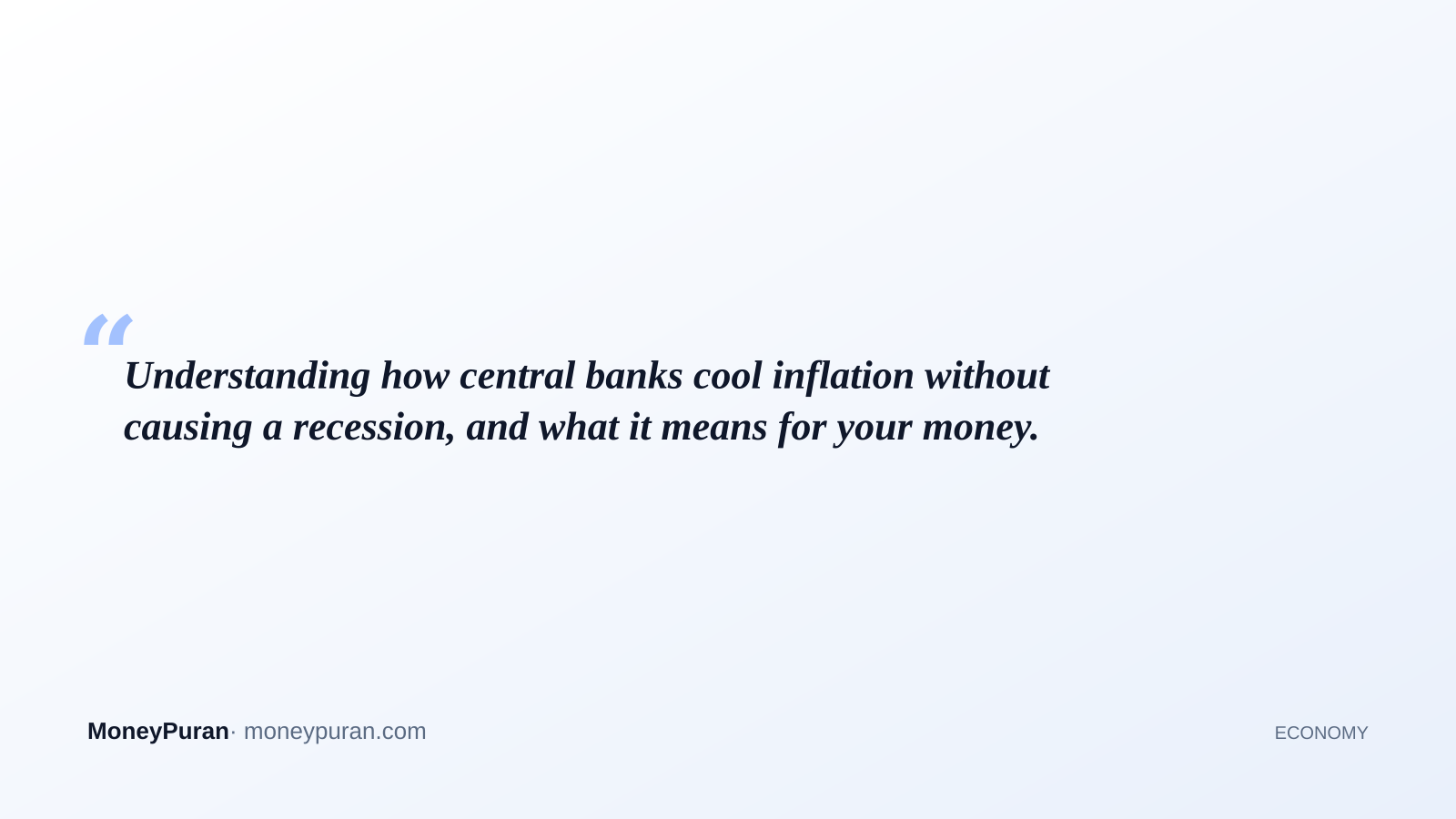
Key points
- A soft landing occurs when central bank rate hikes successfully bring inflation down to target without causing an economic recession.
- Achieving a soft landing is historically difficult due to the long and variable time lags associated with monetary policy decisions.
- Key data tracked by policymakers includes CPI inflation, job openings, GDP growth, wage trends, and consumer credit health.
- US and Indian central banks both seek soft landings, though India focuses more on supply-driven inflation and maintaining higher growth rates.
A soft landing economy refers to a scenario where a central bank successfully raises interest rates to cool down high inflation without causing a severe economic downturn or recession. The ultimate goal of this delicate monetary policy maneuver is to bring inflation back to its target rate while preserving steady economic growth, keeping unemployment low, and maintaining financial market stability. When achieved, the economy cools down gradually rather than crashing violently.
Understanding the Three Economic Landing Scenarios
To evaluate whether a central bank is succeeding, economists generally compare three potential outcomes during an inflation-fighting rate cycle: a soft landing, a hard landing, and a no landing scenario.
A soft landing happens when rising borrowing costs reduce consumer demand and business expansion just enough to stabilize prices. Growth slows below its long-term trend, but gross domestic product (GDP) remains positive or flat, and job losses remain low.
A hard landing occurs when central bank rate hikes overshoot the mark, severe monetary tightening chokes off borrowing, and the economy contracts sharply into a recession. In a hard landing, unemployment rises rapidly, consumer spending collapses, and corporate bankruptcies escalate.
A no landing scenario describes an economy where inflation stays stubbornly high despite elevated interest rates because consumer spending and hiring remain excessively strong. While this avoids an immediate recession, it forces the central bank to keep interest rates higher for longer, increasing the ultimate risk of a hard landing down the road.
Why Soft Landings Are Historically Difficult to Achieve
Central banks face an immense challenge when attempting to engineer a soft landing because monetary policy operates with what economists call long and variable lags. When a central bank increases interest rates, it can take anywhere from 12 to 24 months for those higher borrowing costs to fully filter through mortgage markets, corporate debt, consumer credit, and hiring decisions.
Because of these time delays, policymakers are essentially driving a vehicle by looking in the rearview mirror. If they raise rates until economic growth stops completely, they have already tightened too much and guaranteed a recession. Conversely, if they stop raising rates too early, inflation expectations can become anchored at high levels, eroding purchasing power across the nation.
Key Economic Indicators Policymakers and Investors Watch
Determining whether an economy is heading toward a soft landing requires monitoring a broad dashboard of financial and macroeconomic data. Central bankers analyze these key criteria to calibrate their interest rate decisions:
- Inflation metrics: Year-over-year trends in the Consumer Price Index (CPI) and core price measures show whether goods and services prices are slowing toward official target levels.
- Labor market tightness: Trackers such as the unemployment rate, job openings, monthly payroll growth, and wage growth help show whether hiring is cooling without widespread layoffs.
- Gross Domestic Product (GDP): Real GDP growth figures reveal whether overall economic activity is moderating gently or contracting into negative territory.
- Consumer spending and debt metrics: Credit card default rates, personal savings rates, and retail sales data indicate whether household finances remain resilient under high interest rates.
- Corporate health indices: Profit margins, debt refinancing costs, and purchasing managers’ indices (PMI) provide early signals of business slowdowns.
US vs. India: How Central Banks Manage Rate Cycles
While the mechanics of controlling inflation are universal, the monetary framework and economic realities differ significantly between developed and emerging economies like the United States and India.
In the United States, the Federal Reserve operates under a dual mandate: achieving maximum employment and price stability (targeting around 2% inflation). US rate hikes directly impact 30-year fixed mortgage rates, corporate bond yields, and global capital flows. A soft landing in the US keeps job growth moderate while lowering headline and core inflation.
In India, the Reserve Bank of India (RBI) operates under a flexible inflation-targeting framework, seeking to keep retail inflation at 4% with a tolerance band of +/- 2%. Unlike developed markets, India’s inflation is often heavily influenced by supply-side shocks such as volatile monsoon rains affecting food prices and global crude oil price swings. For the RBI, guiding a soft landing involves maintaining robust GDP growth—often targeted above 6%—while managing food and energy price pressures without stifling domestic investment and consumption.
How Individual Investors Should Position Their Finances
Attempting to time the stock market based on economic landing predictions is notoriously difficult, even for professional fund managers. Instead of placing speculative bets, individual investors can protect and grow their wealth through disciplined financial principles during uncertain monetary cycles:
- Maintain a broad asset allocation: Balance equities with fixed-income instruments like high-quality government bonds, treasury bills, or high-yield savings accounts that benefit from elevated interest rates.
- Focus on corporate balance sheets: Invest in companies with low debt burdens, stable cash flows, and strong pricing power that can withstand prolonged periods of higher borrowing costs.
- Strengthen personal cash reserves: Keep three to six months of living expenses in liquid, short-term accounts to cushion against potential localized job losses or economic disruptions.
- Avoid dramatic portfolio shifts: Stick to long-term financial plans rather than trying to buy or sell assets ahead of central bank interest rate announcements.
Frequently asked questions
Has a central bank ever successfully executed a soft landing? Yes, though rare, successful soft landings have occurred. A classic example in the US took place between 1994 and 1995, when the Federal Reserve under Alan Greenspan doubled interest rates to preempt inflation without causing a recession.
How long does it take to confirm a soft landing? It usually takes several quarters or even years after a central bank stops raising interest rates to confirm a soft landing. Policymakers must verify that inflation remains low while economic output and hiring return to stable growth.
Does a soft landing mean interest rates will drop quickly? Not necessarily. In a soft landing, central banks may keep interest rates elevated for an extended period to ensure inflation does not rebound, bringing rates down only slowly to neutral levels.
How does a soft landing impact household borrowing costs? During a soft landing phase, mortgage rates, auto loans, and personal credit rates tend to stabilize and eventually decline gradually as central banks begin easing policy.
This article is for general education and is not investment, tax or financial advice. Rules and figures change — check the official source or a licensed adviser before acting.
Official information: https://www.federalreserve.gov
This explainer is published by the MoneyPuran desk for general awareness. Rules, limits and rates change over time — please confirm with the official source. Corrections: corrections@moneypuran.com