 Money

The Reserve Bank of India has directed all commercial banks, NBFCs, and financial institutions to update their customer databases following five amendments to the UN Security Council’s Taliban Sanctions List.
Key points
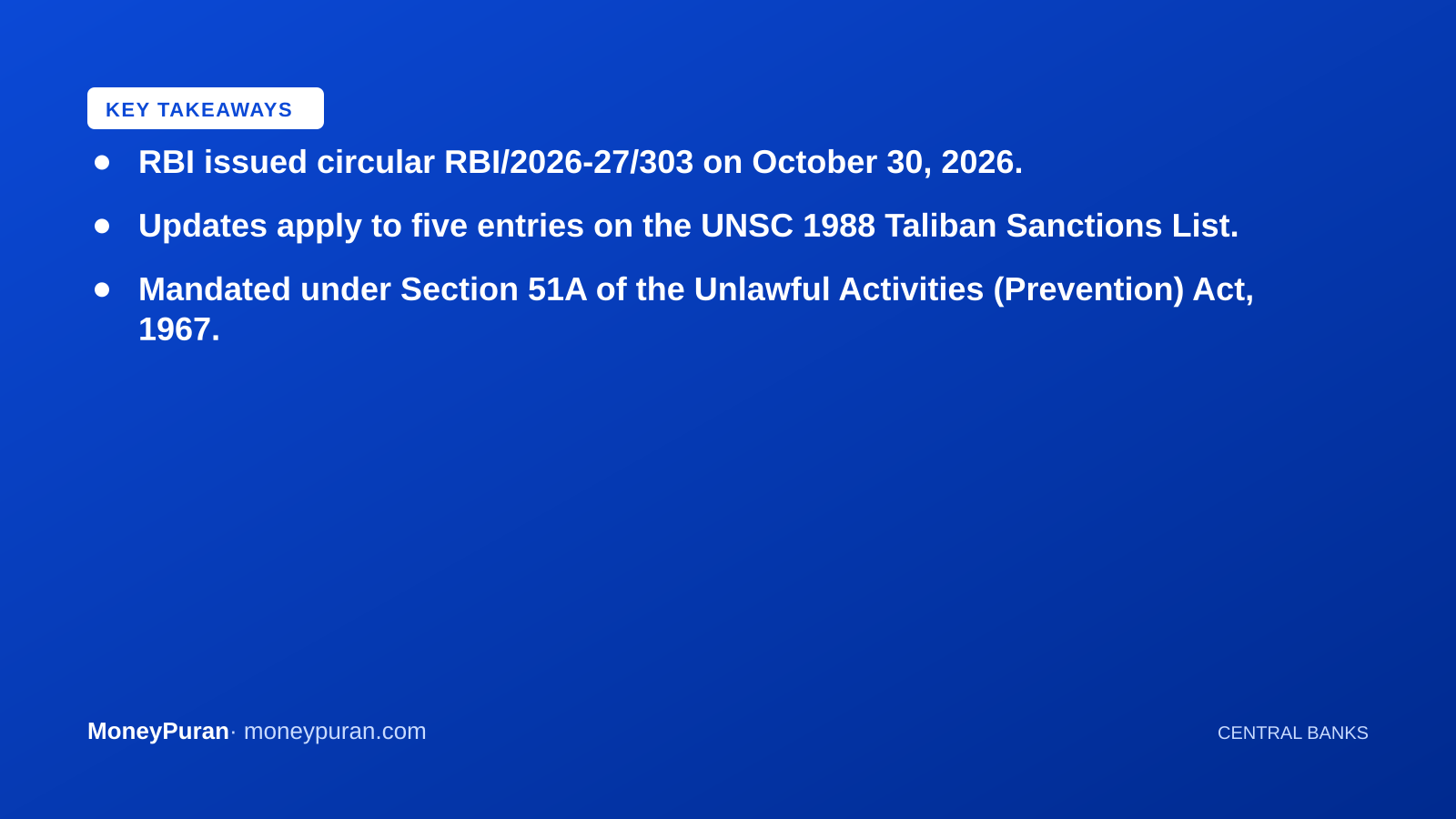
- RBI issued circular RBI/2026-27/303 on October 30, 2026.
- Updates apply to five entries on the UNSC 1988 Taliban Sanctions List.
- Mandated under Section 51A of the Unlawful Activities (Prevention) Act, 1967.
- Affects all commercial banks, small finance banks, NBFCs, and co-operative banks in India.
The Reserve Bank of India (RBI) has issued a directive instructing all commercial banks, non-banking financial companies (NBFCs), and other regulated financial institutions to immediately update their screening systems following recent amendments to the United Nations Security Council’s Taliban Sanctions List. In a circular dated October 30, 2026, the central bank mandated strict adherence to compliance protocols under Section 51A of the Unlawful Activities (Prevention) Act (UAPA), 1967.
According to the notification, the Ministry of External Affairs (MEA) informed the regulator about UNSC press release SC/16494, which enacts modifications to five entries on the 1988 Taliban Sanctions List. These entries involve individuals subject to international asset freezes, travel bans, and arms embargoes. The affected entries include prominent figures linked to the former Taliban regime such as Abdul Latif Mansur, Abdul Ghani Baradar, Amir Khan Muttaqi, Abdul-Haq Wasiq, and Khairullah Khairkhwah.
Compliance Obligations for Indian Financial Institutions
Under Chapter IX of the Reserve Bank of India – Know Your Customer (KYC) Directions, 2025, regulated entities are legally bound to ensure that no accounts are maintained for individuals or entities flagged by UN sanctions committees. The central bank’s latest communication reminds institutions to cross-reference their customer databases against the updated designations without delay.
The regulatory framework requires financial intermediaries to freeze any identified assets instantly, block transactions, and report potential matches to relevant authorities. Institutions must follow the standard operating procedures outlined in the UAPA order annexures, ensuring that compliance teams continuously monitor ongoing updates provided through official UN channels and the Ministry of Home Affairs.
- Circular Reference: RBI/2026-27/303 DoR.AML.REC.255/14.06.001/2026-27
- Date of Notification: October 30, 2026
- UNSC Source: Press Release SC/16494 dated October 29, 2026
- Governing Statute: Section 51A of the UAPA Act, 1967
What this means for investors
For institutional investors and market participants, this directive underscores the rigorous and continuous compliance burdens placed on the Indian financial sector. While routine updates to global sanction lists do not directly impact the operational earnings or share prices of major commercial banks and NBFCs, maintaining robust anti-money laundering (AML) and countering financing of terrorism (CFT) infrastructure is critical to avoiding heavy regulatory penalties.
Compliance failures regarding international sanctions can lead to severe supervisory scrutiny and financial penalties from both domestic regulators like the RBI and international bodies. Consequently, banks continuously allocate resources toward advanced automated transaction monitoring and customer screening software to ensure seamless adherence to evolving global security mandates.
Frequently asked questions
What is the purpose of the RBI circular? The circular instructs Indian financial institutions to update their screening databases to reflect recent amendments made by the UN Security Council to its Taliban Sanctions List.
Which institutions must comply with these directions? All commercial banks, small finance banks, payment banks, urban and rural co-operative banks, NBFCs, asset reconstruction companies, and financial institutions regulated by the RBI must comply.
How are de-listing requests handled? Any requests for removal from the sanctions list received by Indian banks must be forwarded electronically to the Joint Secretary (CTCR) of the Ministry of Home Affairs for review.
This article is for information only and is not investment advice. Do your own research or consult a licensed adviser before investing.
Based on information published by Reserve Bank of India (RBI) — notifications. Source: Reserve Bank of India (RBI) — notifications. Spotted an error? corrections@moneypuran.com