 Money

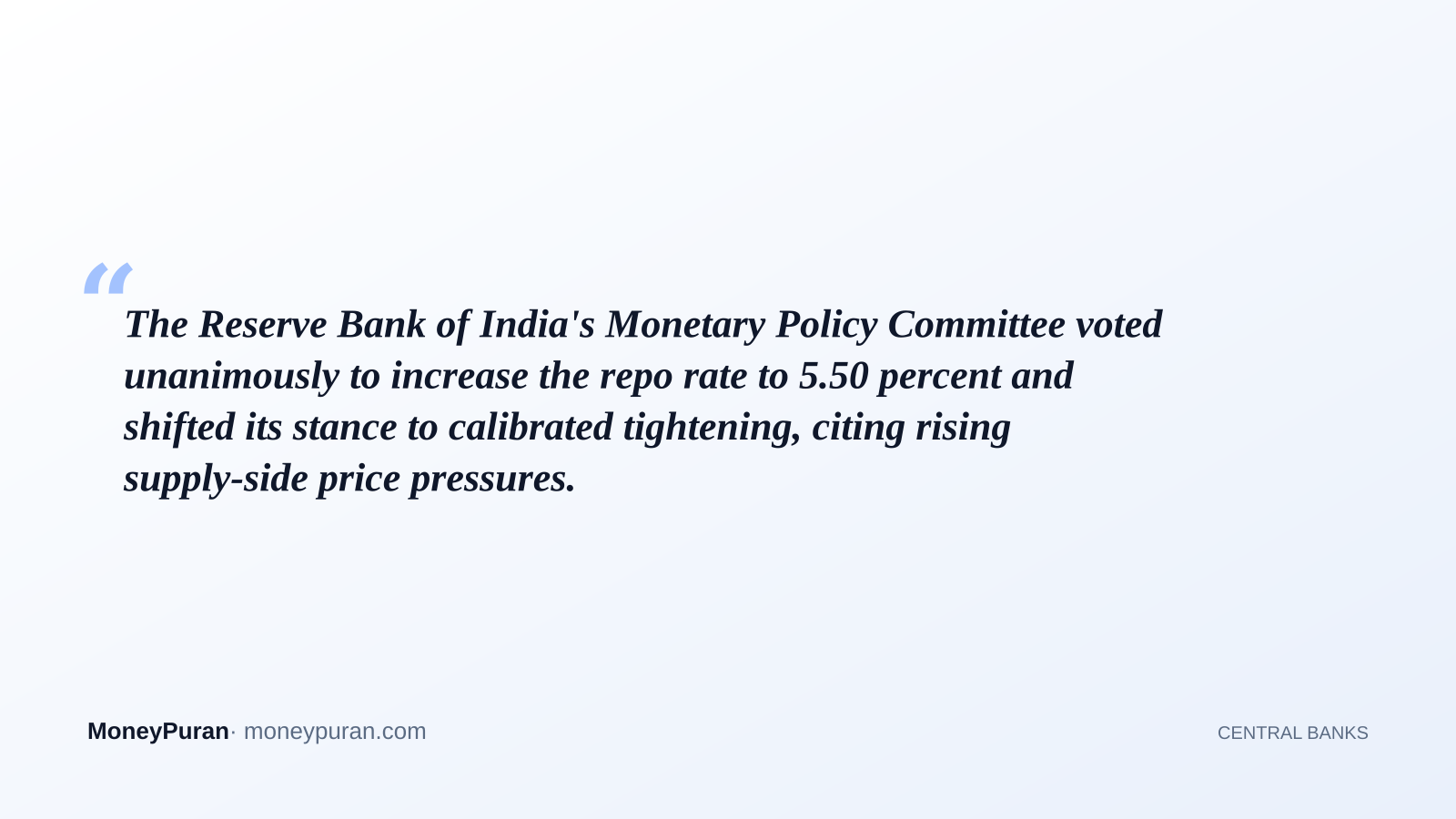
The Reserve Bank of India’s Monetary Policy Committee voted unanimously to increase the repo rate to 5.50 percent and shifted its stance to calibrated tightening, citing rising supply-side price pressures.
Key points
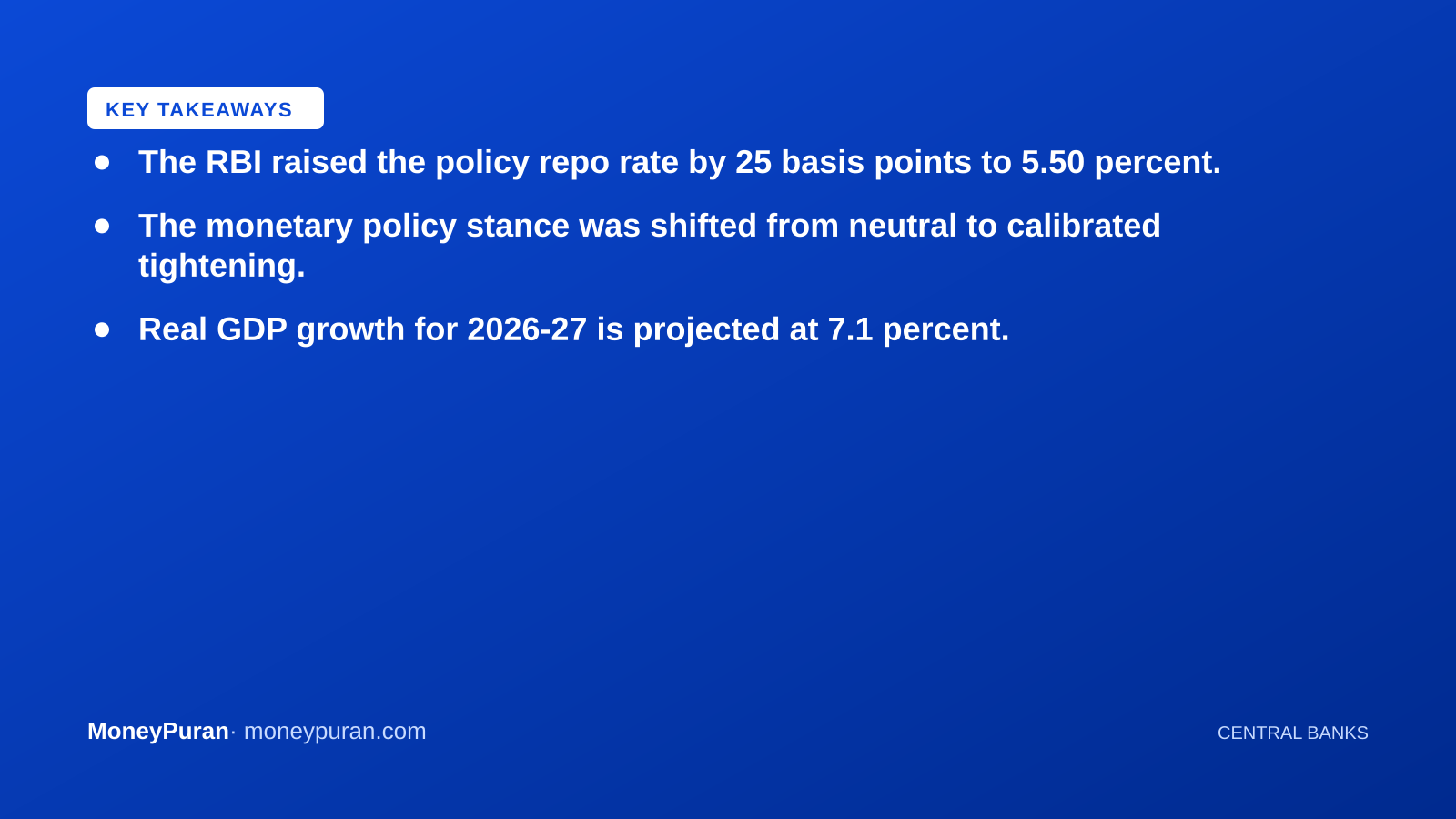
- The RBI raised the policy repo rate by 25 basis points to 5.50 percent.
- The monetary policy stance was shifted from neutral to calibrated tightening.
- Real GDP growth for 2026-27 is projected at 7.1 percent.
- Headline CPI inflation for 2026-27 is projected at 5.2 percent.
The Reserve Bank of India (RBI) Monetary Policy Committee (MPC) has voted unanimously to raise the policy repo rate by 25 basis points to 5.50 percent, marking a decisive shift toward a stance of calibrated tightening. Announced in the minutes of the October 2026 MPC meeting chaired by Governor Sanjay Malhotra, the central bank acted to contain creeping inflationary pressures stemming from supply-side disruptions, elevated crude oil prices, and a deficient southwest monsoon.
Alongside the rate hike, the standing deposit facility (SDF) rate was adjusted to 5.25 percent, while the marginal standing facility (MSF) rate and the Bank Rate moved up to 5.75 percent. The shift to calibrated tightening signals that near-term interest rate cuts are officially off the table for Indian borrowers and investors, with future actions hinging strictly on incoming growth and inflation trajectories.
Resilient Economic Growth Meets Stubborn Inflation
Despite persistent global headwinds, including renewed conflict in West Asia and tighter global financial conditions, the Indian domestic economy has sustained robust momentum. National Statistics Office (NSO) figures pegged real GDP growth for the first quarter of 2026-27 at an impressive 7.8 percent, underpinned by strong manufacturing activity and steady urban and rural demand. Gross fixed capital formation also registered a notable jump, pointing toward a budding private investment cycle.
However, consumer price index (CPI) inflation ticked upward to 4.8 percent in August, driven largely by volatile food items such as sugar and onions, alongside higher fuel costs. The RBI projected headline inflation to average 5.2 percent for the full financial year 2026-27, with Q3 expected to peak at 6.0 percent. The central bank emphasized that while demand-side overheating is absent, managing second-round effects from supply-side shocks remains imperative to anchor medium-term price stability.
What this means for investors
For Indian investors, the RBI’s shift to calibrated tightening carries clear implications across asset classes. Fixed-income investors can anticipate continued attractive yields on bank fixed deposits and short-term debt instruments as lenders pass on the cumulative repo rate hikes. However, existing bondholders may face near-term mark-to-market pressures as yields adjust upward in response to a tighter monetary environment.
Equity markets, particularly rate-sensitive sectors like real estate, auto, and banking, may experience cautious near-term consolidation as higher borrowing costs filter through the financial system. On the other hand, robust corporate balance sheets, strong credit growth, and continuing infrastructure outlays provide structural support for the broader market. Investors should monitor corporate margin trends closely to assess how effectively firms absorb higher input costs.
Frequently asked questions
What is the current repo rate set by the RBI? Following the October 2026 MPC meeting, the policy repo rate stands at 5.50 percent.
Why did the central bank change its policy stance? The MPC shifted its stance to calibrated tightening to signal that rate cuts are off the table and future adjustments will focus entirely on subduing persistent inflation risks.
How does this affect retail loan borrowers? Borrowers with floating-rate retail loans, such as home and car loans linked to external benchmarks, can expect their equated monthly installments (EMIs) or loan tenures to increase accordingly.
This article is for information only and is not investment advice. Do your own research or consult a licensed adviser before investing.
Based on information published by Reserve Bank of India (RBI). Source: Reserve Bank of India (RBI). Spotted an error? corrections@moneypuran.com