 Money


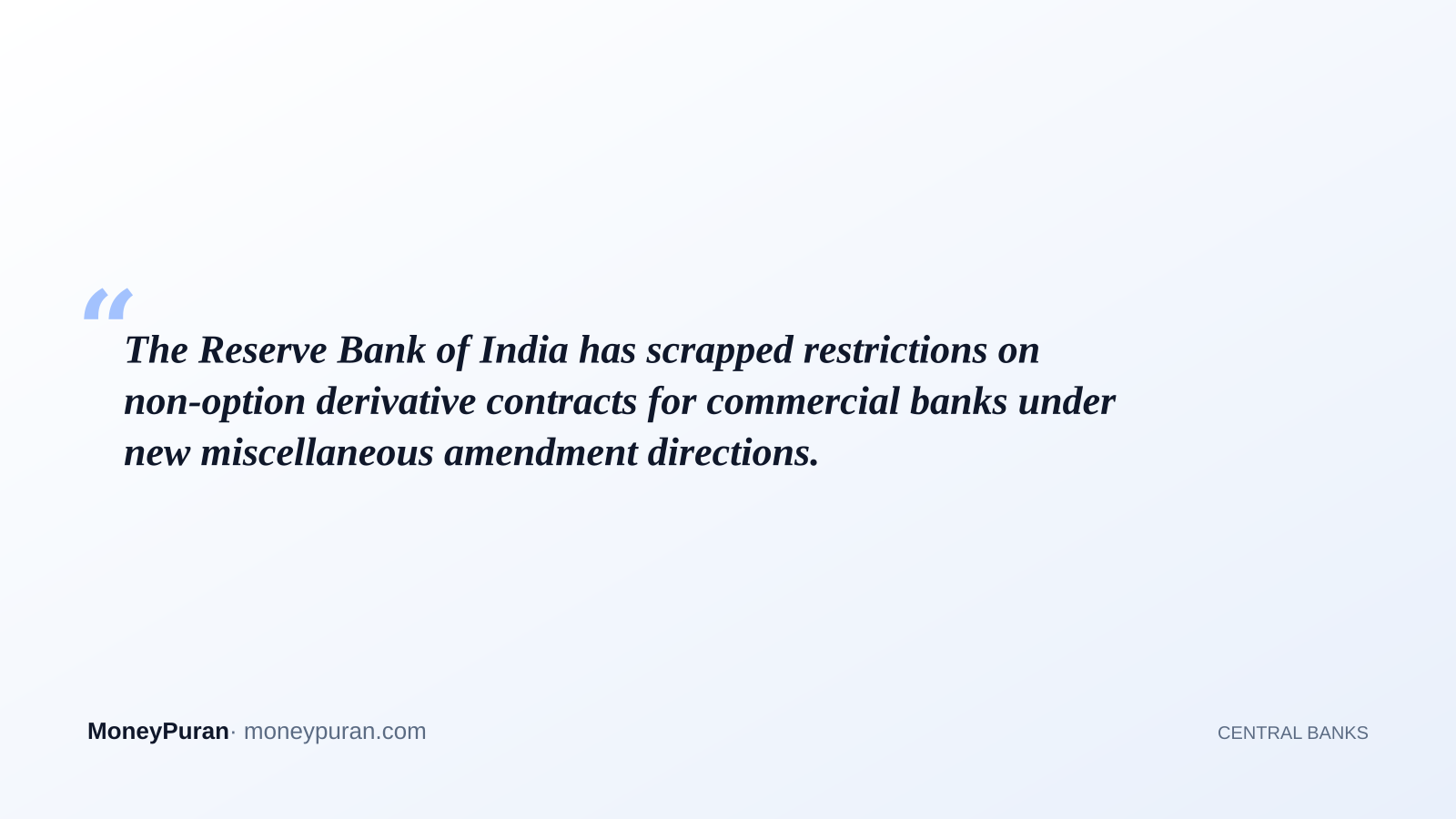
The Reserve Bank of India has scrapped restrictions on non-option derivative contracts for commercial banks under new miscellaneous amendment directions.
Key points
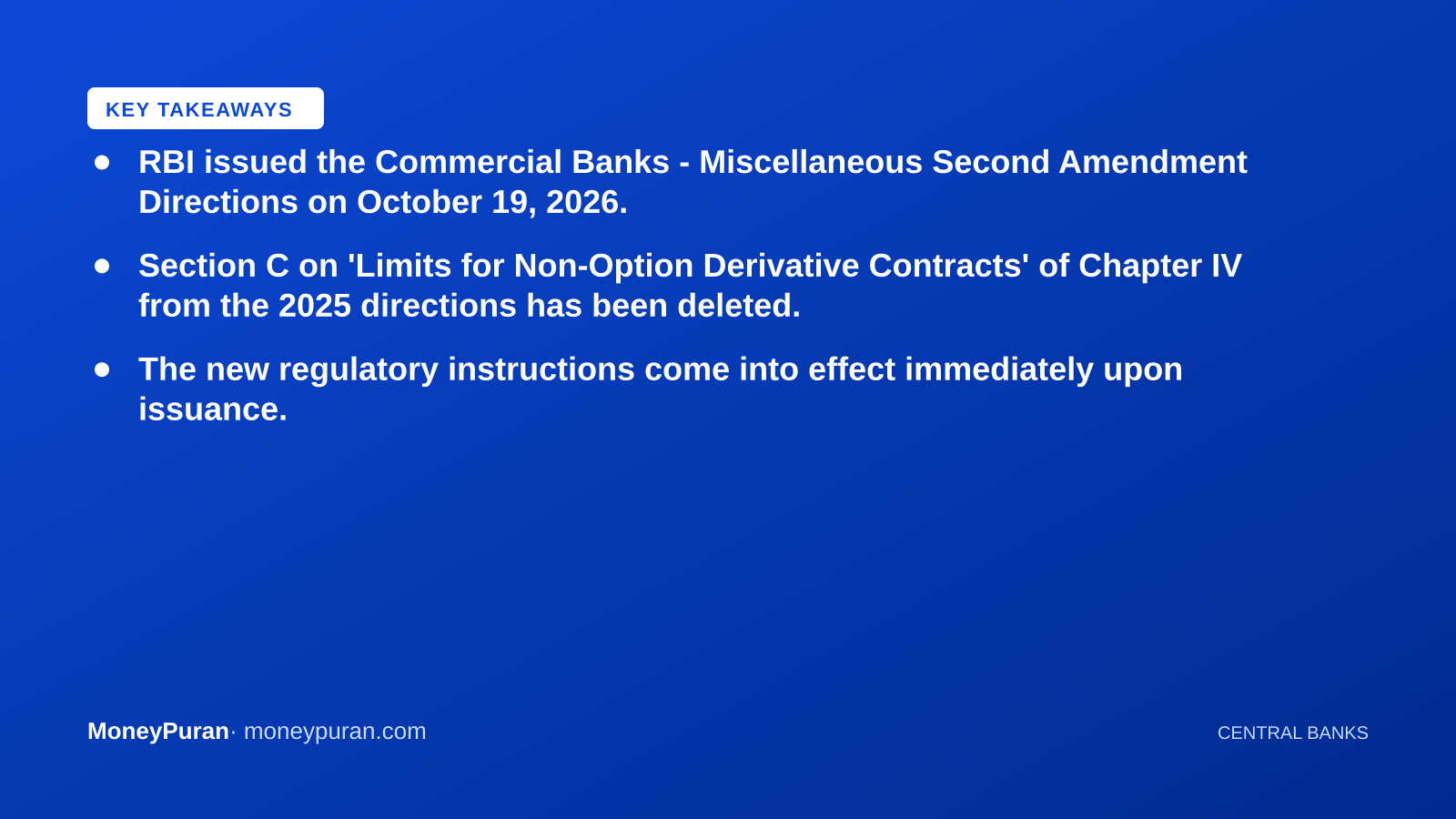
- RBI issued the Commercial Banks – Miscellaneous Second Amendment Directions on October 19, 2026.
- Section C on ‘Limits for Non-Option Derivative Contracts’ of Chapter IV from the 2025 directions has been deleted.
- The new regulatory instructions come into effect immediately upon issuance.
- The directive was issued under Section 35A of the Banking Regulation Act, 1949.
The Reserve Bank of India (RBI) has officially rescinded specific regulatory caps governing non-option derivative contracts handled by commercial banks. According to a notification issued by Chief General Manager Sunil T S Nair, the central bank has deleted Section C on ‘Limits for Non-Option Derivative Contracts’ from Chapter IV of the existing 2025 master framework. The newly minted Reserve Bank of India (Commercial Banks – Miscellaneous) Second Amendment Directions, 2026, took effect immediately upon publication.
This regulatory adjustment alters the compliance framework within which commercial banks structure and manage certain financial derivative products. By removing these specific boundaries, the central bank shifts the supervisory approach for non-option contracts, which typically include forwards, swaps, and futures used by institutions and their corporate clients for hedging or risk management purposes.
Understanding the Regulatory Shift
The updated guidelines stem from a formal review conducted by the central bank under powers conferred by Section 35A of the Banking Regulation Act, 1949. The RBI stated that it was satisfied that issuing the amendment directions was necessary and expedient in the public interest. While the previous 2025 framework imposed specific quantitative ceilings or structural limitations on these instruments under paragraph 37 of the directions, the 2026 update strips those specific boundaries away.
Commercial banks operating in India must now reassess their internal risk management models and compliance policies to align with the removal of these statutory limits. Financial institutions utilize various derivative instruments to manage interest rate risks, foreign exchange exposures, and other balance sheet variables. The deletion of these provisions means banks will rely more heavily on their own internal risk controls and overarching prudential norms set by the central bank.
- Notification reference: RBI/2026-27/294 DOR.MRG.REC.No.248/00-00-020/2026-27
- Date of issuance: October 19, 2026
- Statutory power: Section 35A of the Banking Regulation Act, 1949
- Impact: Immediate deletion of paragraph 37 from Chapter IV of the 2025 directions
What this means for investors
For Indian market participants and investors watching the banking sector, regulatory updates regarding derivatives signal shifting dynamics in risk management and treasury operations for major lenders. When the central bank amends rules governing financial instruments, commercial banks often experience changes in how they execute corporate treasury transactions and manage their own market exposure.
Investors should monitor how individual banks adjust their internal risk parameters following the removal of these formal central bank limits. While derivative products help corporations hedge against currency and interest rate fluctuations, they also introduce complexity into bank balance sheets. Observing subsequent commentary from major Indian lenders will provide clearer insight into how these regulatory changes translate into daily treasury operations and institutional risk appetites.
Frequently asked questions
Question? What specific part of the earlier guidelines was removed by the RBI? Answer. The central bank deleted Section C covering ‘Limits for Non-Option Derivative Contracts’ from Chapter IV, which corresponds to paragraph 37 of the 2025 framework.
Question? When did these regulatory changes become effective? Answer. The Second Amendment Directions, 2026, came into effect immediately upon their issuance on October 19, 2026.
This article is for information only and is not investment advice. Do your own research or consult a licensed adviser before investing.
Based on information published by Reserve Bank of India (RBI) — notifications. Source: Reserve Bank of India (RBI) — notifications. Spotted an error? corrections@moneypuran.com