 Money

The Reserve Bank of India has issued revised prudential directions updating the leverage ratio framework for commercial banks, matching international Basel Committee standards.

Key points
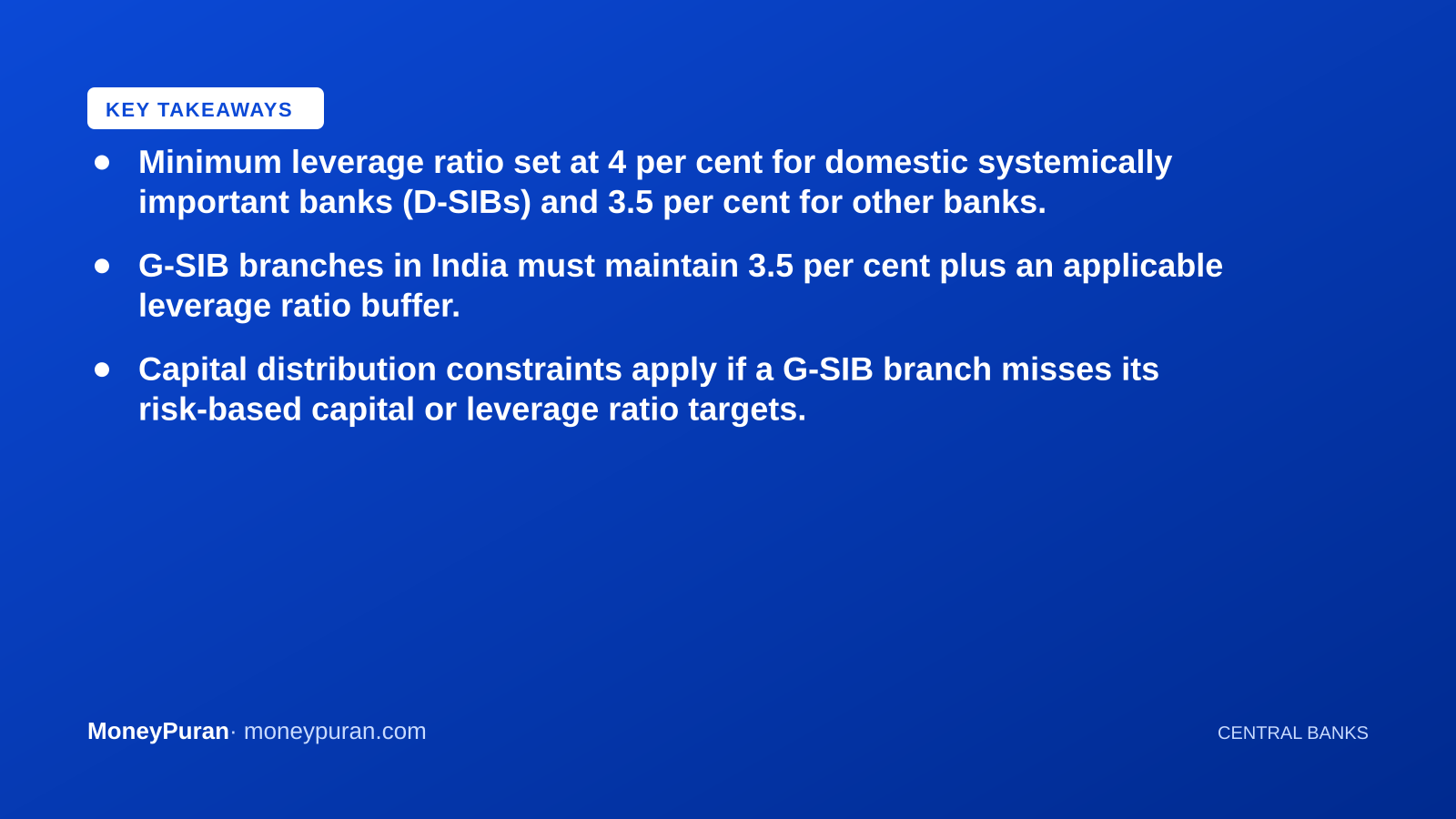
- Minimum leverage ratio set at 4 per cent for domestic systemically important banks (D-SIBs) and 3.5 per cent for other banks.
- G-SIB branches in India must maintain 3.5 per cent plus an applicable leverage ratio buffer.
- Capital distribution constraints apply if a G-SIB branch misses its risk-based capital or leverage ratio targets.
- The rules detail gross accounting values, derivative exposures, and unsettled trade treatments.
The Reserve Bank of India (RBI) has released the Eleventh Amendment Directions, 2026, overhauling the leverage ratio framework for commercial banks operating in the country. Announced on October 23, 2026, the updated regulations align Indian banking norms with the latest leverage ratio standards issued by the Basel Committee on Banking Supervision. The changes introduce precise definitions for capital and exposure measures, alongside explicit supervisory mechanisms for domestic and foreign systemically important institutions.
New Leverage Thresholds for Domestic and Global Banks
Under the revised directions, the minimum leverage ratio is established at 4 per cent for domestic systemically important banks (D-SIBs) and 3.5 per cent for all other commercial banks. Meanwhile, branches of global systemically important banks (G-SIBs) operating in India are required to maintain a baseline leverage ratio of 3.5 per cent, augmented by any specific leverage ratio buffer prescribed by their home regulator or the RBI.
The regulatory framework also institutes strict capital distribution constraints for G-SIB branches that fail to meet their combined risk-based capital and leverage ratio targets. Depending on the extent of the shortfall, these branches face escalating restrictions on earnings distributions, scaling from a 40 percent to a 100 percent conservation ratio constraint if they drop below requisite thresholds.
Exposure Measurement and Accounting Standards
The central bank’s directions outline comprehensive methodologies for calculating the leverage ratio exposure measure, which fundamentally relies on gross accounting values. Banks are generally restricted from taking credit risk mitigants, collateral, or netting arrangements into account when computing the denominator, with specific adjustments mandated for Tier 1 capital deductions and prudent valuation adjustments.
- On-balance sheet non-derivative assets must be included at accounting values minus specific provisions.
- Securitised exposures may be excluded by originators only if the transactions meet strict risk-transference operational criteria.
- The RBI retains supervisory authority to intervene in structural transactions designed to minimize exposure measures, such as specific securities financing transactions (SFTs) or collateral swaps.
- The central bank may temporarily exempt central bank reserves from the exposure measure during exceptional macroeconomic conditions, accompanied by a commensurate calibration of minimum requirements.
What this means for investors
For investors tracking Indian banking stocks, these updated guidelines reinforce the capital strength and transparency of the financial sector by adhering to stringent global risk standards. Higher leverage ratio floors mean banks must maintain robust capital cushions relative to their total exposure, limiting excessive balance-sheet expansion funded by leverage.
While well-capitalized domestic systemically important banks and major lenders already operate comfortably above these minimum thresholds, compliance requires ongoing monitoring of derivative exposures and securities financing transactions. Investors should watch how institutions manage their asset growth and capital planning to ensure uninterrupted earnings distributions and compliance with the RBI’s tightened supervisory oversight.
Frequently asked questions
What is the Basel III leverage ratio? It is defined as a bank’s capital measure (the numerator) divided by its total exposure measure (the denominator), expressed as a percentage, acting as a backstop to risk-based capital requirements.
Who is affected by the 4 per cent minimum leverage ratio? Domestic systemically important banks (D-SIBs) in India must maintain the 4 per cent minimum, whereas other commercial banks are held to a 3.5 per cent minimum requirement.
This article is for information only and is not investment advice. Do your own research or consult a licensed adviser before investing.
Based on information published by Reserve Bank of India (RBI) — notifications. Source: Reserve Bank of India (RBI) — notifications. Spotted an error? corrections@moneypuran.com