 Money


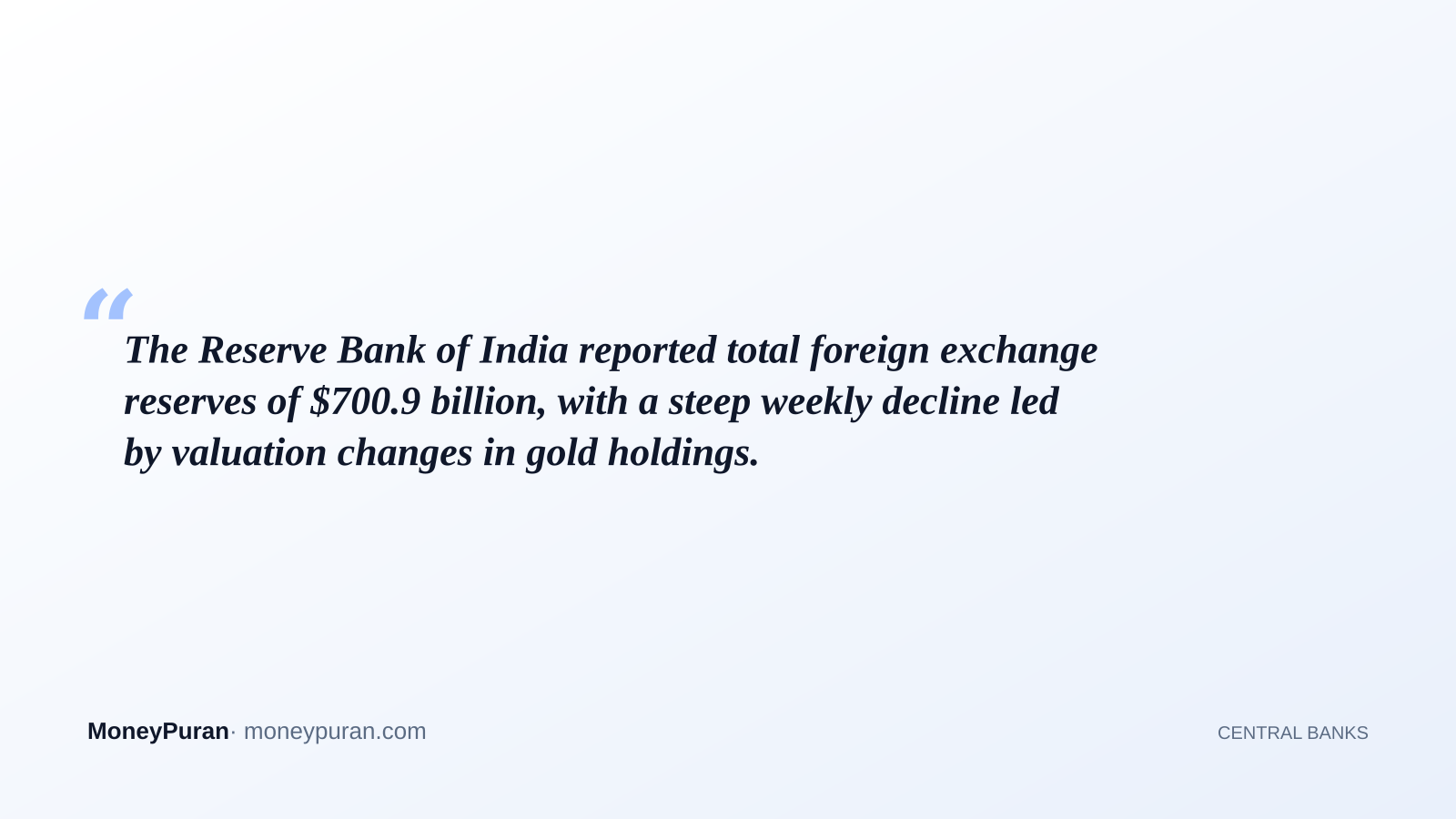
The Reserve Bank of India reported total foreign exchange reserves of $700.9 billion, with a steep weekly decline led by valuation changes in gold holdings.
Key points
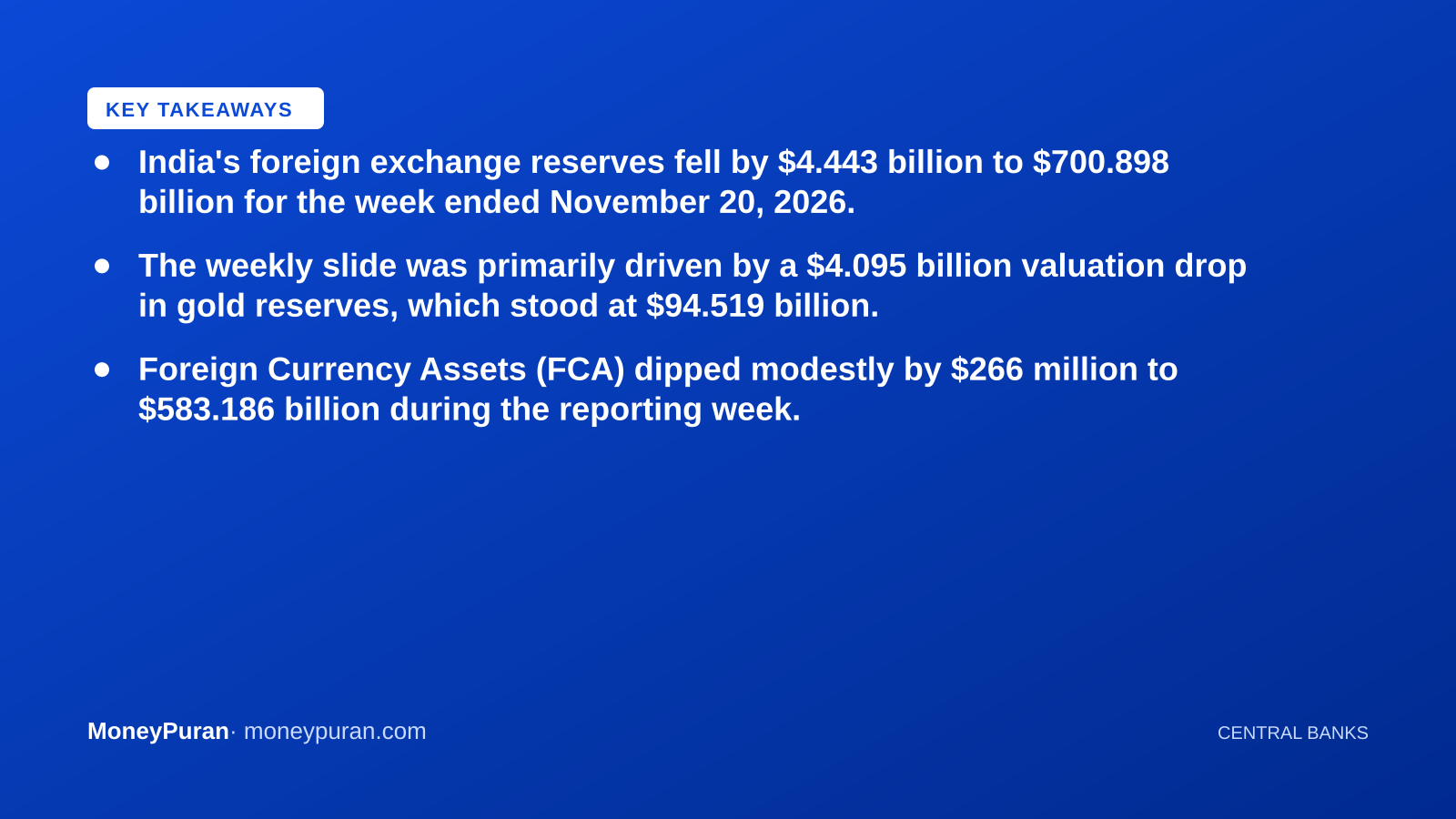
- India’s foreign exchange reserves fell by $4.443 billion to $700.898 billion for the week ended November 20, 2026.
- The weekly slide was primarily driven by a $4.095 billion valuation drop in gold reserves, which stood at $94.519 billion.
- Foreign Currency Assets (FCA) dipped modestly by $266 million to $583.186 billion during the reporting week.
- Bank credit expanded 19.3% year-on-year to ₹231.11 lakh crore as of November 15, outstripping aggregate deposit growth of 16.4%.
India’s foreign exchange reserves contracted by $4.443 billion to stand at $700.898 billion for the week ended November 20, 2026, according to the latest Weekly Statistical Supplement released by the Reserve Bank of India (RBI). The sharp decline in total reserves was largely driven by a reduction in the valuation of gold holdings, even as Foreign Currency Assets recorded a modest dip. Despite the weekly contraction, India’s foreign exchange chest remains substantially higher compared to the end of March 2026 and year-ago levels, providing a strong cushion against international currency market volatility.
Gold valuation drives weekly slide in total reserves
Data published by the central bank showed that the value of gold reserves fell by $4.095 billion during the week to $94.519 billion. Gold holdings expressed in rupee terms dropped by ₹53,174 crore to ₹8,76,256 crore. Foreign Currency Assets (FCA), which form the largest component of total reserves, slipped by $266 million during the week to $583.186 billion (₹54,06,553 crore). Special Drawing Rights (SDRs) with the International Monetary Fund decreased by $67 million to $18.451 billion, while India’s reserve position with the IMF edged down by $15 million to $4.743 billion. On a year-on-year basis, overall foreign exchange reserves have expanded by $12.794 billion, supported by a $22.586 billion increase in Foreign Currency Assets over the past 12 months.
Bank credit grows 19.3% as deposit growth lags behind
The RBI report also provided updated metrics for scheduled commercial banks as of November 15, 2026. Bank credit growth continued to show robust momentum, rising 19.3% year-on-year to reach ₹2,31,11,541 crore. Non-food credit dominated the expansion, standing at ₹2,29,74,751 crore, up 19.3% compared to the same period last year. On a fortnightly basis, aggregate bank credit contracted by ₹71,139 crore or 0.3%. Meanwhile, aggregate deposits with commercial banks grew 16.4% year-on-year to ₹2,80,46,926 crore, though deposits declined by ₹2,04,150 crore (-0.7%) over the fortnight. Time deposits saw a strong annual growth rate of 16.9%, totaling ₹2,46,93,597 crore, whereas demand deposits grew 11.9% annually to ₹33,53,329 crore. The persistent gap between credit growth and deposit growth highlights ongoing funding demands across commercial sectors.
RBI maintains net absorption in banking system liquidity
Broad money supply (M3) stood at ₹3,36,44,451 crore as of November 15, 2026, registering a year-on-year growth rate of 16.2%. Currency with the public expanded by 15.9% year-on-year to ₹43,46,732 crore, reflecting steady cash demand in the economy. Net bank credit to the government grew 9.7% year-on-year to ₹96,42,492 crore, with RBI credit to the government standing at ₹17,02,632 crore. In money market management, the central bank maintained a net liquidity absorption stance through its Liquidity Adjustment Facility (LAF). Net absorption stood at ₹65,248 crore on November 20, 2026, supported by Standing Deposit Facility (SDF) balances of ₹1,47,573 crore and Marginal Standing Facility (MSF) deployments of ₹7,315 crore. Net liquidity absorption peaked at ₹1,44,401 crore on November 16, demonstrating active cash management by the central bank.
- Total Foreign Exchange Reserves: $700.898 billion (-$4.443 billion over the week ended Nov 20, 2026).
- Gold Holdings: $94.519 billion (-$4.095 billion weekly variation).
- Foreign Currency Assets: $583.186 billion (-$266 million weekly variation).
- Bank Credit Growth: 19.3% year-on-year to ₹2,31,11,541 crore (as of Nov 15, 2026).
- Bank Deposit Growth: 16.4% year-on-year to ₹2,80,46,926 crore.
- M3 Money Supply Growth: 16.2% year-on-year to ₹3,36,44,451 crore.
What this means for investors
For domestic equity investors and Indian market watchers, a foreign reserve cushion above $700 billion provides significant structural defense for the Indian Rupee against global macro shifts and sudden capital outflows. Although global commodity fluctuations directly impact weekly reserve figures via gold valuation adjustments, the core Foreign Currency Assets remain resilient, reassuring foreign institutional investors (FIIs) regarding macroeconomic stability.
The sustained momentum in bank credit expansion, coupled with credit growth (19.3%) continuing to pace ahead of deposit accumulation (16.4%), points to strong underlying economic demand. However, this divergence implies that commercial banks may face elevated funding costs or need to maintain competitive deposit interest rates to support loan books. Investors tracking Nifty Bank and financial sector stocks should monitor net interest margins (NIMs) and bank liquidity coverage ratios in the coming quarters.
From a fixed-income standpoint, the RBI’s consistent net absorption stance in daily liquidity operations indicates comfortable liquidity in the banking system without generating inflationary money market overhangs. Bond yields are likely to remain anchored to macroeconomic inflation trajectories and upcoming central bank monetary policy signals.
Frequently asked questions
Why did India forex reserves decrease despite strong foreign currency assets? The decline of $4.44 billion was predominantly caused by a $4.095 billion valuation drop in gold reserves due to global price shifts, while foreign currency assets recorded a smaller decrease of $266 million.
What is the current gap between credit growth and deposit growth in India? As of November 15, 2026, bank credit grew at 19.3% year-on-year, whereas aggregate bank deposit growth trailed at 16.4% year-on-year according to RBI statistical data.
What does net liquidity absorption by the RBI indicate? Net liquidity absorption indicates that commercial banks have excess funds deposited back with the central bank via facilities like the Standing Deposit Facility (SDF), reflecting comfortable system liquidity.
This article is for information only and is not investment advice. Do your own research or consult a licensed adviser before investing.
Based on information published by Reserve Bank of India (RBI). Source: Reserve Bank of India (RBI). Spotted an error? corrections@moneypuran.com