 Money

Fresh RBI statistical data shows a sharp drop in foreign currency assets and gold reserves, while domestic credit growth maintains robust double-digit momentum.
Key points
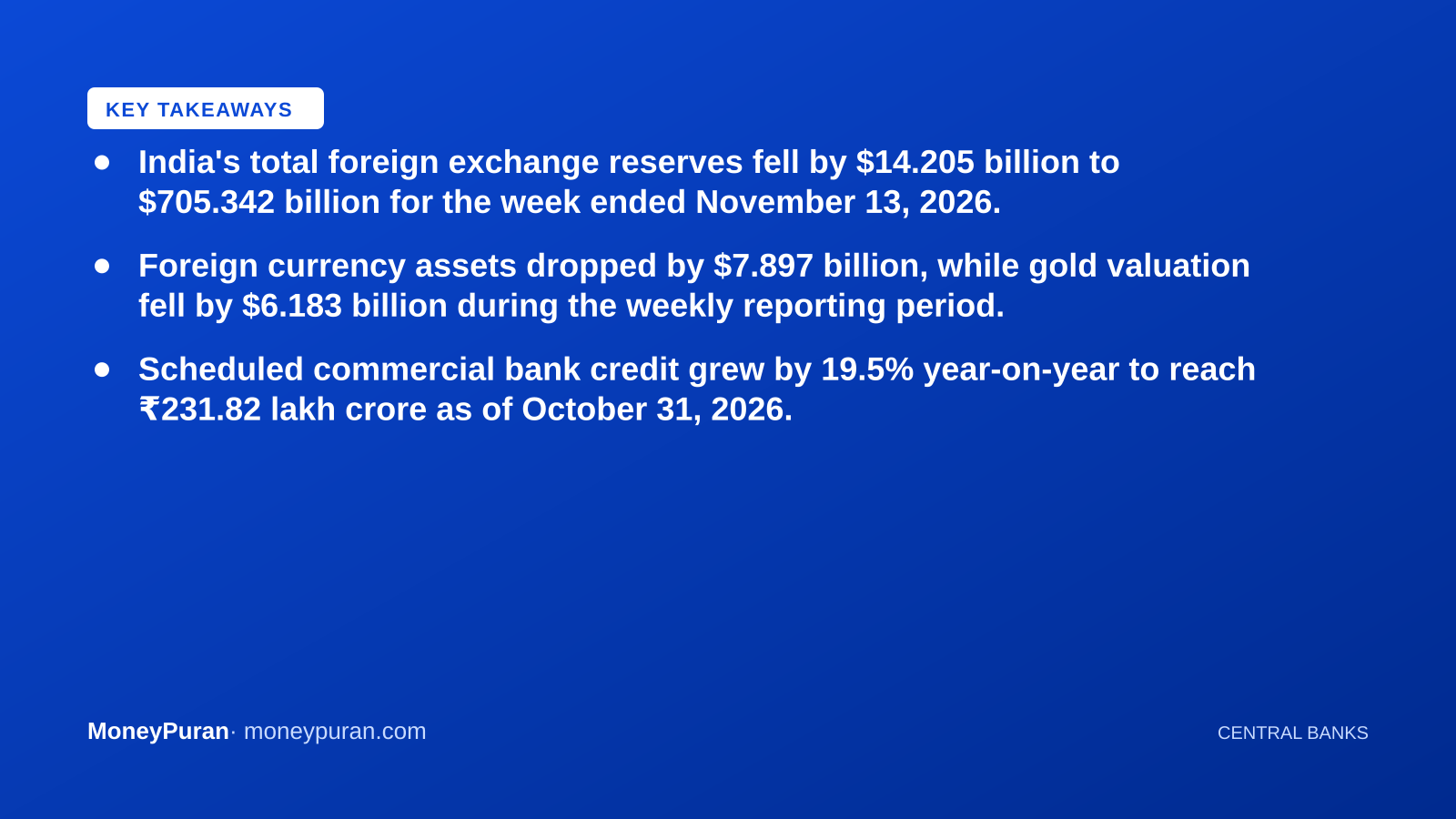
- India’s total foreign exchange reserves fell by $14.205 billion to $705.342 billion for the week ended November 13, 2026.
- Foreign currency assets dropped by $7.897 billion, while gold valuation fell by $6.183 billion during the weekly reporting period.
- Scheduled commercial bank credit grew by 19.5% year-on-year to reach ₹231.82 lakh crore as of October 31, 2026.
- Aggregate bank deposits expanded 16.9% year-on-year to ₹282.51 lakh crore, led by fixed time deposits.
- Broad money supply (M3) recorded a 16.5% year-on-year increase, reaching ₹337.68 lakh crore.
India forex reserves experienced a steep weekly contraction of $14.205 billion, sliding to $705.342 billion for the week ended November 13, 2026, according to the weekly statistical supplement released by the Reserve Bank of India (RBI). Despite the sharp pull-back in reserve buffers, underlying domestic credit expansion remained robust, with scheduled commercial bank credit expanding by 19.5% year-on-year to stand at ₹231.82 lakh crore as of October 31, 2026.
Breakdown of the Foreign Exchange Reserve Decline
The total reserve portfolio of the RBI fell from the previous week’s figures to $705.342 billion (₹66.47 lakh crore). The fall was primarily driven by a substantial dip in Foreign Currency Assets (FCA), which dropped by $7.897 billion during the week to reach $583.452 billion. FCAs form the largest component of India’s reserve holdings and reflect revaluation shifts as well as central bank foreign exchange interventions.
Gold reserves held by the central bank also registered a notable decline in dollar terms, falling by $6.183 billion in a single week to $98.613 billion. Among smaller reserve components, Special Drawing Rights (SDRs) dipped by $92 million to $18.517 billion, while India’s reserve position in the International Monetary Fund (IMF) shed $32 million to settle at $4.758 billion.
Bank Credit and Deposit Dynamics
Data covering scheduled commercial banks highlighted sustained momentum in domestic economic activity. Total bank credit stood at ₹231.82 lakh crore as of October 31, 2026, representing a fortnight increase of ₹4.39 lakh crore and a strong year-on-year growth rate of 19.5%. Non-food credit dominated the expansion, rising 19.4% year-on-year to ₹230.59 lakh crore.
Aggregate deposits grew by 16.9% year-on-year to hit ₹282.51 lakh crore. Time deposits accounted for the bulk of total banking liabilities, standing at ₹247.74 lakh crore with a year-on-year growth rate of 17.4%. In contrast, demand deposits saw a fortnight increase of ₹1.77 lakh crore to reach ₹34.77 lakh crore, growing at 12.0% on an annual basis.
Broad Money Supply and Systemic Liquidity
The RBI report showed that broad money supply (M3) stood at ₹337.68 lakh crore as of late October 2026, expanding by 16.5% over the previous year. Currency with the public expanded to ₹42.68 lakh crore, recording a 14.7% year-on-year growth rate. Net bank credit to the commercial sector surged 19.4% year-on-year to ₹241.14 lakh crore, underscoring healthy credit demand across private enterprise.
Liquidity management operations by the RBI indicated a net liquidity absorption state in the banking system. Through its Standing Deposit Facility (SDF) and Variable Rate Reverse Repo operations, the central bank absorbed net liquidity ranging between ₹1.37 lakh crore and ₹1.99 lakh crore daily during the week of November 9 to November 15, 2026.
Key Statistical Highlights
- Total Forex Reserves: $705.342 billion (Down $14.205 billion weekly)
- Foreign Currency Assets: $583.452 billion (Down $7.897 billion weekly)
- Gold Reserves Value: $98.613 billion (Down $6.183 billion weekly)
- Bank Credit Growth: ₹231.82 lakh crore (Up 19.5% year-on-year)
- Aggregate Deposit Growth: ₹282.51 lakh crore (Up 16.9% year-on-year)
- Broad Money (M3): ₹337.68 lakh crore (Up 16.5% year-on-year)
What this means for investors
The drop in total foreign exchange reserves highlights the ongoing dynamic management of global currency shifts and domestic liquidity by the RBI. While a $14.2 billion decline appears sizeable over a single week, overall reserve buffers remaining above the $700 billion mark provide significant insulation for the Indian rupee against foreign institutional cash outflows and external shocks.
For banking equity investors, the double-digit growth rates in bank credit (19.5%) and aggregate deposits (16.9%) demonstrate solid balance-sheet expansion across commercial lenders. The strong growth in time deposits indicates that banks have successfully attracted stable funding to support their rapid credit growth, helping manage asset-liability mismatches.
Systemic liquidity remains in absorption mode, meaning the RBI continues to mop up surplus cash from banks to maintain short-term interest rates aligned with its monetary policy stance. Investors tracking Indian capital markets should monitor how sustained credit growth interacts with deposit growth rates, as well as foreign portfolio capital flows in upcoming RBI releases.
Frequently asked questions
What caused the decline in India’s forex reserves? The weekly drop of $14.2 billion was primarily driven by a $7.897 billion fall in foreign currency assets and a $6.183 billion decrease in the value of gold reserves, reflecting currency revaluations and reserve management operations.
How fast is bank lending growing in India? Scheduled commercial bank credit grew by 19.5% year-on-year to ₹231.82 lakh crore as of October 31, 2026, led primarily by non-food credit growth.
What is the current level of broad money supply (M3) in India? Broad money supply (M3) reached ₹337.68 lakh crore as of October 31, 2026, representing a 16.5% year-on-year increase.
This article is for information only and is not investment advice. Do your own research or consult a licensed adviser before investing.
Based on information published by Reserve Bank of India (RBI). Source: Reserve Bank of India (RBI). Spotted an error? corrections@moneypuran.com