 Money

The Reserve Bank of India has maintained the systemic importance bucketing for SBI, HDFC Bank, and ICICI Bank in its 2026 assessment, requiring extra CET1 capital buffers.
Key points
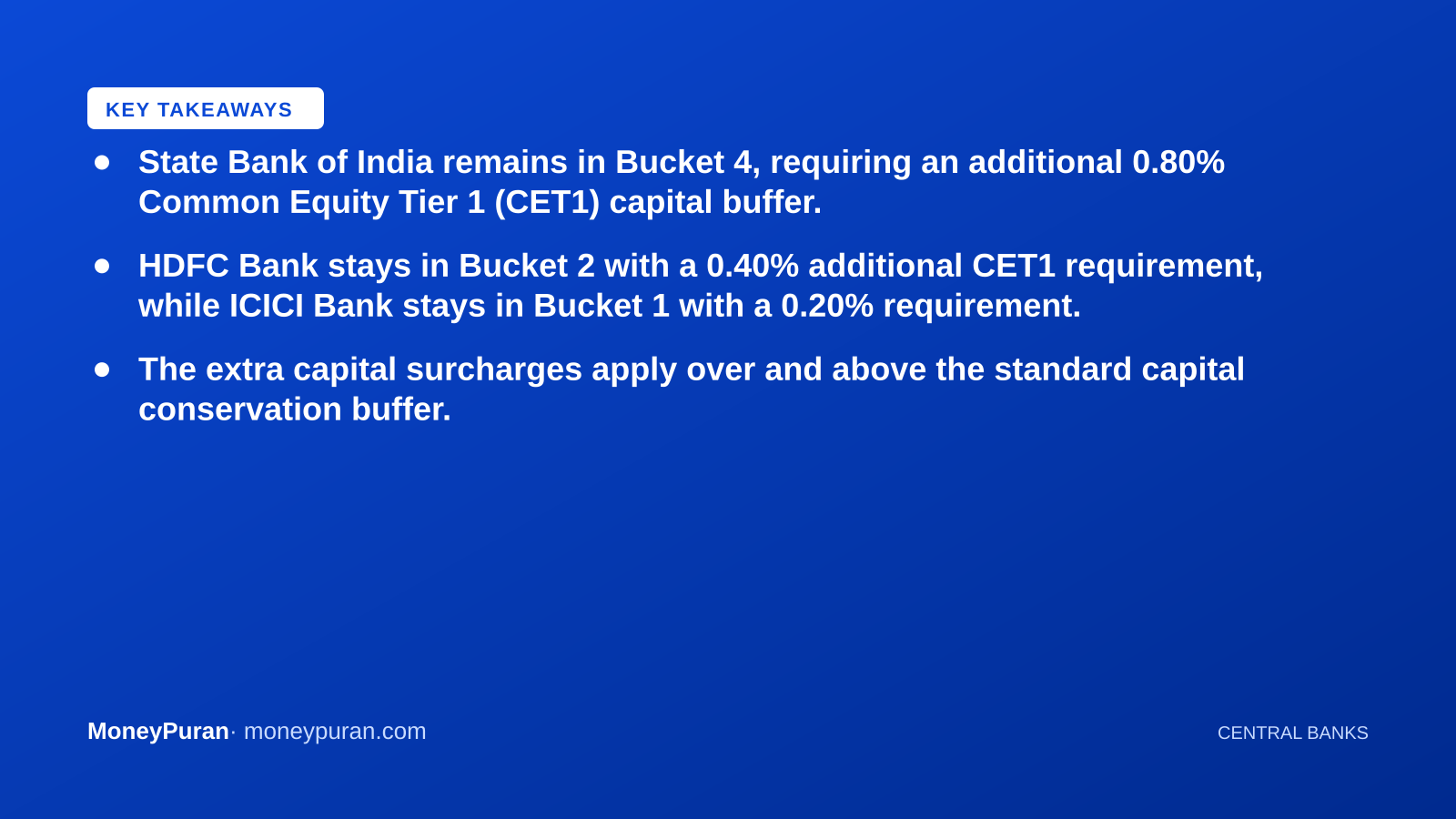
- State Bank of India remains in Bucket 4, requiring an additional 0.80% Common Equity Tier 1 (CET1) capital buffer.
- HDFC Bank stays in Bucket 2 with a 0.40% additional CET1 requirement, while ICICI Bank stays in Bucket 1 with a 0.20% requirement.
- The extra capital surcharges apply over and above the standard capital conservation buffer.
- The 2026 evaluation is based on financial and systemic data collected from banks as of March 31, 2026.
- Foreign banks operating in India that are classified as G-SIBs must maintain proportional CET1 surcharges in India.
The Reserve Bank of India (RBI) has released its 2026 list of Domestic Systemically Important Banks (D-SIBs), retaining State Bank of India, HDFC Bank, and ICICI Bank in the same risk buckets as the previous year. The announcement confirms that India’s three largest lenders must continue holding additional Common Equity Tier 1 (CET1) capital buffers to protect against potential systemic risks.
Often referred to as banks that are ‘too big to fail’, D-SIBs are financial institutions whose size, cross-jurisdictional activity, complexity, lack of substitutability, and interconnectedness make them vital to the national economy. Under the D-SIB framework, these institutions face heightened regulatory scrutiny and extra capital obligations beyond the standard capital conservation buffer required for all commercial banks.
Capital Buffer Requirements Across Buckets
The central bank places designated lenders into five systemic importance buckets, with higher buckets carrying larger capital surcharges calculated as a percentage of Risk Weighted Assets (RWAs). For 2026, the RBI confirmed that no bank occupies the highest tier (Bucket 5), which carries a 1.00% additional CET1 surcharge, or Bucket 3, which carries a 0.60% requirement.
The specific capital requirements established in the latest RBI assessment include:
- State Bank of India (Bucket 4): Additional CET1 requirement of 0.80% of Risk Weighted Assets.
- HDFC Bank (Bucket 2): Additional CET1 requirement of 0.40% of Risk Weighted Assets.
- ICICI Bank (Bucket 1): Additional CET1 requirement of 0.20% of Risk Weighted Assets.
- Bucket 3: Surcharge level of 0.60% (currently empty).
- Bucket 5: Surcharge level of 1.00% (currently empty).
For foreign lenders operating through branches in India that are classified as Global Systemically Important Banks (G-SIBs), the RBI reaffirmed that they must maintain an additional CET1 capital surcharge in India. This requirement is calculated proportionally based on their home country regulator’s G-SIB buffer multiplied by the bank’s Indian RWAs relative to its total consolidated global RWAs.
Evolution of the D-SIB Framework in India
The RBI first introduced its framework for dealing with Domestic Systemically Important Banks on July 22, 2014, establishing the mechanism to evaluate and categorize major financial institutions. Under the framework, the regulator evaluates banks based on Systemic Importance Scores (SISs) compiled from annual data disclosures.
The central bank began officially designating lenders under this policy in 2015, when State Bank of India was first named a D-SIB alongside ICICI Bank in 2016. HDFC Bank was added to the list in 2017. The D-SIB framework underwent a regulatory update on December 28, 2023, which refined the bucketing structure and scoring methodologies. The 2026 designations were determined using bank balance sheet data collected as of March 31, 2026.
What this means for investors
For equity investors holding shares in SBI, HDFC Bank, or ICICI Bank, the RBI’s decision to keep capital surcharges stable provides regulatory predictability. Because all three institutions already maintain robust total capital adequacy ratios well above minimum regulatory thresholds, the maintained CET1 surcharges will not require sudden capital raises or disruptive equity dilution.
From a credit and balance-sheet perspective, the D-SIB designation serves as a double-edged sword. On one hand, requiring these institutions to carry additional equity buffers enhances financial stability, lowers solvency risks, and bolsters institutional safety during market stress. On the other hand, holding extra CET1 capital slightly increases the overall cost of capital for these banks, which can marginally weigh on return on equity (ROE) targets compared to unconstrained smaller peers.
For broader equity market investors in India, the stability of the D-SIB list reinforces confidence in the domestic banking system. The explicit recognition of systemic importance ensures that the country’s primary credit engines maintain sufficient capital cushions to absorb unexpected credit losses without disrupting national liquidity or financial stability.
Frequently asked questions
What is a D-SIB? A Domestic Systemically Important Bank (D-SIB) is an institution whose distress or failure would cause significant disruption to the domestic financial system and economy. They are subject to additional capital safety buffers.
Why are extra capital buffers required for D-SIBs? Extra Common Equity Tier 1 (CET1) buffers ensure that large, interconnected banks have sufficient high-quality capital to absorb potential losses, reducing the risk of insolvency and systemic financial contagion.
Which banks are currently on the RBI D-SIB list? As of the 2026 assessment, State Bank of India (SBI), HDFC Bank, and ICICI Bank are the three institutions designated as D-SIBs by the Reserve Bank of India.
This article is for information only and is not investment advice. Do your own research or consult a licensed adviser before investing.
Based on information published by Reserve Bank of India (RBI). Source: Reserve Bank of India (RBI). Spotted an error? corrections@moneypuran.com