 Money
Money
U.S. payroll employment crept up by 29,000 in September while the jobless rate remained flat at 4.2 percent, according to Bureau of Labor Statistics data.
Key points
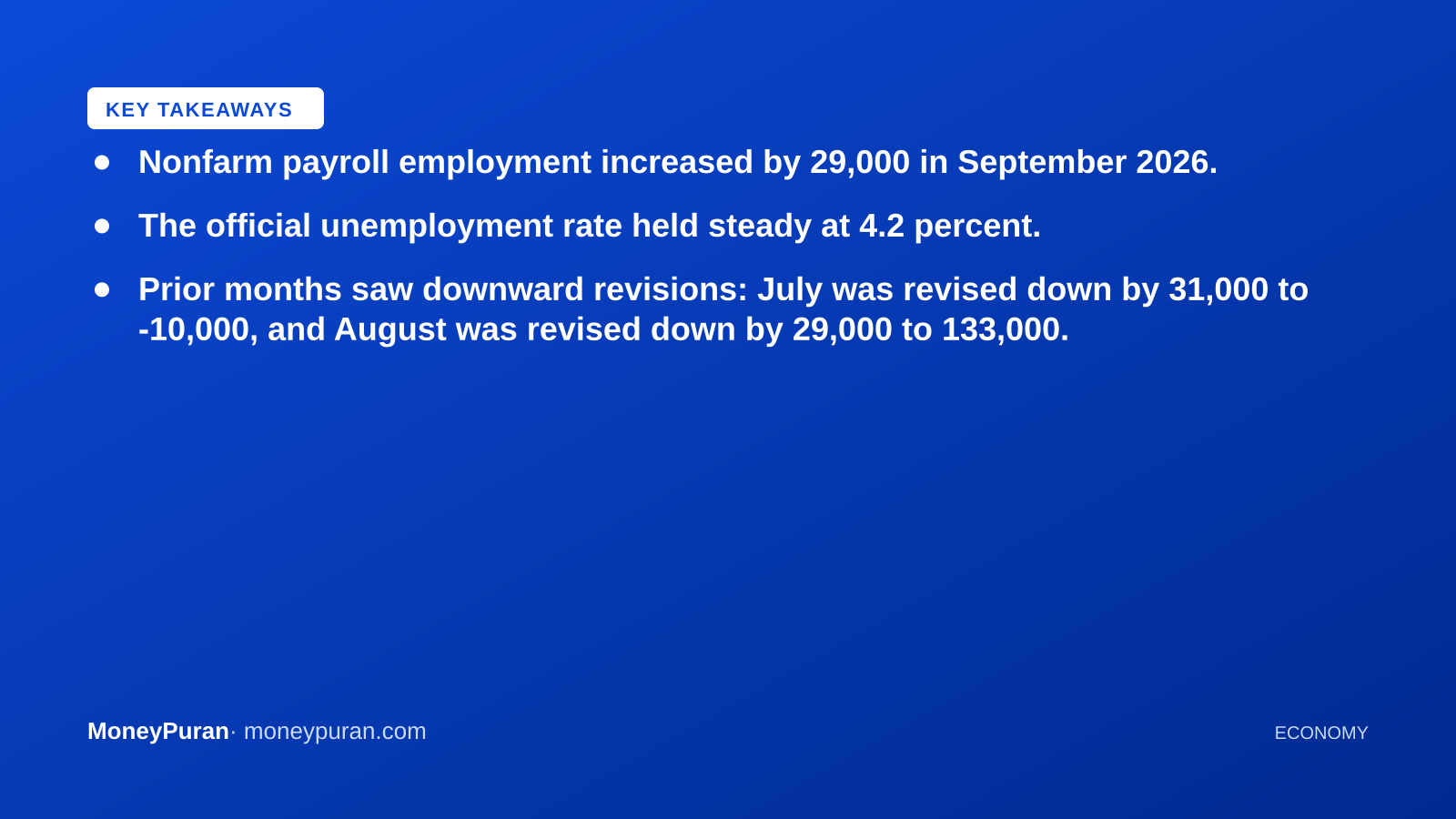
- Nonfarm payroll employment increased by 29,000 in September 2026.
- The official unemployment rate held steady at 4.2 percent.
- Prior months saw downward revisions: July was revised down by 31,000 to -10,000, and August was revised down by 29,000 to 133,000.
- Average hourly earnings edged up by 5 cents, or 0.1 percent, to $37.81.
U.S. nonfarm payroll employment crawled upward by 29,000 in September, while the unemployment rate remained essentially unchanged at 4.2 percent, according to data released by the U.S. Bureau of Labor Statistics. The latest figures point to a cooling labor market, with job gains falling well below the prior 12-month average monthly gain of 45,000. In addition to modest job additions for the month, significant downward revisions to prior months altered the recent employment landscape.
Mixed Industry Performance and Revisions
Employment across major industries showed little movement over the course of September. Health care continued its long-term upward trend by adding 17,000 jobs, though this represented a slower pace than its prior 12-month average of 33,000. Construction payrolls nudged up by 11,000, and manufacturing employment ticked higher by 9,000. Conversely, financial activities shed 7,000 jobs, continuing a broader downward trend in that sector.
Meanwhile, the BLS heavily revised previous estimates downward. July’s total nonfarm payroll change was slashed by 31,000, bringing it down to a loss of 10,000 jobs. August’s job gains were also marked down by 29,000 to 133,000. Combined, employment for July and August is now calculated to be 60,000 lower than initial reports indicated.
Earnings and Hours Hold Steady
Average hourly earnings for all private nonfarm employees edged up by 5 cents, or 0.1 percent, to $37.81 in September. Over the past 12 months, average hourly pay has advanced by 3.0 percent. For private-sector production and nonsupervisory employees, average hourly earnings rose by 7 cents, or 0.2 percent, to reach $32.60.
The average workweek for all employees on private nonfarm payrolls held flat at 34.4 hours. Manufacturing recorded an unchanged average workweek of 40.6 hours, with overtime holding steady at 3.0 hours. The number of long-term unemployed individuals—those out of work for 27 weeks or more—stood essentially unchanged at 1.9 million, making up 27.1 percent of all jobless individuals.
What this means for investors
Employment data serves as a critical barometer for the health of the broader economy and heavily influences central bank monetary policy. Weaker job growth and downward revisions to previous months reduce immediate pressures on the Federal Reserve to implement aggressive rate hikes, potentially shifting expectations toward monetary easing or rate cuts depending on upcoming inflation prints.
For global investors, including those tracking markets from India, U.S. employment data directly impacts foreign institutional investor (FII) flows, currency valuations like the rupee-dollar exchange rate, and broader risk sentiment across global equities. A softening U.S. labor market often prompts adjustments in dollar strength, which in turn influences emerging market capital allocation. Investors should monitor subsequent central bank commentary and upcoming inflation releases to gauge the trajectory of global interest rates.
Frequently asked questions
Why are there two monthly measures of employment? The BLS publishes estimates from a household survey, which measures demographic factors and self-employment, and an establishment survey, which tracks nonfarm payrolls and business payroll data. The establishment survey has a larger sample size, making its month-to-month changes more statistically reliable.
Are undocumented immigrants counted in the employment reports? Neither the household nor the establishment survey is designed to track legal status, though researchers note that both surveys likely capture some undocumented workers inadvertently via general business and household sampling.
Why does the establishment survey undergo revisions? The BLS revises initial monthly estimates over the subsequent two months as more businesses submit late data and seasonal adjustment factors are recalculated. Annual benchmark revisions are later anchored to state unemployment insurance tax records.
This article is for information only and is not investment advice. Do your own research or consult a licensed adviser before investing.
Based on information published by U.S. Bureau of Labor Statistics (BLS). Source: U.S. Bureau of Labor Statistics (BLS). Spotted an error? corrections@moneypuran.com