 Money
Money

The Federal Reserve Board has published the 2025 Survey of Consumer Finances, revealing key shifts in American household wealth, income, debt, and stock market participation between 2022 and 2025.

Key points
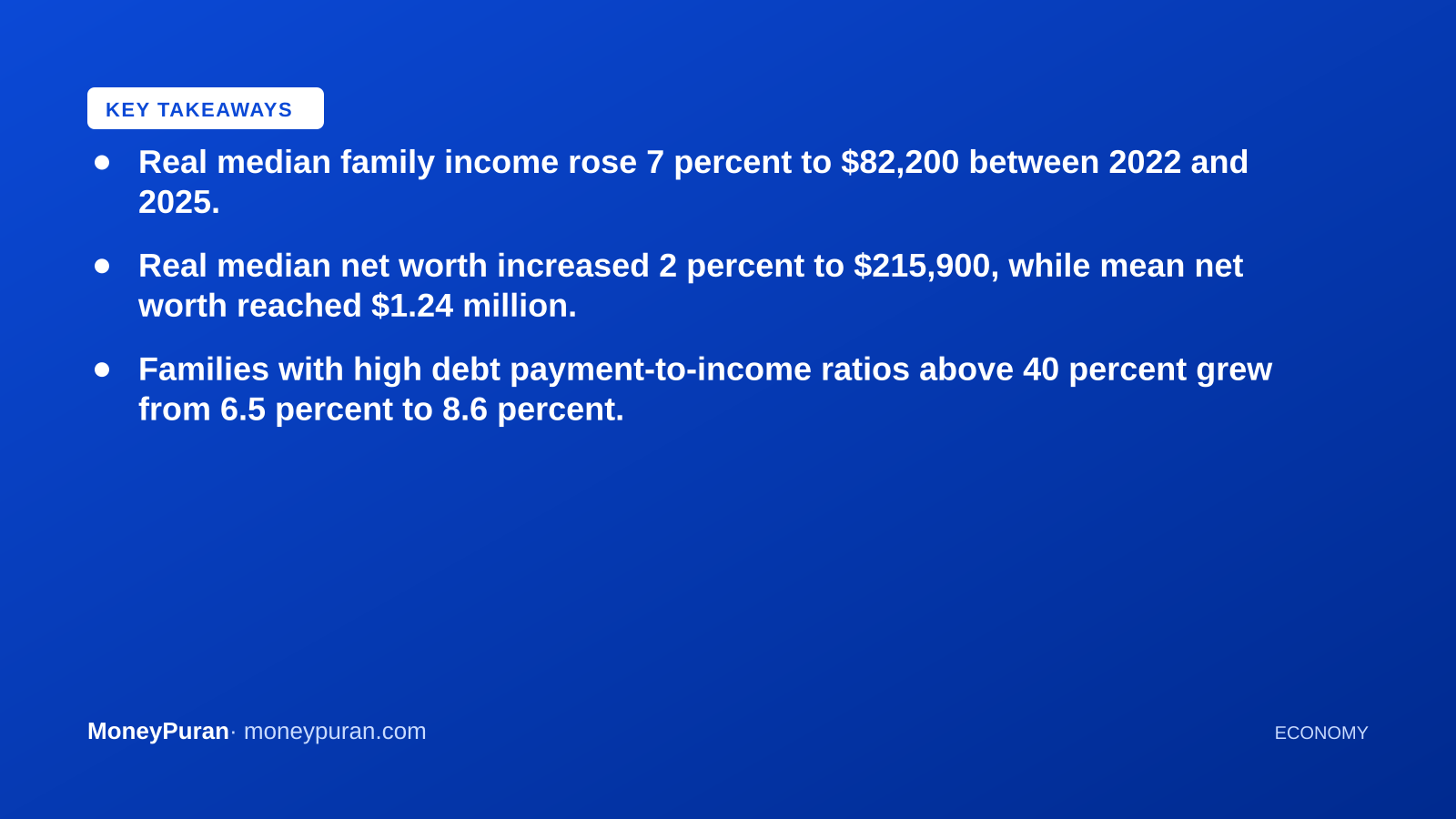
- Real median family income rose 7 percent to $82,200 between 2022 and 2025.
- Real median net worth increased 2 percent to $215,900, while mean net worth reached $1.24 million.
- Families with high debt payment-to-income ratios above 40 percent grew from 6.5 percent to 8.6 percent.
- Stock market participation dipped slightly to 56 percent, though median holdings for investors jumped 36 percent.
The Federal Reserve Board has released the findings of its triennial Survey of Consumer Finances, shedding light on the evolving economic condition of American households. Conducted in partnership with NORC at the University of Chicago, the comprehensive study offers policymakers and the public a detailed look into household assets, liabilities, and banking habits. Alongside the raw datasets, the central bank issued a summary report titled Changes in U.S. Family Finances from 2022 to 2025.
The survey data highlights notable divergences across income and wealth tiers over the three-year period. While real median family income advanced 7 percent to $82,200, real mean family income contracted 6 percent to $145,200. Lower-income and lower-net-worth households experienced modest gains in both median and mean income, whereas wealthier demographics recorded declines. Meanwhile, overall wealth measures expanded, with real median net worth climbing 2 percent to $215,900 and mean net worth jumping 7 percent to $1.24 million.
Shifts in Housing, Debt, and Savings
Housing remained a primary driver of household balance sheets. The homeownership rate held steady at 66 percent, but median net housing values—calculated as home value minus mortgage debt—advanced to $230,000 from $218,900 in 2022. Retirement plan participation ticked up slightly to approximately 65 percent, with participating families seeing higher median and mean account balances.
Debt burdens presented a mixed picture. The overall share of indebted families remained stable at 77 percent, with median and mean debt outstanding showing no change. However, financial vulnerability metrics highlighted some strain: the proportion of families facing debt payment-to-income ratios above 40 percent increased from 6.5 percent to 8.6 percent, matching levels last recorded in the 2013 survey.
Stock Market Participation and Holdings
Direct and indirect stock market participation experienced a minor contraction, easing from 58 percent of families in 2022 to 56 percent in 2025. Despite the slight drop in overall participation, equity investors saw substantial gains. Conditional on holding stocks, median portfolio values surged 36 percent, moving from $56,900 to $77,400 over the three-year period. Understanding how these consumer balance sheet shifts intersect with broader monetary policy remains critical as tracked by the Fed rate monitor.
What this means for investors
For investors and financial analysts, the Survey of Consumer Finances provides vital context on the underlying health and resilience of the US consumer, which drives a significant portion of domestic economic activity. The rise in high debt-to-income ratios alongside growing median net worth indicates that while aggregate wealth is expanding, a subset of households faces tighter monthly cash-flow constraints. These dynamics directly influence consumer discretionary spending, retail trends, and credit delinquency metrics.
Monitoring these trends helps market participants gauge how resilient consumer balance sheets might be against shifting borrowing costs. As central banks evaluate economic data for monetary policy adjustments, household liquidity and debt servicing burdens remain key barometers for broader economic stability.
Frequently asked questions
How often is the Survey of Consumer Finances conducted? The survey has been undertaken every three years since 1989 by the Federal Reserve Board.
What was the median family income in the 2025 survey? Real median family income reached $82,200, representing a 7 percent increase compared to the 2022 survey results.
This article is for information only and is not investment advice. Do your own research or consult a licensed adviser before investing.
Based on information published by U.S. Federal Reserve Board. Source: U.S. Federal Reserve Board. Spotted an error? corrections@moneypuran.com