 Money


Indian benchmark indices closed in the red on October 27, 2026, dragged down by a steep correction in the banking sector alongside a higher exchange rate for the US dollar.
Key points
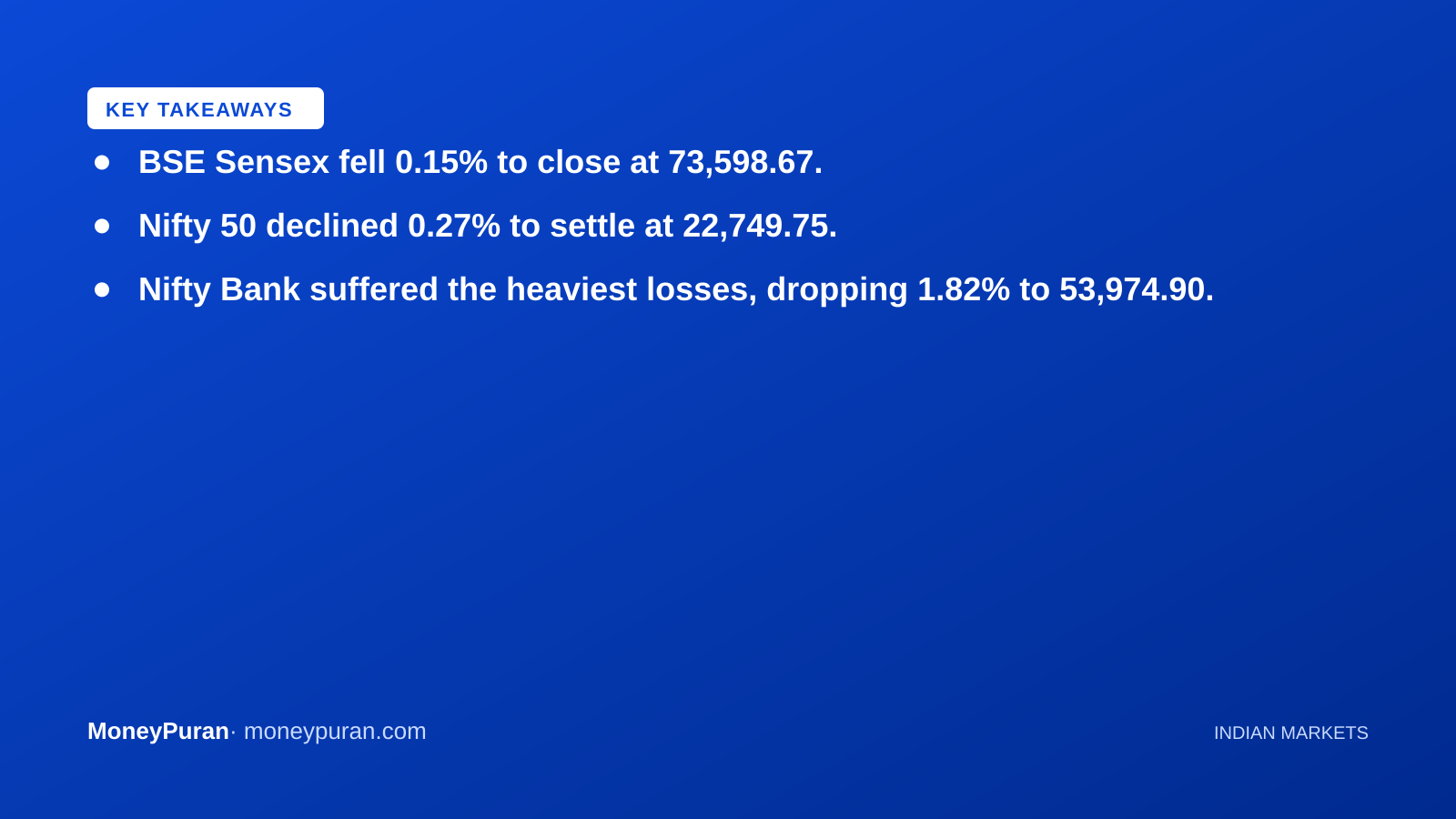
- BSE Sensex fell 0.15% to close at 73,598.67.
- Nifty 50 declined 0.27% to settle at 22,749.75.
- Nifty Bank suffered the heaviest losses, dropping 1.82% to 53,974.90.
- USD/INR rose 0.41% to end the session at 95.11.
Indian benchmark stock indices ended the trading session in negative territory on October 27, 2026, weighed down by heavy selling pressure across financial counters. The broader market action reflected cautious sentiment as investors digested sector-specific movements and currency fluctuations. For a deeper understanding of macro triggers, investors often evaluate why the market moved today to put daily index shifts into proper perspective.
The Bombay Stock Exchange 30-share Sensex drifted lower by 0.15 percent, or 111.02 points, to finish the day at 73,598.67. Throughout the session, the index traded within a wide band of 73,179.41 and 73,762.98, failing to sustain early attempts at recovery. Similarly, the broader National Stock Exchange Nifty 50 slipped 0.27 percent, losing 61.60 points to close at 22,749.75, after traversing an intraday range of 22,636.85 to 22,829.75.
Banking Sector Bears the Brunt of Selling
The primary catalyst behind the day’s downward drift was severe weakness in the banking vertical. The Nifty Bank index underperformed the broader benchmarks substantially, tumbling 1.82 percent to close at 53,974.90. The sectoral gauge touched a low of 53,951.20 during the session, reflecting intense institutional distribution in major private and public sector lenders.
Meanwhile, the foreign exchange market saw the Indian rupee lose ground against the greenback. The USD/INR pair advanced 0.41 percent to settle at 95.11, moving within a daily band between 95.08 and 95.24. Currency depreciation often adds a layer of caution for foreign portfolio investors active in Indian equities.
- BSE Sensex close: 73,598.67 (-0.15%)
- Nifty 50 close: 22,749.75 (-0.27%)
- Nifty Bank close: 53,974.90 (-1.82%)
- USD/INR exchange rate: 95.11 (+0.41%)
What this means for investors
For domestic market participants, sessions marked by heavy sectoral underperformance like the sharp drop in Nifty Bank highlight the importance of portfolio diversification. When high-weightage financial stocks correct sharply, index-level movements can mask underlying resilience or weakness in other sectors such as IT, pharma, or consumer goods. Investors should monitor whether banking weakness persists across multiple sessions or remains a localized adjustment.
Currency movements also demand close attention. A rising USD/INR exchange rate can influence imported inflation metrics and corporate earnings margins, particularly for import-heavy industries, while potentially offering a tailwind for export-oriented sectors like information technology. Observing how foreign institutional flows react to currency shifts remains a critical task for active portfolio managers.
Frequently asked questions
What were the closing levels for Sensex and Nifty 50? The BSE Sensex closed at 73,598.67, down 0.15%, while the Nifty 50 settled at 22,749.75, lower by 0.27%.
Which sector recorded the steepest decline during the session? The Nifty Bank index experienced the heaviest losses among major sectoral gauges, plunging 1.82% to close at 53,974.90.
This article is for information only and is not investment advice. Do your own research or consult a licensed adviser before investing.
Based on information published by MoneyPuran market data. Source: MoneyPuran market data. Spotted an error? corrections@moneypuran.com