 Money


Indian benchmark equity indices closed lower as sharp losses in banking stocks weighed heavily on broader market sentiment.
Key points
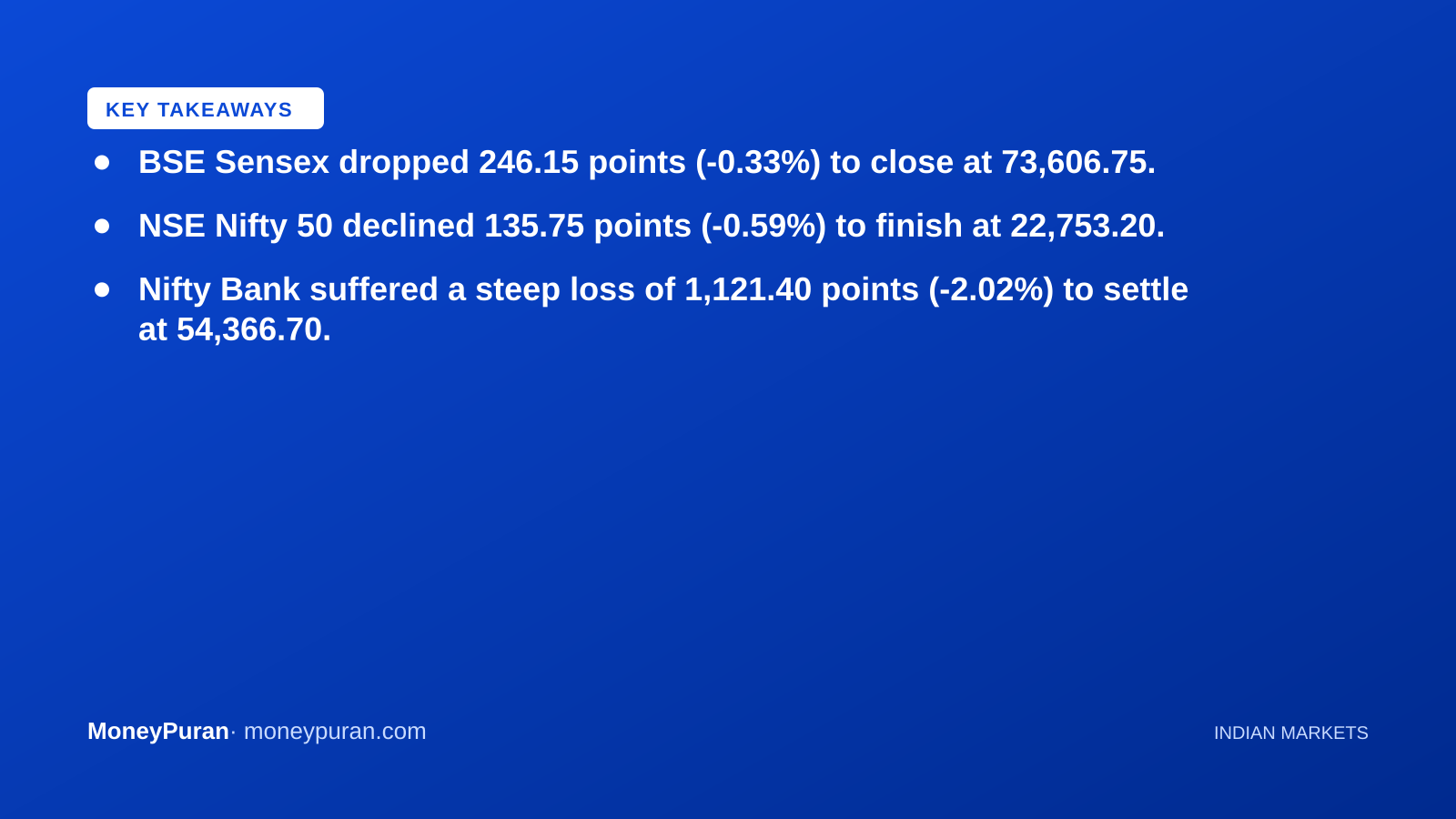
- BSE Sensex dropped 246.15 points (-0.33%) to close at 73,606.75.
- NSE Nifty 50 declined 135.75 points (-0.59%) to finish at 22,753.20.
- Nifty Bank suffered a steep loss of 1,121.40 points (-2.02%) to settle at 54,366.70.
- USD/INR exchange rate rose 0.19% to close at 95.18 against the greenback.
Indian equity benchmarks closed lower on October 26, 2026, as significant selling pressure across financial institutions pulled the broader market into negative territory. The BSE Sensex today fell by 246.15 points, or 0.33%, to finish at 73,606.75, after fluctuating across a wide range during trading hours. Concurrently, the NSE Nifty 50 index slipped 135.75 points, or 0.59%, to settle at 22,753.20. The primary driver of the benchmark decline was a sharp downturn in banking equities, alongside a marginal weakening of the Indian rupee against the US dollar.
Benchmark indices reflect intraday volatility
Throughout the trading session, market participants witnessed substantial price swings across major indices. The Sensex registered a wide daily range, touching an intraday low of 72,514.57 before trimming a large portion of its losses to close near its high for the session at 73,606.75. Similarly, the Nifty 50 dipped to a low of 22,387.35 during peak selling hours before recovering towards its closing level of 22,753.20. While the late recovery prevented a deeper market rout, investors remain attentive to underlying macroeconomic signals to evaluate why the market moved today across key sectors.
Key market statistics for the session
A snapshot of benchmark index performances and currency movements illustrates the sector-specific pressure seen across domestic exchanges:
- BSE Sensex: Closed at 73,606.75 (-246.15 points / -0.33%), intraday range: 72,514.57 – 73,606.75
- NSE Nifty 50: Closed at 22,753.20 (-135.75 points / -0.59%), intraday range: 22,387.35 – 22,753.20
- Nifty Bank: Closed at 54,366.70 (-1,121.40 points / -2.02%), intraday range: 53,777.50 – 54,392.50
- USD/INR Pair: Settled at 95.18 (+0.19%), intraday range: 94.89 – 95.26
Banking sector leads market declines
The financial segment bore the brunt of the day’s market correction. The Nifty Bank index posted a steep loss of 2.02%, sliding by 1,121.40 points to close at 54,366.70. The banking benchmark tumbled to an intraday low of 53,777.50 before making a modest bounce towards 54,392.50 at the closing bell. Because banking and financial services stocks carry a heavy weight in both the Sensex and the Nifty 50, weakness in private and public sector lenders frequently creates a drag across the broader stock market.
Rupee weakens against the US dollar
In the foreign exchange market, the Indian rupee experienced mild downside pressure against the greenback. The USD/INR currency pair rose by 0.19% to close at 95.18, compared to its previous close of 94.99. During the session, the exchange rate fluctuated between a low of 94.89 and a high of 95.26. Currency volatility remains a key factor for domestic markets, as exchange rate shifts influence international capital flows and imported inflation.
What this means for investors
Sharp movements in banking heavyweights typically exert a magnified influence on benchmark indices, but they do not necessarily reflect weakness across every corner of the economy. Investors holding diversified mutual funds or broad market portfolios may see temporary valuation drawdowns when major banking stocks experience steep single-day pullbacks. Understanding that sector rotation is a standard feature of market cycles helps investors avoid knee-jerk decisions during volatile trading sessions.
The simultaneous shift in the USD/INR currency pair highlights the importance of monitoring sector-specific currency sensitivities. A weaker rupee can generate tailwinds for export-oriented businesses such as information technology and pharmaceuticals, as their foreign revenues convert into higher local currency earnings. Conversely, companies reliant on imported inputs or foreign-currency debt may face margin compression if currency weakness persists over multiple quarters.
For long-term investors, sessions characterized by intraday recoveries off deep lows underscore the value of a disciplined asset allocation strategy. Rather than attempting to time short-term market tops and bottoms, market participants should monitor upcoming corporate earnings reports, liquidity conditions, and central bank commentary. Rebalancing portfolios according to personal risk tolerance remains a prudent approach during periods of heightened market volatility.
Frequently asked questions
Why did the Nifty Bank index fall more than the Nifty 50? Sector indices like Nifty Bank consist entirely of financial institutions, making them far more concentrated. When banking equities face sector-wide selling, the index drops more severely than broader market benchmarks like the Nifty 50, which benefit from diversification across technology, consumer goods, energy, and pharmaceuticals.
How does a weakening rupee affect Indian stock markets? A declining rupee increases the cost of imported commodities and can spark capital outflows from foreign portfolio investors seeking currency stability. However, it can also bolster export-oriented sectors, creating divergent performances across different stock market segments.
This article is for information only and is not investment advice. Do your own research or consult a licensed adviser before investing.
Based on information published by MoneyPuran market data. Source: MoneyPuran market data. Spotted an error? corrections@moneypuran.com