 Money


The U.S. Securities and Exchange Commission has granted targeted exemptive relief from Treasury clearing requirements for certain non-U.S. and inter-affiliate repo transactions to smooth market transition.
Key points
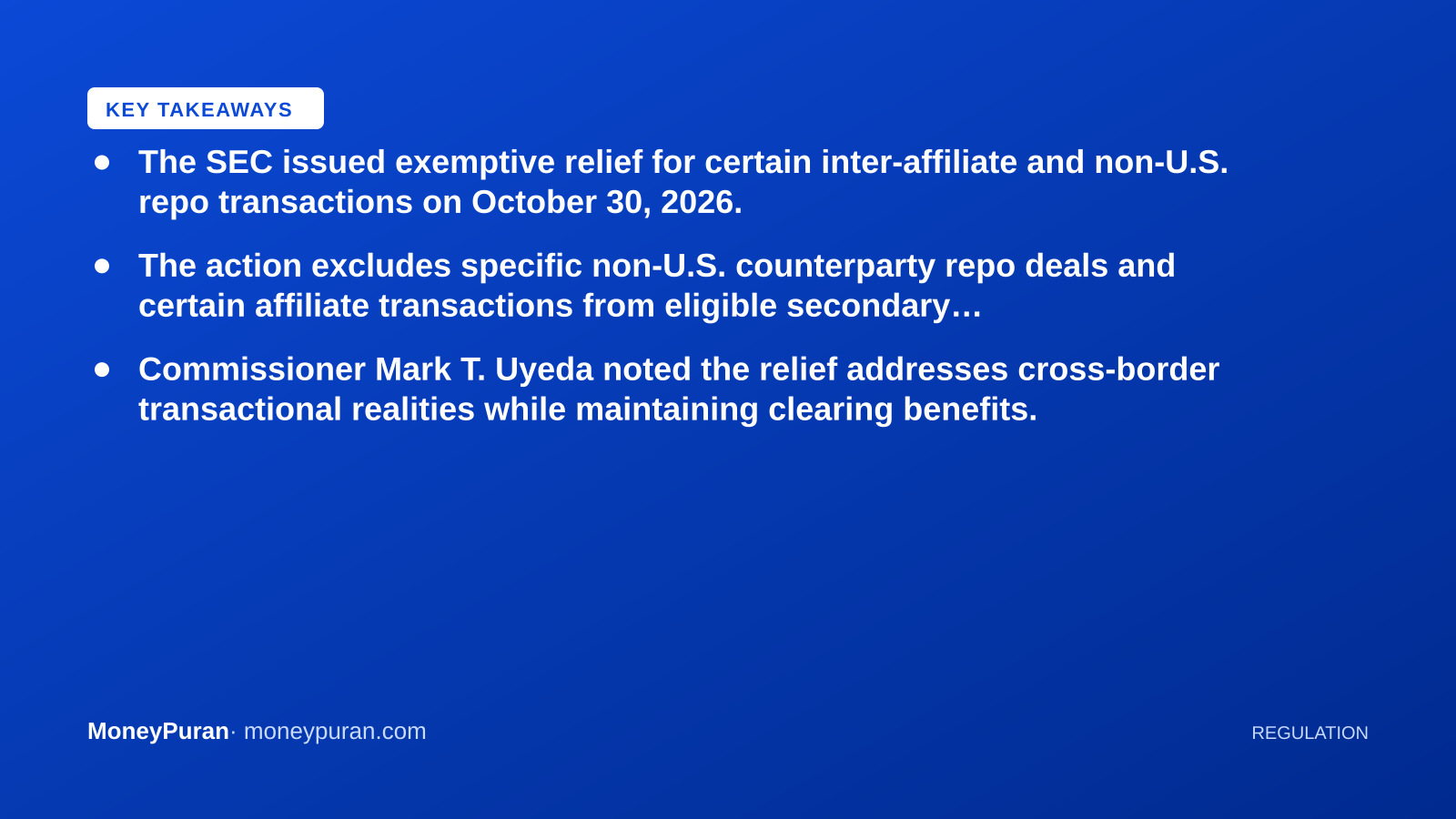
- The SEC issued exemptive relief for certain inter-affiliate and non-U.S. repo transactions on October 30, 2026.
- The action excludes specific non-U.S. counterparty repo deals and certain affiliate transactions from eligible secondary market transactions.
- Commissioner Mark T. Uyeda noted the relief addresses cross-border transactional realities while maintaining clearing benefits.
- Market participants can contact the SEC Division of Trading and Markets via email or phone for implementation questions.
The U.S. Securities and Exchange Commission has introduced targeted exemptive relief concerning central clearing mandates for the US Treasury yield curve market ecosystem. Specifically, the regulatory body has adjusted its framework to assist broker-dealers and broader financial market participants adapting to upcoming central clearing requirements for U.S. Treasury securities.
Originally adopted in December 2023, the overarching Treasury clearing rules have faced ongoing calibration regarding operational, interpretive, and compliance challenges. By granting this latest round of relief, the Commission aims to facilitate a smoother implementation timeline for cross-border and internal corporate structures.
Details of the SEC Exemptive Relief
Under the newly announced parameters, the Commission has carved out specific exclusions from the strict definition of eligible secondary market transactions. These modifications directly target structural complexities highlighted by financial institutions during public comment periods and industry engagements.
- Excludes certain repo transactions involving non-U.S. counterparties under specified limits and conditions.
- Excludes specific repo transactions between direct clearing agency participants and non-investment company affiliates.
- Provides operational breathing room while preserving systemic risk protections tied to central clearing.
Commissioner Mark T. Uyeda, designated by Chairman Paul S. Atkins to oversee the central clearing transition initiative, emphasized that regulatory adjustments are necessary to reflect the practical realities of cross-border financing operations without eroding the fundamental stability goals of the policy.
What this means for investors
For global investors and market participants, this regulatory adjustment signals a pragmatic approach by the SEC to prevent market friction and liquidity bottlenecks in the massive repo market. Because repo transactions form the plumbing of short-term institutional funding, sudden and rigid operational demands can disrupt pricing and liquidity across fixed-income assets.
While retail investors do not trade repo agreements directly, any disruption in institutional repo financing cascades into broader bond markets, corporate borrowing costs, and overall market stability. The targeted relief ensures that internal corporate group financing and foreign counterparty transactions do not face abrupt compliance blockages, keeping short-term funding markets operating with fewer disruptions as the broader clearing mandate approaches.
Frequently asked questions
Who is eligible for the new repo transaction relief? The relief applies to certain repo transactions involving non-U.S. counterparties under strict limits, as well as specific inter-affiliate repo trades between direct clearing participants and qualifying non-investment company affiliates.
Where can market participants direct implementation questions? Broker-dealers and firms can reach out directly to the SEC Division of Trading and Markets by emailing tradingandmarkets@sec.gov or calling 202-551-5777.
This article is for information only and is not investment advice. Do your own research or consult a licensed adviser before investing.
Based on information published by U.S. Securities and Exchange Commission (SEC). Source: U.S. Securities and Exchange Commission (SEC). Spotted an error? corrections@moneypuran.com