 Money

The U.S. Securities and Exchange Commission unveiled its fiscal year 2026 enforcement tally, securing over $1 billion in financial remedies while launching new analytical and retail-fraud units.
Key points
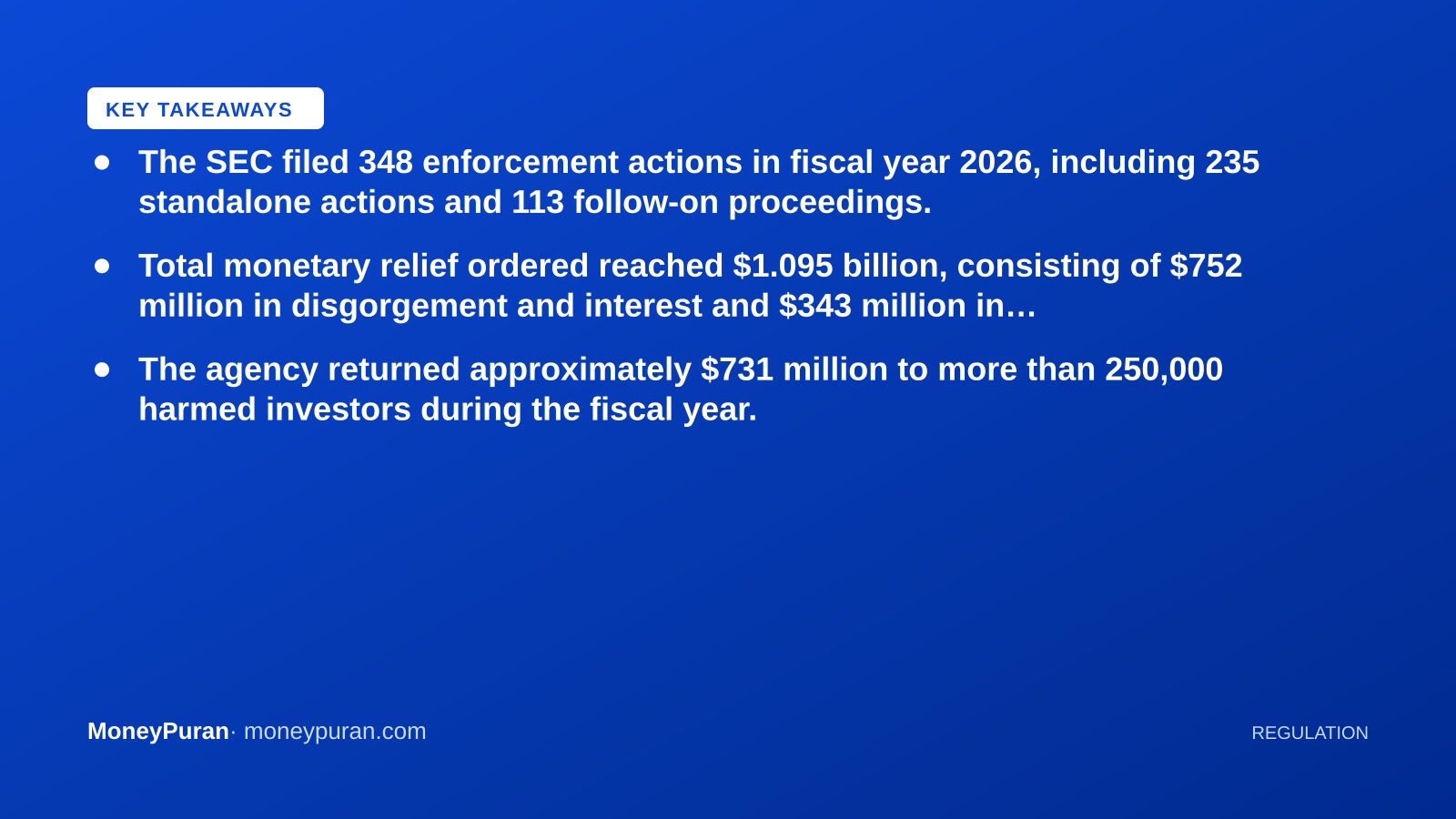
- The SEC filed 348 enforcement actions in fiscal year 2026, including 235 standalone actions and 113 follow-on proceedings.
- Total monetary relief ordered reached $1.095 billion, consisting of $752 million in disgorgement and interest and $343 million in civil penalties.
- The agency returned approximately $731 million to more than 250,000 harmed investors during the fiscal year.
- New units launched include the Retail Fraud Working Group, the Financial Reporting and Accounting Unit, and the Office of Super Intelligence and Analytics.
The U.S. Securities and Exchange Commission (SEC) announced its enforcement results for fiscal year 2026, highlighting $1.095 billion in monetary relief ordered and sweeping structural reforms designed to modernize its investigative capabilities. For the fiscal year ending September 30, the regulator’s Division of Enforcement targeted serious market violations, including fraud, insider trading, and financial reporting misstatements, while returning approximately $731 million to more than 250,000 harmed investors.
Under the leadership of SEC Chairman Paul S. Atkins and Enforcement Director David Woodcock, the agency filed a total of 348 enforcement actions over the twelve-month period. This figure comprised 235 standalone actions and 113 follow-on administrative proceedings. Notably, two-thirds of all standalone actions included charges against at least one individual, underscoring the regulator’s focus on personal accountability and deterrence. The Commission also issued 13 trading suspensions to protect investors from suspected market manipulation involving Asia-based issuers.
Structural Modernization and Specialized Units
To keep pace with evolving financial crimes and emerging market risks, the Division of Enforcement implemented major organizational enhancements during fiscal year 2026. The agency established the Retail Fraud Working Group to deploy data-driven strategies against Ponzi schemes, offering frauds, and broker-dealer misconduct. Additionally, the new Financial Reporting and Accounting Unit combined attorneys and accountants to tackle complex corporate accounting fraud earlier in the reporting cycle.
The regulator also launched the Office of Super Intelligence and Analytics to integrate advanced data tools into investigative workflows, aiding in anomaly detection and financial-flow analysis. Furthermore, the SEC updated its Enforcement Manual for the first time since 2017 to standardise the Wells process and formally rescinded Rule 202.5(e), removing the blanket restriction that prevented defendants from publicly denying allegations in settlement orders. These procedural updates aim to give the agency greater flexibility in resolving cases swiftly.
Cross-Border Enforcement and Interagency Ties
Cross-border misconduct remained a central priority through the agency’s Cross-Border Task Force. The SEC brought numerous actions against foreign bad actors, including charges against multiple entities for filing false Forms ADV to pose as legitimate U.S. advisers and running online investment confidence scams that siphoned millions overseas. Interagency coordination was also strengthened via new memoranda of understanding with the Commodity Futures Trading Commission and the Food and Drug Administration, facilitating joint oversight of complex financial products and life-sciences disclosures.
What this means for investors
For everyday investors, robust regulatory enforcement helps maintain the integrity of capital markets by deterring fraud, market manipulation, and misleading disclosures. When the SEC successfully investigates and penalizes bad actors—and returns hundreds of millions of dollars to victims—it reduces the systemic risk of encountering fraudulent investment schemes. However, regulatory oversight is not a guarantee against individual investment losses, and enforcement actions often occur long after misconduct has already harmed market participants.
Investors should continue to perform thorough due diligence before allocating capital, verifying the registration status of advisers and platforms through official regulatory databases. Watch for red flags such as guaranteed high returns with zero risk, unsolicited investment tips via social media, and unregistered entities operating overseas. Staying informed about regulatory trends and enforcement priorities can help market participants identify emerging risks early.
Frequently asked questions
How much money did the SEC collect in fiscal year 2026? The Commission obtained orders for monetary relief totaling $1.095 billion, which included $752 million in disgorgement and prejudgment interest alongside $343 million in civil penalties.
How many enforcement actions were filed? The SEC filed 348 total enforcement actions, consisting of 235 standalone actions and 113 follow-on administrative proceedings.
This article is for information only and is not investment advice. Do your own research or consult a licensed adviser before investing.
Based on information published by U.S. Securities and Exchange Commission (SEC). Source: U.S. Securities and Exchange Commission (SEC). Spotted an error? corrections@moneypuran.com