 Money

The Reserve Bank of India’s latest monthly publication points to resilient domestic activity, strong NBFC credit expansion, and shifting global inflation drivers impacting local markets.
Key points
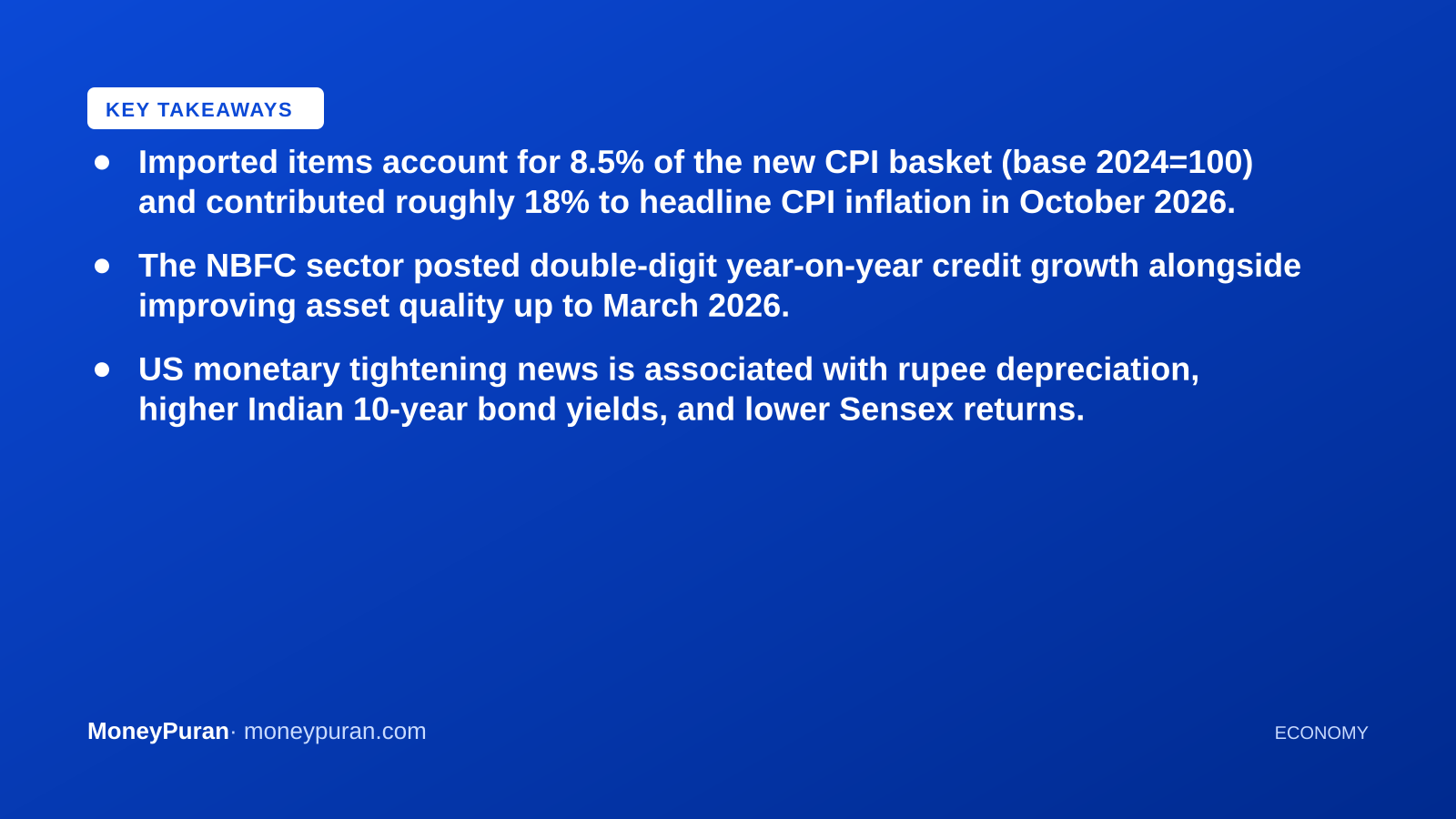
- Imported items account for 8.5% of the new CPI basket (base 2024=100) and contributed roughly 18% to headline CPI inflation in October 2026.
- The NBFC sector posted double-digit year-on-year credit growth alongside improving asset quality up to March 2026.
- US monetary tightening news is associated with rupee depreciation, higher Indian 10-year bond yields, and lower Sensex returns.
- October 2026 saw domestic equity markets rebound, supported by robust corporate earnings and foreign portfolio inflows.
The Reserve Bank of India (RBI) published its November 2026 Bulletin, detailing key insights into domestic macroeconomic performance, non-banking financial company expansion, and the transmission of global shocks to Indian financial markets. Amidst persistent international headwinds, high-frequency indicators revealed that the Indian economy maintained steady momentum through October, backed by robust credit demand and narrowing trade deficits.
While global markets grappled with elevated sovereign bond yields, geopolitical tensions, and shifting monetary policies, domestic equities rebounded. Strong corporate earnings and steady foreign portfolio inflows helped cushion the broader financial ecosystem against external volatility, according to the central bank’s flagship publication.
Shifting Drivers of Imported Inflation
An article examining imported inflation highlights how successive global crises have transformed retail price pressures in India. Using an import-intensity-weighted consumer price index, researchers found that while imported items comprise 8.5 percent of the new CPI basket (base 2024=100), they contributed approximately 18 percent to headline retail inflation in October 2026.
- Fuel and light exhibit the highest import intensity in the basket, followed by food and beverages.
- The West Asia conflict triggered a sharper crude oil price shock than the Russia-Ukraine conflict, though lower domestic pass-through contained retail pressures.
- Precious metals emerged as a key driver of imported core inflation starting in 2024.
NBFC Sector Performance and Credit Growth
A review of the non-banking financial company (NBFC) sector as of end-March 2026 showed sustained momentum. The sector recorded double-digit year-on-year credit growth accompanied by healthier asset quality metrics.
Industry and retail segments continued to command the largest shares of NBFC loan portfolios. Within retail lending, rapid expansion in advances backed by gold, alongside vehicle and microfinance loans, propelled overall growth figures.
Impact of US Monetary Policy on Indian Markets
Another study in the Bulletin analyzed how US Federal Open Market Committee announcements transmit to Indian financial assets. The findings indicate that US yield increases driven by tighter monetary news correlate with Indian rupee depreciation, rising domestic 10-year government bond yields, and lower Sensex returns.
Conversely, growth news reflecting stronger US economic prospects showed no statistically significant association with Indian financial variables. Interestingly, the India VIX volatility index maintained no significant association with either monetary or growth news.
What this means for investors
For investors monitoring domestic portfolios, the RBI Bulletin underscores the ongoing resilience of Indian economic activity despite global uncertainties. Strong credit expansion across NBFCs and solid corporate earnings continue to support domestic equity markets, even as external pressures like US monetary tightening and commodity price swings linger.
Understanding how global factors—such as US Federal Reserve policy shifts and imported inflation via fuel and precious metals—influence the rupee and local bond yields helps market participants navigate portfolio risks. Keeping an eye on high-frequency domestic credit data and trade deficits remains crucial for assessing near-term market direction.
Frequently asked questions
What is the main takeaway of the RBI November 2026 Bulletin? The Bulletin highlights strong domestic economic resilience, robust credit growth in the NBFC sector, and detailed analyses of imported inflation and US monetary policy spillovers.
How much do imported items contribute to Indian retail inflation? According to the RBI’s import-intensity-weighted CPI measure, imported items account for 8.5 percent of the CPI basket and contributed about 18 percent to headline inflation in October 2026.
This article is for information only and is not investment advice. Do your own research or consult a licensed adviser before investing.
Based on information published by Reserve Bank of India (RBI). Source: Reserve Bank of India (RBI). Spotted an error? corrections@moneypuran.com