 Money

The central bank’s study of 2.25 lakh Gram Panchayats highlights heavy reliance on government transfers and calls for property tax rationalisation.
Key points
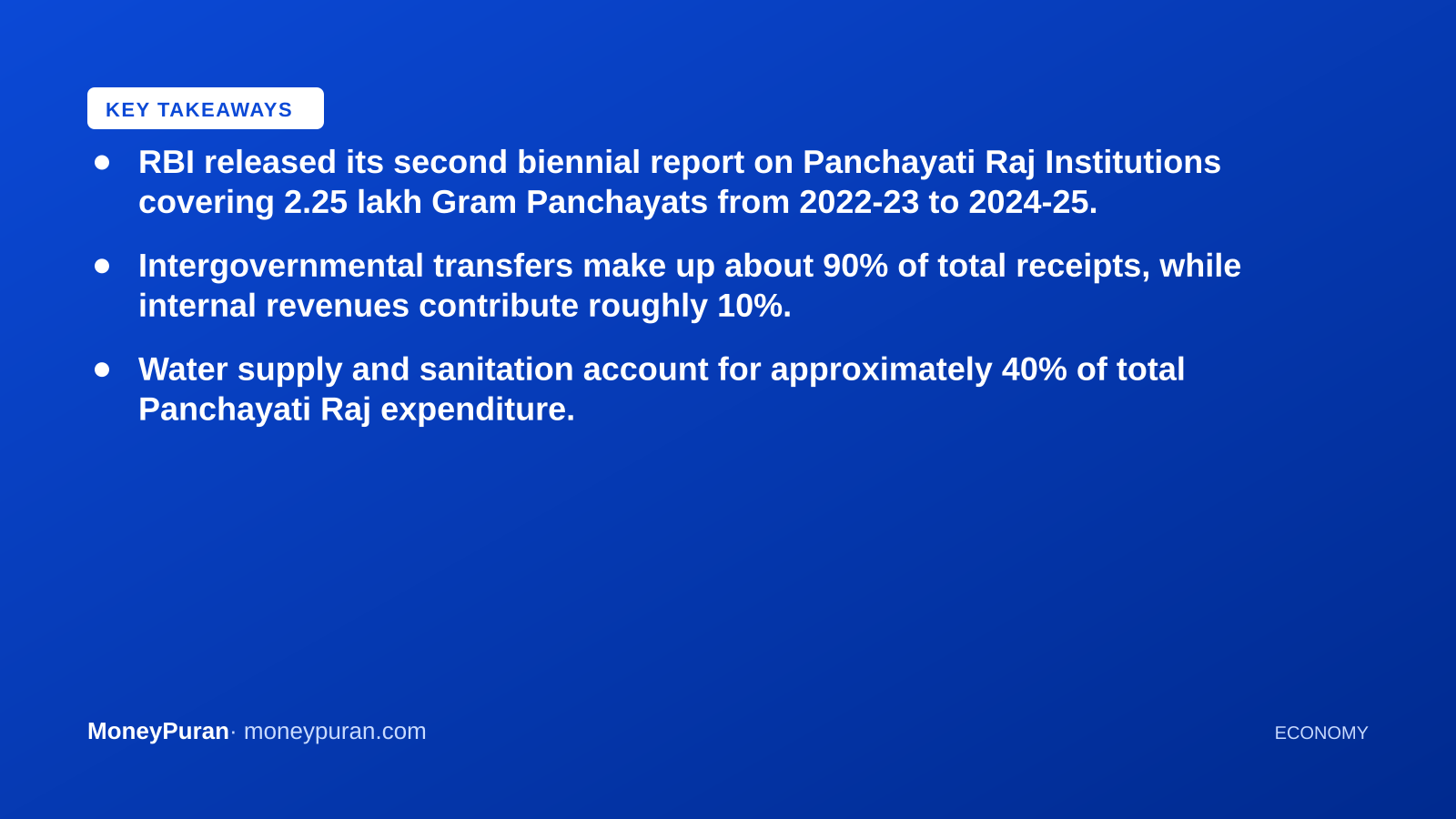
- RBI released its second biennial report on Panchayati Raj Institutions covering 2.25 lakh Gram Panchayats from 2022-23 to 2024-25.
- Intergovernmental transfers make up about 90% of total receipts, while internal revenues contribute roughly 10%.
- Water supply and sanitation account for approximately 40% of total Panchayati Raj expenditure.
- The report recommends rationalising property taxes and license fees as large panchayats transition to urban local bodies.
The Reserve Bank of India (RBI) released the second edition of its biennial report on the financial health of local rural bodies, revealing that Gram Panchayats in India remain overwhelmingly dependent on government grants for their operations. According to the central bank’s report, intergovernmental transfers from central and state governments accounted for roughly 90% of total receipts during the period from 2022-23 to 2024-25, while independent revenue generation remained constrained.
Titled Finances of Panchayati Raj Institutions with the theme “Local Finances and Capacity Building in Rural India,” the study examined a balanced panel of 2.25 lakh Gram Panchayats across the country. Prepared by the Division of Local Finances within the RBI’s Department of Economic and Policy Research, the report evaluates local governance fiscal health and highlights structural revenue challenges facing rural administration.
Key Findings on Local Revenues and Expenditure
The central bank highlighted that while financial resources available to Gram Panchayats expanded over 2022-23 and 2023-24, their internal revenue base remains thin. Own Source Revenue (OSR) contributed only about 10% of total receipts. Most of this internal revenue came from non-tax sources, including interest earnings, Panchayati Raj programme funds, and local user charges, rather than direct local taxation.
On the expenditure side, spending patterns were closely tied to mandates under the Fifteenth Finance Commission and aligned with major national development schemes. Water supply and sanitation emerged as the primary area of expenditure, eating up approximately 40% of total spending by Gram Panchayats.
- Sample Size: 2.25 lakh Gram Panchayats tracked between fiscal years 2022-23 and 2024-25.
- Grant Reliance: Intergovernmental transfers accounted for approximately 90% of overall receipts.
- Internal Revenue: Own Source Revenue (OSR) represented roughly 10% of receipts, driven primarily by non-tax channels.
- Primary Spending Driver: Water supply and sanitation consumed about 40% of total local expenditure.
Infrastructure Progress and Regional Disparities
The RBI report recognized notable advancements in basic physical and social infrastructure across rural India. Investments led by central transfers and national missions have improved rural road connectivity, household electrification, drinking water availability, sanitation facilities, and community asset creation. However, the study stressed that wide inter-state disparities persist regarding the quality, accessibility, and functional sustainability of these local infrastructure assets.
The central bank noted that while infrastructure availability has grown, the capacity of local bodies to maintain these assets relies heavily on continued fiscal support from higher tiers of government.
Transition Challenges for Expanding Local Bodies
A critical issue highlighted by the RBI is the transition of larger Gram Panchayats into small urban local bodies or Town Panchayats. As rural settlements grow in population and economic activity, their administrative and functional obligations expand rapidly. However, their fiscal capacities and administrative mechanisms often lag behind this rapid structural change.
To address this gap, the central bank recommended providing transitional fiscal support alongside targeted administrative capacity building. The RBI emphasized the need for a calibrated effort to boost internal revenues by improving tax collection efficiency, rationalising local property taxes, and updating fee structures for commercial licenses.
What this means for investors
For market participants and macro analysts, the RBI report provides vital context on public spending trends and rural economic administration. The heavy concentration of local spending on water supply and sanitation—accounting for 40% of Gram Panchayat budgets—underscores sustained public order inflows for companies in water management, pipe manufacturing, and civil sanitation infrastructure. Public spending driven by Fifteenth Finance Commission transfers ensures a steady flow of fiscal resources into rural civil works.
However, the report also underscores structural fiscal limitations in rural India. The 90% dependence on intergovernmental transfers highlights that rural development budgets remain tied to central and state budgetary allocations. If macroeconomic constraints affect higher-level government budgets, local spending capacity could experience direct knock-on effects. Investors tracking consumer goods (FMCG) and rural demand should note that local administrative bodies currently lack independent fiscal power to counter economic downturns without higher-level support.
Over the medium term, efforts to rationalise property taxes and strengthen municipal revenues could alter local land administration and small business licensing costs. A successful transition toward stronger municipal revenue collection would build more resilient local infrastructure and support long-term rural economic stabilization.
Frequently asked questions
What is the main finding of the RBI report on Panchayati Raj finances?
The primary finding is that Gram Panchayats rely on central and state government grants for about 90% of their total receipts, while their own internal revenues account for only around 10%.
Where do Gram Panchayats spend most of their funds?
Water supply and sanitation account for the largest share of Gram Panchayat spending, consuming approximately 40% of total local expenditure, guided by national developmental schemes and Finance Commission mandates.
This article is for information only and is not investment advice. Do your own research or consult a licensed adviser before investing.
Based on information published by Reserve Bank of India (RBI). Source: Reserve Bank of India (RBI). Spotted an error? corrections@moneypuran.com