 Money
Money

The Reserve Bank of India has introduced a streamlined one-time approval framework for institutional investors acquiring major stakes in local area banks.
Key points
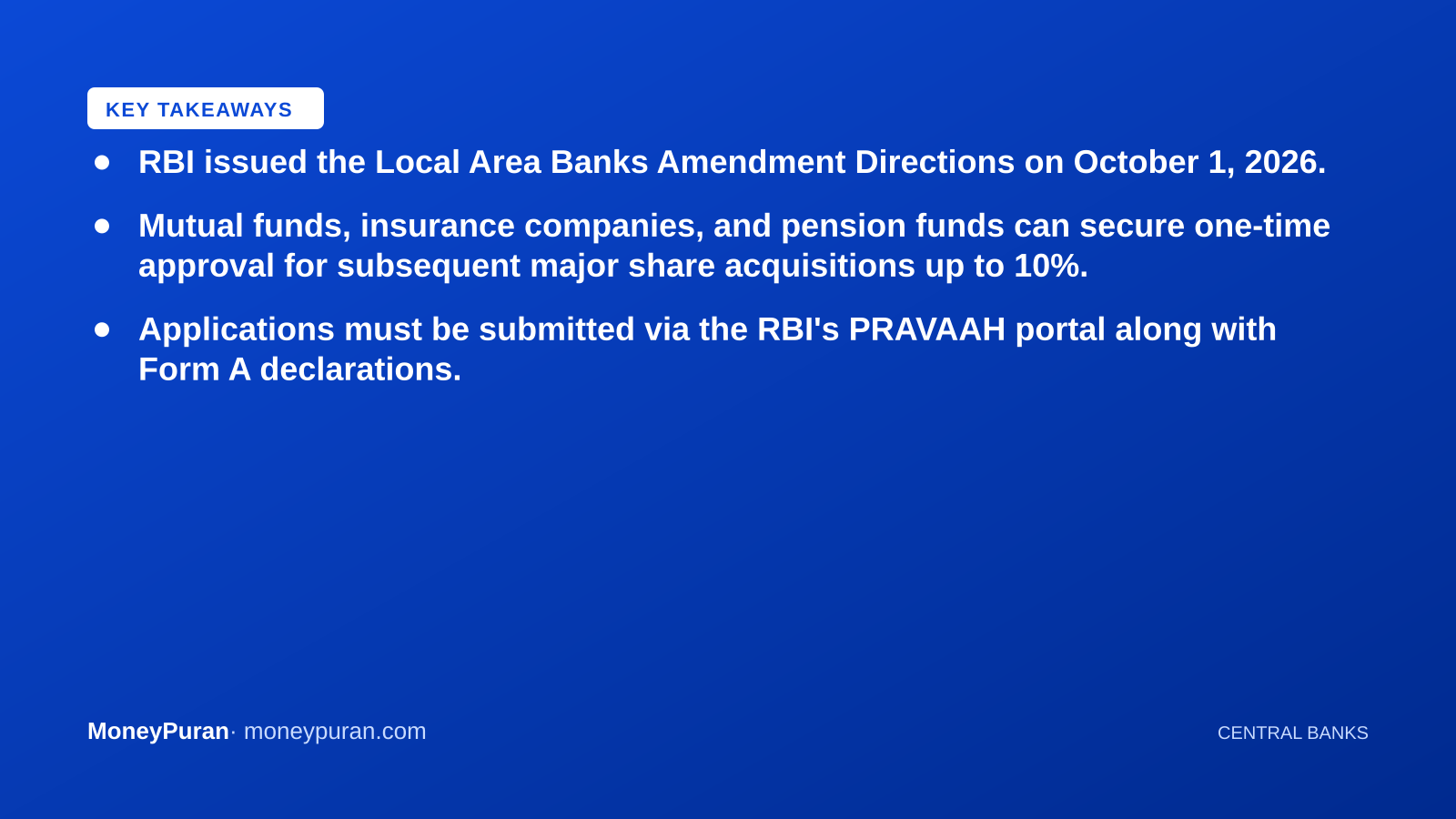
- RBI issued the Local Area Banks Amendment Directions on October 1, 2026.
- Mutual funds, insurance companies, and pension funds can secure one-time approval for subsequent major share acquisitions up to 10%.
- Applications must be submitted via the RBI’s PRAVAAH portal along with Form A declarations.
- Investors must report any cross-over of the 5 percent holding threshold within three working days.
The Reserve Bank of India (RBI) has streamlined the regulatory approval process for institutional investors looking to build stakes in banking companies. Under the newly released Reserve Bank of India (Local Area Banks – Acquisition and Holding of Shares or Voting Rights) Amendment Directions, 2026, institutional investors such as mutual funds, insurance companies, and pension funds can now secure a streamlined, one-time clearance for subsequent share purchases.
Previously, any investor whose aggregate shareholding dipped below five percent after an initial acquisition of major shareholding was required to seek fresh prior approval from the central bank before buying back in. The latest directive changes this requirement for non-promoter institutional entities. While an initial prior approval remains strictly mandatory, qualifying institutions can apply through the RBI’s PRAVAAH portal for a single clearance covering subsequent acquisitions of major shareholding up to 10 percent of the paid-up share capital or voting rights.
Details of the 2026 Amendment Directions
Issued by Chief General Manager Scenta Joy under Sections 12, 12B, and 35A of the Banking Regulation Act, 1949, the updated rules establish clear definitions for qualifying market participants. Entities registered with SEBI as mutual funds, PFRDA-regulated pension funds, or IRDAI-registered insurance companies that do not belong to the promoter group are now eligible for the simplified framework.
The guidelines also clarify indirect acquisitions made via portfolio managers. Client purchases will not count as indirect holdings by a portfolio manager if the client remains the registered voting owner, the portfolio manager acts purely as a non-binding advisor, and any votes cast rely strictly on a specific client mandate.
- One-time approval covers subsequent major shareholding up to 10 percent.
- Applications must include Form A declarations and bank comments via Form A1.
- Holders must report any movement above or below the 5 percent threshold within three working days.
- The central bank retains the authority to revoke approvals for non-compliance or fit-and-proper issues.
What this means for investors
For institutional investors operating in the Indian financial ecosystem, this regulatory update removes a layer of administrative friction. Large institutional pools of capital frequently rebalance portfolios, and crossing the 5 percent threshold previously triggered recurring bureaucratic hurdles that slowed down execution.
By introducing a blanket one-time approval path up to the 10 percent cap, the RBI allows institutional asset managers to manage their banking sector exposures with greater flexibility. However, compliance oversight remains tight; investors must maintain strict adherence to fit-and-proper criteria and disclose shifts around the 5 percent marker within a tight three-day window to avoid revocation.
Frequently asked questions
Who qualifies for the new one-time approval framework? SEBI-registered mutual funds, IRDAI-registered insurance companies, and PFRDA-registered pension funds that are independent of the bank’s promoter group are eligible.
What is the maximum limit covered under the one-time approval? The clearance permits subsequent acquisitions of major shareholding up to 10 percent of the paid-up share capital or voting rights on an aggregate basis.
Where should institutional investors submit their applications? Applications must be routed through the central bank’s PRAVAAH portal accompanied by the necessary Form A documentation.
This article is for information only and is not investment advice. Do your own research or consult a licensed adviser before investing.
Based on information published by Reserve Bank of India (RBI) — notifications. Source: Reserve Bank of India (RBI) — notifications. Spotted an error? corrections@moneypuran.com