 Money


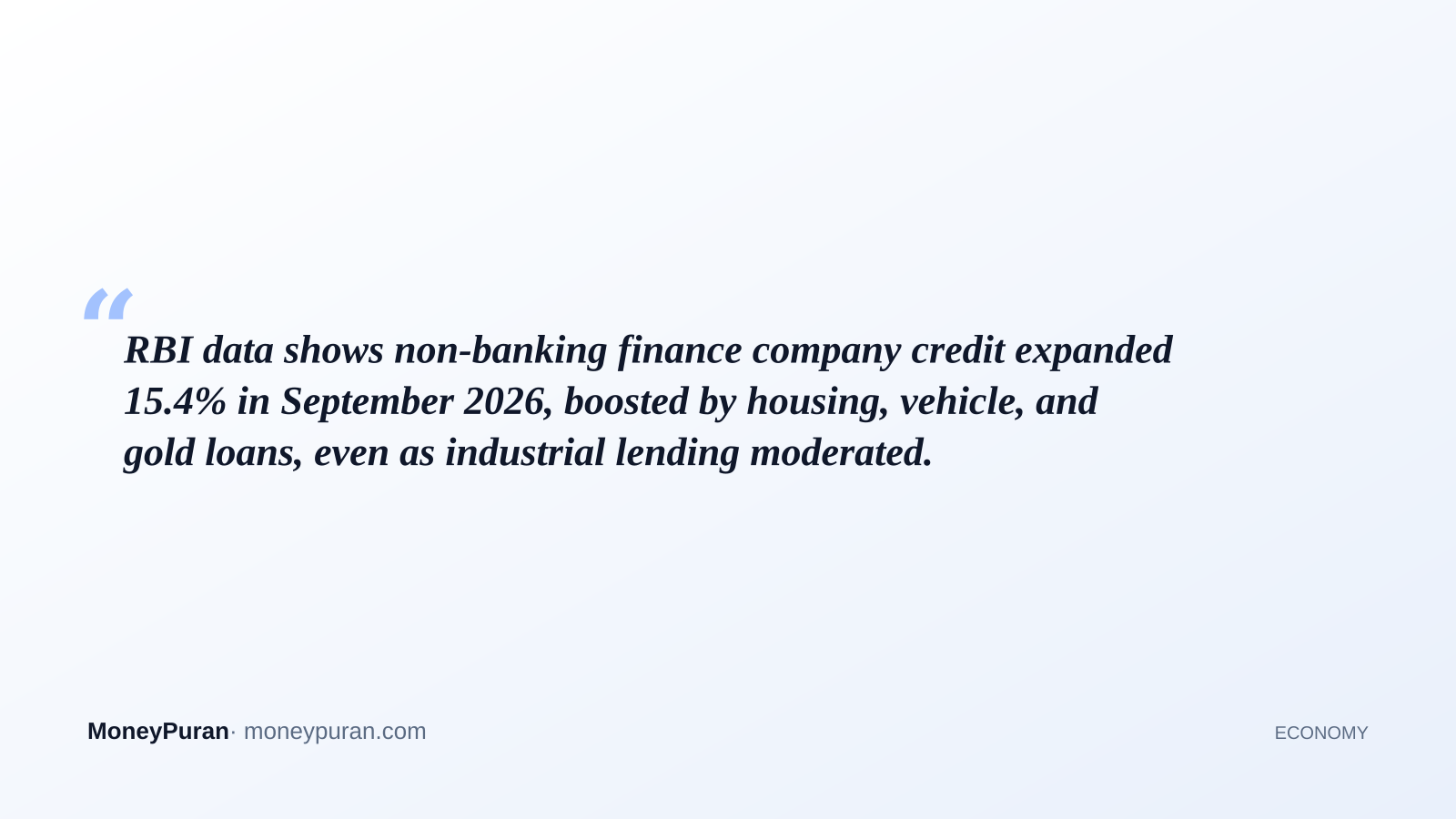
RBI data shows non-banking finance company credit expanded 15.4% in September 2026, boosted by housing, vehicle, and gold loans, even as industrial lending moderated.
Key points
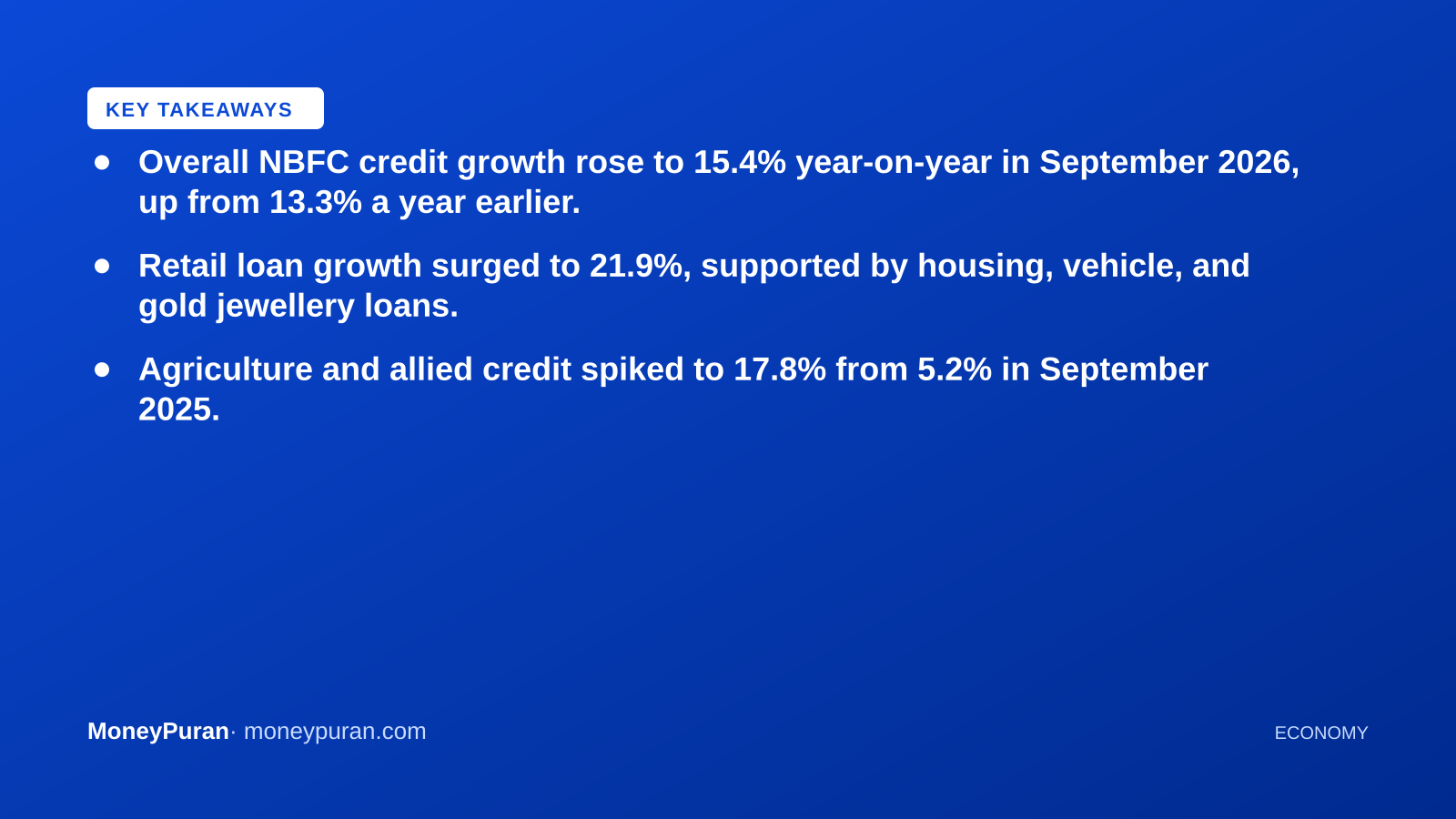
- Overall NBFC credit growth rose to 15.4% year-on-year in September 2026, up from 13.3% a year earlier.
- Retail loan growth surged to 21.9%, supported by housing, vehicle, and gold jewellery loans.
- Agriculture and allied credit spiked to 17.8% from 5.2% in September 2025.
- Industrial credit growth slowed to 7.4%, with infrastructure lending remaining subdued.
Credit growth among non-banking financial companies (NBFCs) and housing finance companies (HFCs) accelerated to 15.4 per cent year-on-year in September 2026, up from 13.3 per cent recorded in the same period last year, according to data released by the Reserve Bank of India (RBI). The expansion was primarily fueled by strong demand in retail lending and a sharp rebound in agricultural credit.
The RBI data on sectoral deployment of credit shows a distinct divergence across economic sectors, with consumer-facing and rural segments showing robust activity while corporate and industrial borrowing slowed down. The monthly bulletin is based on data collected from upper-layer and middle-layer NBFCs as well as HFCs, accounting for approximately 87 per cent of total credit in the sector.
Retail Lending and Farm Loans Lead the Expansion
Retail loans recorded the sharpest acceleration among major categories, expanding by 21.9 per cent year-on-year in September 2026, compared to 16.8 per cent in the corresponding period of 2025. Within retail portfolios, non-bank lenders saw heightened demand across key secured segments, notably housing loans, vehicle finance, and loans against gold jewellery.
Agriculture and allied activities witnessed a dramatic pickup in credit uptake. NBFC lending to the farming sector surged by 17.8 per cent year-on-year in September 2026, stepping up significantly from a modest 5.2 per cent growth reported in September 2025. Stronger monsoon coverage and enhanced rural liquidity contributed to higher credit demand among agricultural borrowers.
Industrial Credit Moderates as Infrastructure Lags
In contrast to the retail momentum, industrial lending by NBFCs registered a slowdown. Credit to the industry sector grew by 7.4 per cent year-on-year in September 2026, down from 10.2 per cent a year earlier. The RBI highlighted that within the industrial segment, borrowing by the infrastructure sector remained subdued, reflecting cautious capital expenditure by large corporate entities.
The services sector also experienced a moderation in overall loan growth, which came in at 17.3 per cent year-on-year compared to 23.0 per cent in September 2025. Despite the top-line deceleration in services, sub-segments such as commercial real estate maintained buoyant expansion, while trade and transport operators also recorded strong credit growth during the month.
Key Sectoral Growth Breakdown
- Overall NBFC Credit: 15.4 per cent y-o-y (vs 13.3 per cent in Sep 2025)
- Retail Loans: 21.9 per cent y-o-y (vs 16.8 per cent in Sep 2025)
- Agriculture & Allied: 17.8 per cent y-o-y (vs 5.2 per cent in Sep 2025)
- Services Sector: 17.3 per cent y-o-y (vs 23.0 per cent in Sep 2025)
- Industry Sector: 7.4 per cent y-o-y (vs 10.2 per cent in Sep 2025)
What this means for investors
The robust acceleration in NBFC credit growth highlights the continued strength of consumer demand in India’s economy, particularly across housing, automobile, and gold-backed loans. For equity investors tracking listed NBFCs and housing finance firms, sustained retail loan growth suggests steady top-line expansion and solid net interest income potential for consumer-focused lenders.
However, the divergence between retail and industrial credit highlights areas for caution. Subdued lending to infrastructure and industry points to slower private capital expenditure, which could cap growth for wholesale-heavy lenders. Investors should monitor asset quality trends in retail portfolios, as rapid growth in consumer loans often requires heightened scrutiny on non-performing assets over subsequent quarters.
Frequently asked questions
What was the overall NBFC credit growth rate in September 2026? Total credit extended by NBFCs and HFCs grew by 15.4 per cent year-on-year in September 2026, up from 13.3 per cent in September 2025.
Which sectors drove NBFC credit growth higher? Growth was primarily driven by retail loans, which expanded 21.9 per cent, and agricultural lending, which grew 17.8 per cent year-on-year.
How much of the NBFC market does this RBI data cover? The RBI data is drawn from a sample of upper and middle-layer NBFCs and HFCs that account for roughly 87 per cent of total sector credit.
This article is for information only and is not investment advice. Do your own research or consult a licensed adviser before investing.
Based on information published by Reserve Bank of India (RBI). Source: Reserve Bank of India (RBI). Spotted an error? corrections@moneypuran.com