 Money

Reserve Bank of India data shows non-food credit growth surged to 19.1 per cent in September 2026, led by strong borrowing in services and industry.
Key points
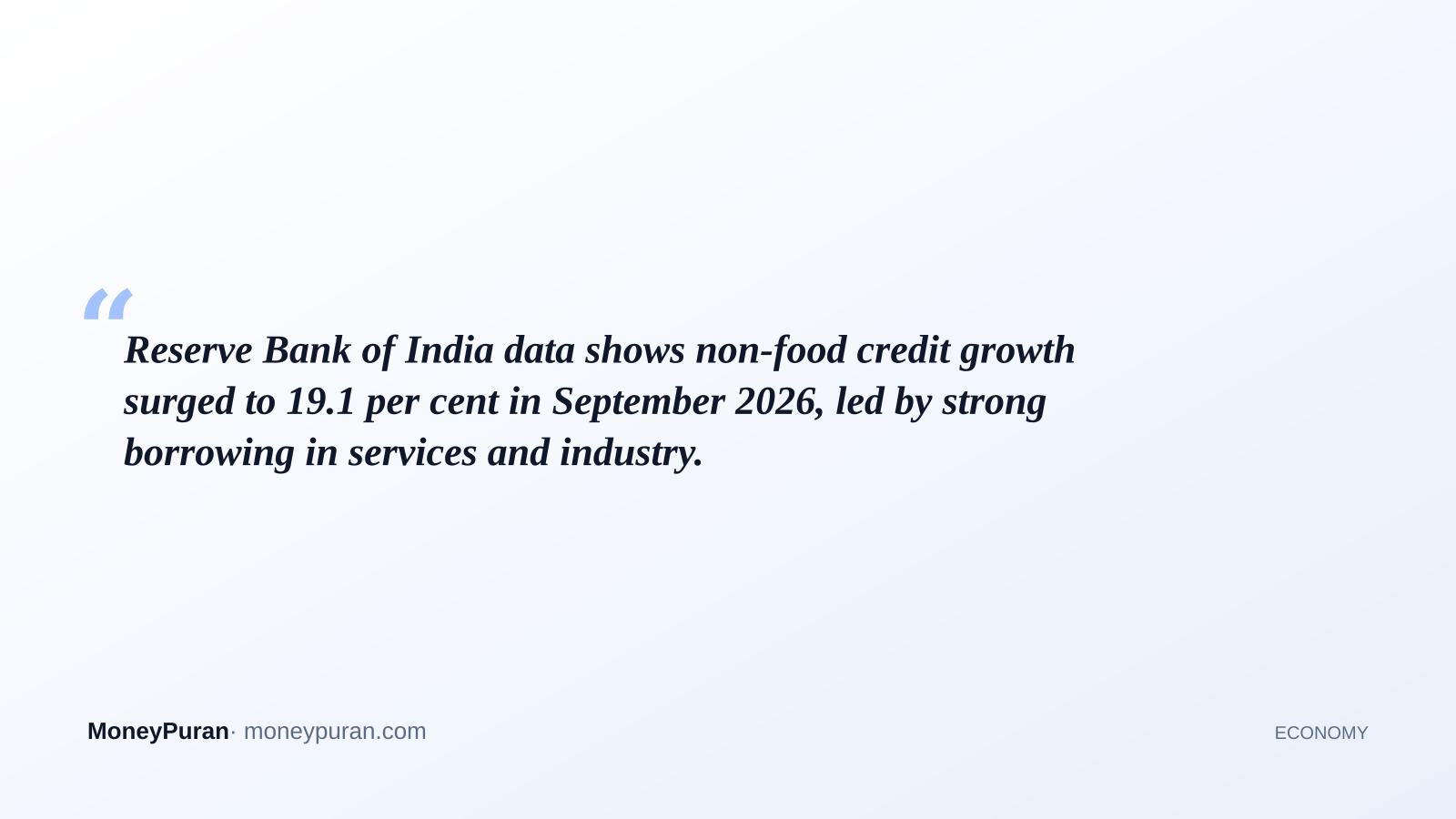
- Non-food bank credit grew 19.1% year-on-year as of September 30, 2026, up from 11.2% in the previous year.
- Services sector credit recorded the highest growth at 28.3%, supported by NBFCs and commercial real estate.
- Industrial credit expanded 19.5%, driven by accelerated lending to large and medium enterprises.
- Personal loans grew by 17.3%, with resilient housing and vehicle lending balance sheets.
India’s non-food bank credit growth accelerated to 19.1 per cent year-on-year for the fortnight ended September 30, 2026, up significantly from 11.2 per cent in the corresponding period of the previous year, according to sectoral deployment data released by the Reserve Bank of India (RBI). The expansion was anchored by substantial gains across the services sector, a revival in industrial borrowing, and steady demand in personal loans and agricultural advances.
The latest figures, derived from 41 select scheduled commercial banks accounting for roughly 95 per cent of total non-food credit extended by all commercial banks, reflect broad-based momentum in commercial and retail credit across the Indian economy.
Services and industrial credit drive expansion
The services sector recorded the strongest expansion among primary categories, with credit growth jumping to 28.3 per cent year-on-year in September 2026, compared with 9.9 per cent in the same fortnight of 2025. This uptick was propelled by robust demand from non-banking financial companies (NBFCs), trade, commercial real estate, transport operators, and professional services.
Industrial credit also demonstrated remarkable acceleration, expanding 19.5 per cent year-on-year compared to 7.7 per cent in the prior-year period. RBI data showed that while credit to large and medium industrial enterprises grew at an accelerated pace, micro and small industries maintained steady credit uptake. Key industrial segments recording strong growth included infrastructure, basic metals and metal products, engineering, chemicals and chemical products, food processing, and textiles.
Agriculture and retail lending trends
Credit extended to agriculture and allied activities expanded by 19.5 per cent year-on-year as of end-September 2026, up from 8.9 per cent a year earlier, reflecting enhanced credit flow to the rural economy.
The personal loans segment registered a growth of 17.3 per cent year-on-year, rising from 11.5 per cent reported in the corresponding fortnight of the previous year. Within retail lending, housing and vehicle loans demonstrated resilience, while advances against fixed deposits experienced accelerated growth. Conversely, credit growth in loans against gold jewellery and education loans decelerated relative to last year’s performance, though underlying growth rates remained healthy.
Key sectoral growth metrics at a glance
- Non-Food Bank Credit: Expanded 19.1% y-o-y (vs 11.2% in October 2025)
- Services Sector Credit: Rose 28.3% y-o-y (vs 9.9% in October 2025)
- Industrial Credit: Grew 19.5% y-o-y (vs 7.7% in October 2025)
- Agriculture Credit: Increased 19.5% y-o-y (vs 8.9% in October 2025)
- Personal Loans: Climbed 17.3% y-o-y (vs 11.5% in October 2025)
What this means for investors
The sharp acceleration in bank credit growth underscores robust demand for institutional capital across both corporate and consumer sectors in India. For equity investors following Indian banking and financial stocks listed on the NSE and BSE, double-digit growth across industrial and services segments highlights expanding balance sheets and sustained earnings capacity for commercial lenders.
A notable surge in credit to NBFCs, commercial real estate, and infrastructure indicates that broad economic activity and capital expenditure cycles are drawing liquidity into core developmental sectors. Increased credit flow to industry suggests private capital deployment is picking up momentum alongside retail consumption.
However, market participants will closely watch asset quality metrics and systemic liquidity as credit expansion outpaces historical averages. Rapid credit growth often prompts institutional investors to track net interest margins (NIMs) and deposit growth rates to assess whether commercial banks can comfortably sustain credit delivery without squeezing funding costs.
Frequently asked questions
What is the RBI sectoral deployment of bank credit report? It is a monthly report published by the Reserve Bank of India detailing how commercial bank credit is distributed across sectors like agriculture, industry, services, and personal loans.
Why is non-food bank credit growth an important economic indicator? Non-food bank credit measures lending to productive sectors of the economy, serving as a key barometer for economic expansion, corporate borrowing demand, and consumer sentiment.
Which sectors led credit growth in September 2026? The services sector led overall expansion with a 28.3 per cent year-on-year increase, followed by industry and agriculture, which both expanded by 19.5 per cent.
This article is for information only and is not investment advice. Do your own research or consult a licensed adviser before investing.
Based on information published by Reserve Bank of India (RBI). Source: Reserve Bank of India (RBI). Spotted an error? corrections@moneypuran.com