 Money

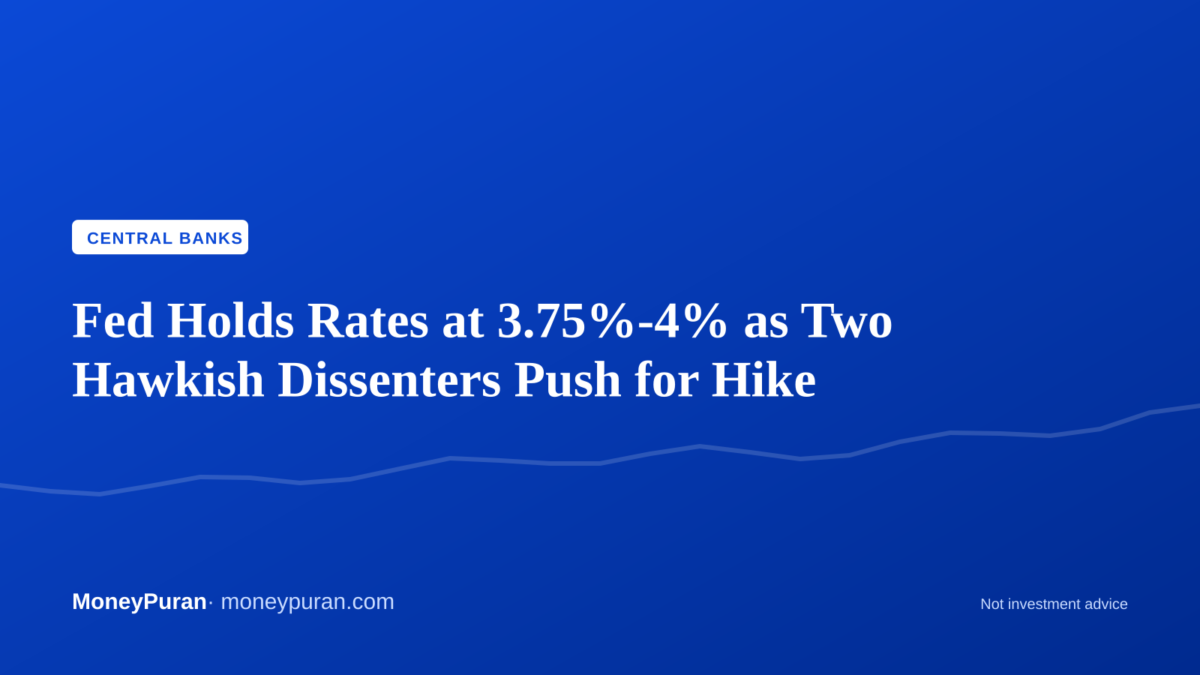
The FOMC leaves benchmark rates at 3.75%-4.00% in a 10-2 vote, with two governors pushing for a quarter-point rate hike amid persistent inflation.
Key points
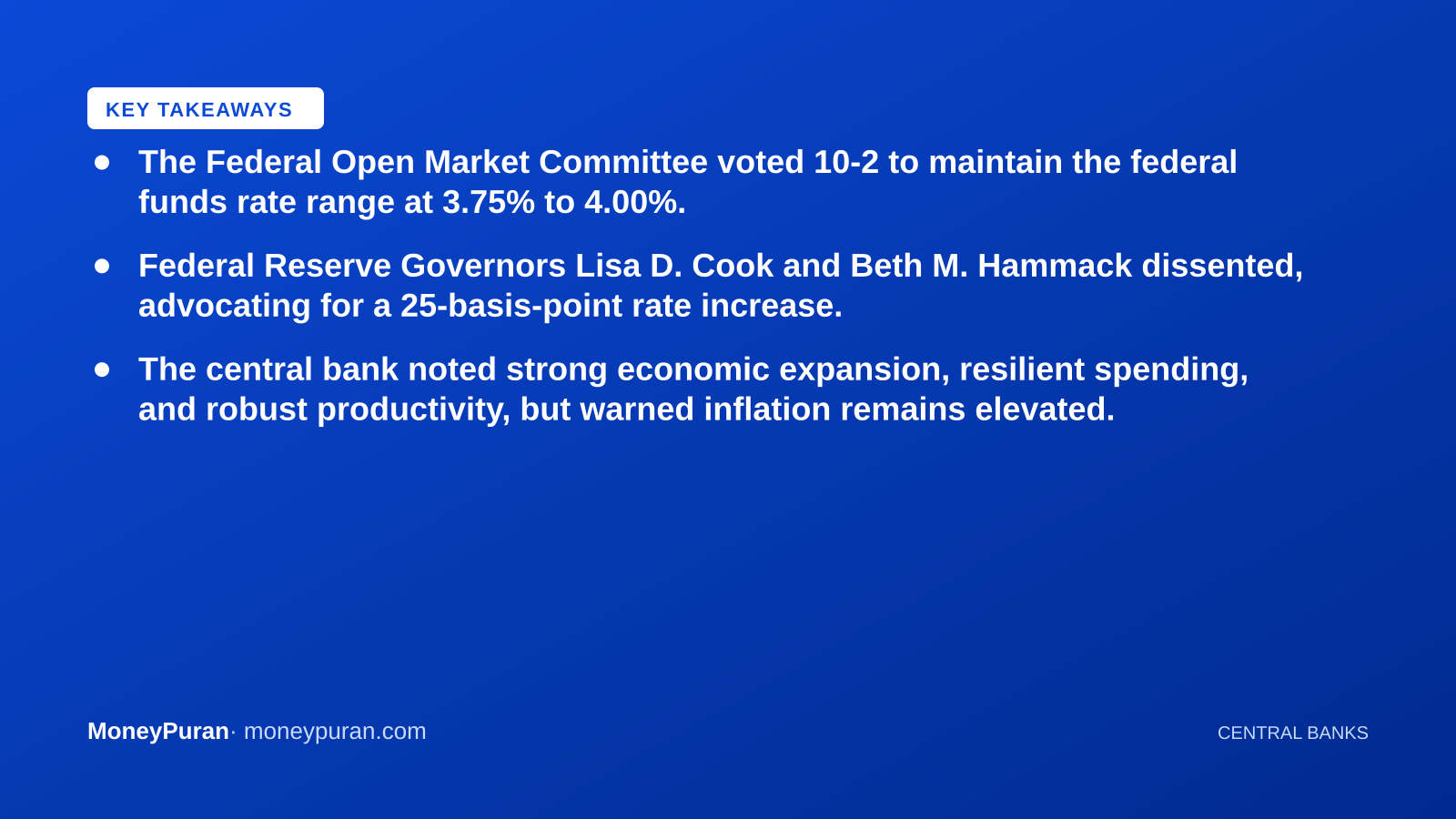
- The Federal Open Market Committee voted 10-2 to maintain the federal funds rate range at 3.75% to 4.00%.
- Federal Reserve Governors Lisa D. Cook and Beth M. Hammack dissented, advocating for a 25-basis-point rate increase.
- The central bank noted strong economic expansion, resilient spending, and robust productivity, but warned inflation remains elevated.
- A sustained high-rate environment in the US keeps yields elevated, impacting global capital flows and Foreign Institutional Investor allocation to emerging markets like India.
The Federal Reserve decided to keep its benchmark interest rate unchanged in a target range of 3.75% to 4.00% following its October monetary policy meeting. While the Federal Open Market Committee (FOMC) approved the decision by a 10-2 majority, two policy makers dissented in favor of an immediate rate hike. Investors tracking the Fed rate monitor noted that persistent inflation concerns continue to prevent central bank officials from embarking on a more aggressive monetary easing cycle despite strong macroeconomic conditions.
Robust economic growth alongside elevated inflation
In its official policy statement, the central bank highlighted that economic activity in the United States continues to expand at a strong pace. Domestic consumer and business spending have demonstrated remarkable resilience despite elevated geopolitical uncertainties worldwide. Additionally, the Fed pointed to robust capital investment and strong productivity growth as key factors supporting ongoing momentum across the economy.
Labor market indicators also reflected stability, with job gains keeping pace with workforce expansion and the unemployment rate showing minimal movement. However, inflation remains stubbornly above the Fed’s 2% long-term target. Central bank officials stated that gathering additional economic data will remain crucial in determining the future stance of monetary policy necessary to ensure a timely return to price stability.
Hawkish dissent highlights internal debate
The decision to hold rates was not unanimous. Federal Reserve Governors Lisa D. Cook and Beth M. Hammack voted against the pause, advocating instead for a 25-basis-point rate hike that would have raised the federal funds target range to 4.00%-4.25%. Their dissent underscores growing concern among some committee members that sustained economic strength could prolong elevated inflation pressures if borrowing costs are not raised further.
Alongside its decision on the target rate range, the FOMC confirmed that it is maintaining its policy of keeping ample reserves within the commercial banking system to support financial market liquidity and effective policy implementation.
Key monetary policy decisions at a glance
- Target Rate Range: Maintained at 3.75% to 4.00%.
- FOMC Vote Result: Approved 10-2, with two members favoring a rate increase.
- Dissenting Voters: Lisa D. Cook and Beth M. Hammack preferred a 25 bps hike.
- Economic Growth Assessment: Strong economic expansion, resilient domestic spending, and robust capital investment.
- Inflation Outlook: Inflation remains elevated, requiring further data accumulation to guide policy stance.
What this means for investors
For US markets, a Fed pause accompanied by hawkish dissent signals that borrowing costs will likely remain higher for longer. Fixed-income investors face a market where short-term Treasury yields remain underpinned by the threat of potential rate hikes if inflation fails to cool. Equity markets, particularly rate-sensitive technology and growth stocks, may experience valuation pressure as elevated real yields raise discounting factors for future corporate cash flows.
For Indian investors, the Fed’s decision to maintain elevated US interest rates carries important cross-border implications. A higher yield environment in the US keeps the US dollar firm, maintaining pressure on emerging market currencies including the Indian rupee. This dynamic can constrain Foreign Institutional Investor (FII) equity inflows into Indian exchanges like the BSE and NSE, as overseas capital finds attractive risk-adjusted yields in US debt instruments.
Furthermore, persistent high interest rates in the US limit the flexibility of the Reserve Bank of India (RBI) to ease domestic interest rates without risking currency depreciation or capital outflows. Investors in Indian equities should monitor high-beta sectors such as financial services, IT exporters, and auto stocks, which often face heightened volatility during periods of foreign portfolio rebalancing.
Frequently asked questions
Why did the Fed decide to hold interest rates unchanged? The FOMC maintained rates at 3.75%-4.00% because while economic growth and employment remain solid, inflation is still above the central bank’s 2% target, prompting officials to evaluate more incoming data before adjusting monetary policy further.
Why did two FOMC members vote for a rate hike? Governors Lisa D. Cook and Beth M. Hammack dissented because they favored raising the benchmark rate by 25 basis points to combat lingering inflation risks stoked by strong domestic spending and robust economic expansion.
How does this Fed decision impact Indian stock markets? Higher US benchmark rates tend to strengthen the US dollar and keep US Treasury yields attractive, which can slow down FII investment into Indian equities and reduce the RBI’s headroom to cut domestic interest rates.
This article is for information only and is not investment advice. Do your own research or consult a licensed adviser before investing.
Based on information published by U.S. Federal Reserve Board. Source: U.S. Federal Reserve Board. Spotted an error? corrections@moneypuran.com