 Money


The Reserve Bank of India has updated framework guidelines for domestic money transfers, capping cash pay-outs at ₹10,000 and mandating Additional Factor of Authentication for remitters.
Key points
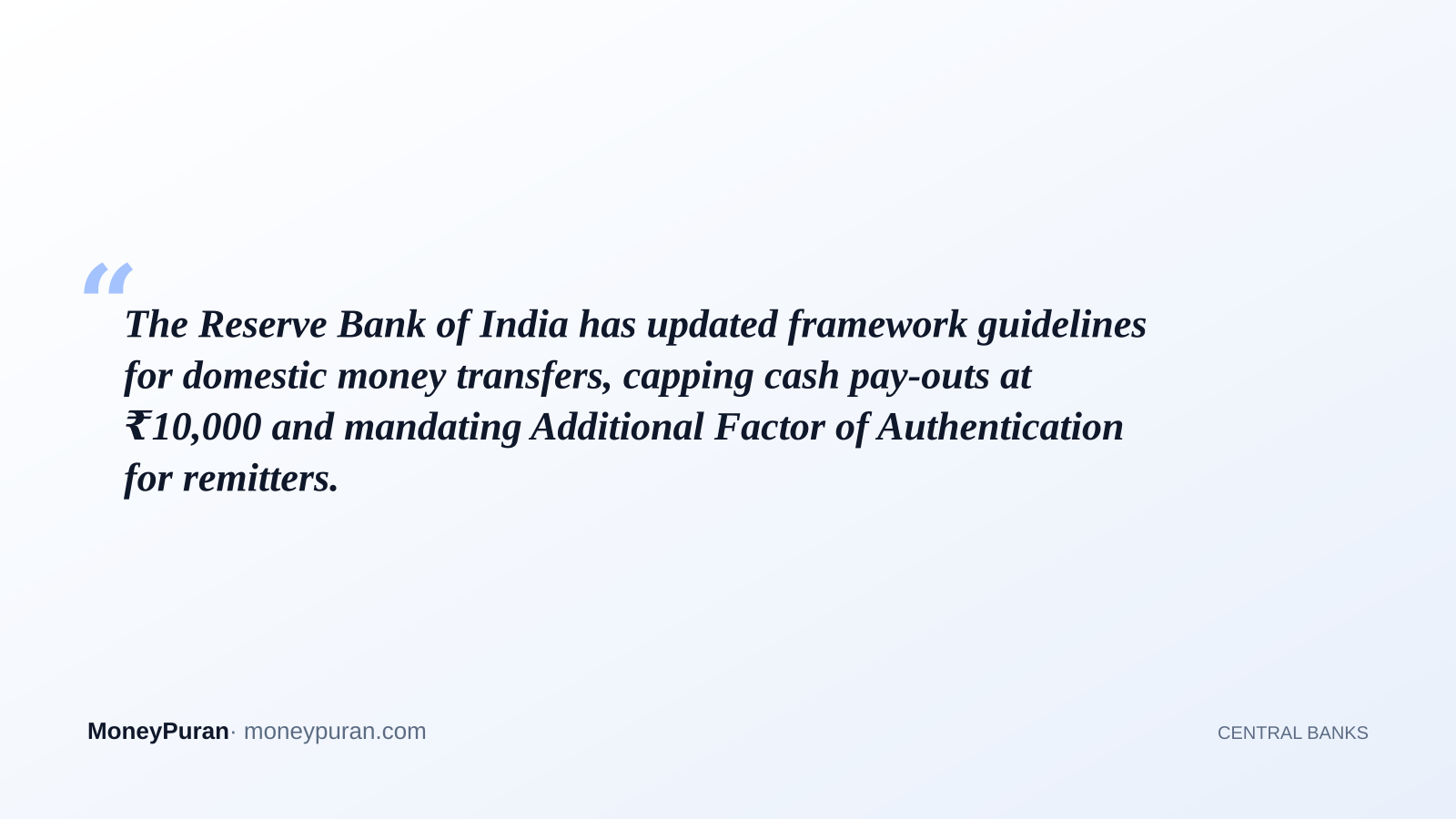
- Cash pay-out transactions capped at ₹10,000 per transaction, with a monthly ceiling of ₹25,000 per beneficiary.
- Walk-in cash pay-in via bank branches permitted up to ₹50,000 through NEFT.
- Cash pay-in through Business Correspondents and ATMs capped at ₹5,000 per transaction and ₹25,000 monthly per remitter.
- Remitters must register using a verified mobile number and a self-certified Officially Valid Document (OVD).
- Every transaction requires Additional Factor of Authentication (AFA) and cash remittance identifiers in IMPS/NEFT messages.
The Reserve Bank of India (RBI) has released consolidated operational guidelines under the Reserve Bank of India (Domestic Money Transfer) Directions, 2026. Issued under Section 18 read with Section 10(2) of the Payment and Settlement Systems Act, 2007, the consolidated rules establish uniform transaction limits, customer authentication standards, and operational safeguards for domestic money transfer (DMT) services across the banking system.
The updated instructions apply immediately to all scheduled commercial banks, regional rural banks, urban co-operative banks, state co-operative banks, district central co-operative banks, and authorised payment system operators. The framework covers both cash pay-in and cash pay-out facilities designed to assist individuals, including migrant workers, who use formal channels for small-value transfers without standard bank accounts. Card-to-card transfers remain excluded from these directions and continue under their specific regulatory guidelines.
Consolidated framework for domestic remittances
The Reserve Bank of India stated that the consolidated directions replace earlier circulars issued on October 5, 2011, and July 24, 2024. The framework aims to maintain accessibility for small-value transfers while tightening compliance, anti-money laundering monitoring, and identity verification.
Under the updated framework, money transfer services are divided into cash pay-out services (where funds are remitted from a bank account for delivery in cash to a non-account holder) and cash pay-in services (where cash is deposited for credit to a beneficiary bank account).
Key transaction limits and remittance caps
The RBI has specified transaction caps for both cash pay-out and pay-in remittance structures to manage operational risk and monitor cash flows through formal financial channels.
- Cash Pay-out limit: Maximum ₹10,000 per transaction, subject to a monthly ceiling of ₹25,000 per beneficiary.
- Branch Cash Pay-in (NEFT): Walk-in customers can deposit and transfer up to ₹50,000 to a beneficiary account at a bank branch.
- Agent/ATM Cash Pay-in: Remittances through Business Correspondents (BCs) and ATMs are capped at ₹5,000 per transaction, with an overall monthly limit of ₹25,000 per remitter.
- Inter-bank Settlement: All inter-bank transactions under the DMT framework must be settled exclusively through RBI-approved payment systems.
- Customer Grievance Redressal: Grievances arising from DMT services fall under the purview of the Reserve Bank – Integrated Ombudsman Scheme, 2026.
KYC, authentication, and operational safeguards
To enhance transaction integrity, remitting institutions and Business Correspondents must register remitters using a verified mobile number and a self-certified Officially Valid Document (OVD), in alignment with the RBI Know Your Customer Directions, 2025. In addition, every remittance transaction undertaken by a customer must be validated through an Additional Factor of Authentication (AFA).
Remitting banks must embed remitter details and a specific flag identifying the transaction as a cash-based remittance into the IMPS or NEFT transaction message. Institutions are required to enforce velocity checks, set up automated alerts for credit spurts, investigate suspicious account activity immediately, and comply with all applicable provisions of the Income-Tax Act, 2025 regarding cash transactions.
What this means for investors
For investors following Indian public sector and private commercial banks, non-banking financial companies (NBFCs), and payment service providers, the consolidated DMT guidelines offer operational clarity and enhanced fraud prevention. By standardising remittance ceilings and mandating Additional Factor of Authentication (AFA) alongside transaction message flags, the RBI reduces compliance ambiguity and risk exposure for retail banking networks.
Payment system operators and banking networks utilizing Business Correspondents may see stabilized transaction patterns as standardized monthly ceilings eliminate regulatory arbitrage across platforms. The emphasis on verified OVD collection and real-time alerts strengthens the asset quality and compliance profile of digital financial infrastructure, protecting institutions against illicit cash flows while preserving basic financial inclusion avenues.
Frequently asked questions
What is the maximum amount allowed for a cash pay-out transaction?
Under the RBI DMT Directions 2026, cash pay-out transfers from a bank account to a recipient without an account are capped at ₹10,000 per transaction, with a monthly ceiling of ₹25,000 per beneficiary.
Are card-to-card money transfers covered under these new directions?
No. The RBI explicitly excludes card-to-card transfers from these directions, stating they remain governed by their respective product approvals and guidelines.
How are customer complaints regarding domestic money transfers handled?
Customer grievances related to domestic money transfer services are covered under the Reserve Bank – Integrated Ombudsman Scheme, 2026.
This article is for information only and is not investment advice. Do your own research or consult a licensed adviser before investing.
Based on information published by Reserve Bank of India (RBI) — notifications. Source: Reserve Bank of India (RBI) — notifications. Spotted an error? corrections@moneypuran.com