 Money

The US central bank expects to recover 101.5% of operating expenses while streamlining check processing services amid declining volumes.
Key points
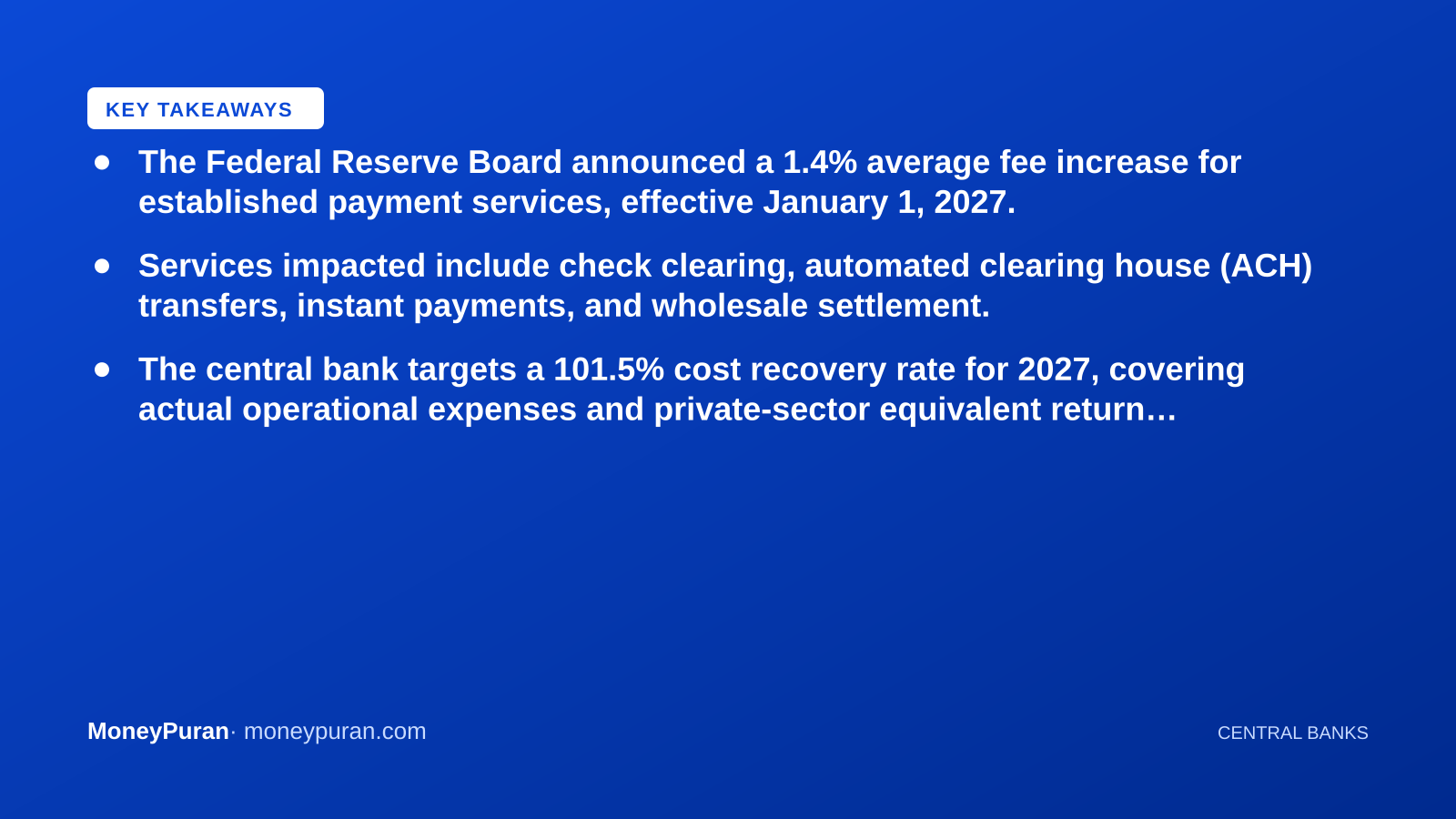
- The Federal Reserve Board announced a 1.4% average fee increase for established payment services, effective January 1, 2027.
- Services impacted include check clearing, automated clearing house (ACH) transfers, instant payments, and wholesale settlement.
- The central bank targets a 101.5% cost recovery rate for 2027, covering actual operational expenses and private-sector equivalent return on equity.
- Check processing workflows will be streamlined with optimized processing windows and higher processing fees for financial institutions.
The Federal Reserve Board has announced a updated fee schedule for the payment services that Federal Reserve Banks provide to commercial banks and credit unions, setting an average price increase of 1.4% for established services beginning January 1, 2027. The revisions cover critical interbank infrastructure, including automated clearing house (ACH) transactions, check clearing, instant payments, and wholesale settlement operations.
Details of the 2027 Pricing Structure
Under US statutory requirements, the Federal Reserve is mandated to set fees for its payment services to recover costs over the long term. These calculations must account for direct operating expenses as well as imputed costs, such as taxes and the return on equity that a private-sector enterprise would earn by offering similar services.
For 2027, the central bank expects to achieve a cost recovery rate of 101.5% across its payment operations. While monetary policy decisions monitored on the Fed rate monitor capture public focus, these backend service fees govern the operational plumbing of the American banking system.
Operational Adjustments to Check Processing
Alongside the pricing announcement, the Federal Reserve outlined changes designed to streamline check processing operations across Federal Reserve Banks. Although total check volumes continue to decline as digital alternatives gain market share, paper checks remain a necessary payment method for numerous commercial and retail customers.
To maintain efficiency, the Fed is making operational updates that include optimizing processing windows during low-volume hours and raising fees charged to financial institutions for handling checks. The Board emphasized that these operational shifts apply strictly to how banks and credit unions interface with Reserve Banks, without directly altering the ability of businesses or consumers to write and receive checks.
Key Figures in the Federal Reserve Fee Announcement
- Effective Date: January 1, 2027.
- Average Price Adjustment: 1.4% increase across established payment services.
- Target Cost Recovery: 101.5% of actual and imputed expenses.
- Affected Services: Check clearing, ACH transactions, instant payments, and wholesale payment/settlement services.
What this means for investors
For investors following the US financial sector, the Fed’s fee adjustments represent a routine operational recalibration rather than a systemic shift. Commercial banks and credit unions will absorb moderate cost increases for clearing transactions and processing paper checks. Because the price hike averages 1.4%, large financial institutions are expected to absorb these costs into standard operating budgets without significant erosion of operating margins.
From a market infrastructure perspective, the higher processing fees on checks reflect a broader structural pivot toward digital and instant clearing mechanisms, such as FedNow and ACH networks. Financial technology providers and payments processors operating in the private sector will continue to benefit from the systemic transition away from legacy paper-based clearing workflows.
For Indian investors and global market participants, the read-through is largely neutral. US banking institutions handle cross-border fund flows and institutional trade settlements through these wholesale networks. The modest 1.4% fee adjustment ensures infrastructure cost recovery without creating friction for international capital flows, currency clearance, or portfolio investment activities involving Indian institutions and foreign portfolio investors (FIIs).
Frequently asked questions
Question? Does this fee change affect retail bank account holders directly?
Answer. No. The Federal Reserve’s fee schedule applies only to financial institutions that use Reserve Bank payment services. Individual retail and business customers will not see direct Fed fee charges, though commercial banks set their own account pricing independently.
Question? Why does the Federal Reserve charge fees for payment services?
Answer. By law under the Monetary Control Act of 1980, the Federal Reserve must price its payment services to recover the full costs of providing them, ensuring fair competition with private-sector payment providers.
This article is for information only and is not investment advice. Do your own research or consult a licensed adviser before investing.
Based on information published by U.S. Federal Reserve Board. Source: U.S. Federal Reserve Board. Spotted an error? corrections@moneypuran.com