 Money

Total nonfarm payroll employment rose by 165,000 in October, beating prior months as professional services and health care led gains, while the unemployment rate held steady at 4.1%.
Key points
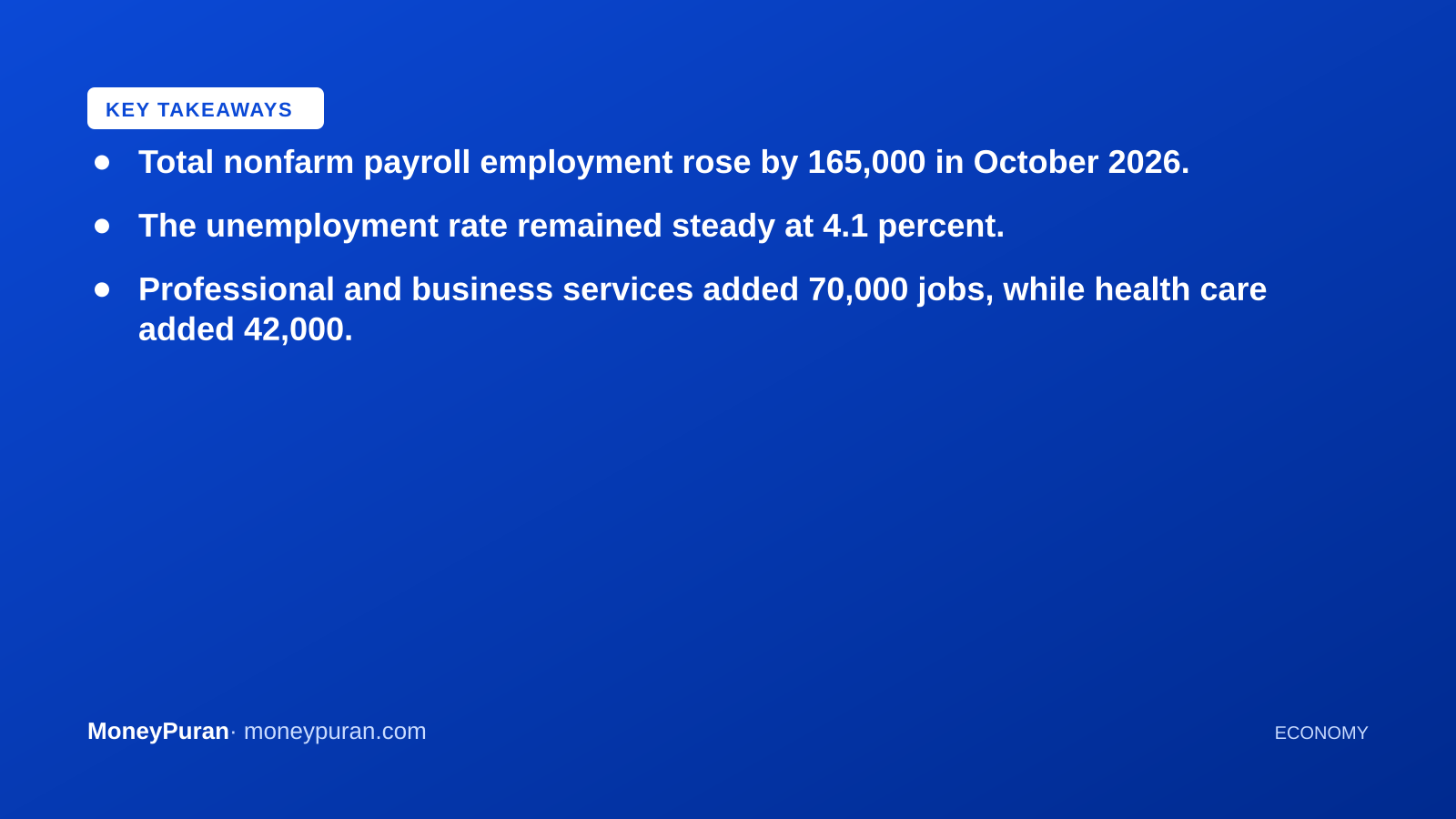
- Total nonfarm payroll employment rose by 165,000 in October 2026.
- The unemployment rate remained steady at 4.1 percent.
- Professional and business services added 70,000 jobs, while health care added 42,000.
- Average hourly earnings increased by 14 cents, or 0.4 percent, to $38.00.
- August and September employment figures were revised up by a combined 84,000 jobs.
U.S. nonfarm payroll employment expanded by 165,000 in October, outpacing average monthly gains over the prior year, while the unemployment rate held nearly flat at 4.1 percent, according to data released by the U.S. Bureau of Labor Statistics. The latest labor market indicators point to steady hiring momentum across key sectors, accompanied by upward revisions to previous months that underscore a more resilient economic foundation than initially reported.
For Indian investors and global market watchers, US macroeconomic data releases carry immediate weight. Strength in the American labor market directly influences Federal Reserve monetary policy expectations, which in turn drive Treasury yields, foreign institutional investor capital flows, and currency dynamics affecting the rupee. As global markets assess the trajectory of interest rates, strong job gains can alter perceptions around how long borrowing costs might remain elevated.
Sector Drivers Behind the October Hiring Gains
The expansion in nonfarm payrolls was heavily supported by gains in professional and business services, health care, and transportation. Professional and business services led major industry sectors by adding 70,000 jobs during the month, rebounding well above its 12-month average. Health care continued its steady upward trend by adding 42,000 jobs, led by increases in hospitals and home health care services.
Meanwhile, transportation and warehousing added 25,000 positions, bolstered largely by couriers and messengers. Manufacturing employment also ticked higher, adding 19,000 jobs with gains concentrated in computer and electronic products, machinery, and primary metals. Other major industries showed little net change over the course of the month.
Wage Growth and Revisions to Prior Months
Average hourly earnings for all employees on private nonfarm payrolls rose by 14 cents, or 0.4 percent, to reach $38.00 in October. Over the trailing 12-month period, average hourly earnings have advanced by 3.1 percent. The average workweek for all private nonfarm employees remained unchanged at 34.4 hours.
Importantly, the Bureau of Labor Statistics substantialized upward revisions for late-summer job creation. Employment gains for August were revised higher by 53,000 to 186,000, while September figures were revised up by 31,000 to 60,000. Combined, these revisions left employment in August and September 84,000 higher than previously estimated.
What this means for investors
Employment reports from the world’s largest economy act as a vital barometer for global growth and central bank policymaking. When job growth remains steady and wage pressures are contained, it dampens fears of an imminent recession while reducing the urgency for aggressive monetary easing. For global portfolios, this balance influences risk sentiment across equity indices and emerging-market currencies.
Indian market participants monitor US employment data closely because hotter-than-expected or resilient labor reports can keep US Treasury yields elevated. Higher yields often prompt foreign portfolio investors to reallocate capital away from emerging markets like India back toward dollar-denominated assets. Conversely, signs of labor cooling can ease yield pressures and support broader risk-on sentiment across domestic equities.
Frequently asked questions
What was the official unemployment rate in October? The unemployment rate was 4.1 percent, showing little change from previous months.
Which sectors added the most jobs? Professional and business services led with 70,000 new jobs, followed by health care with 42,000 jobs.
Were there any revisions to past data? Yes, August employment was revised up by 53,000 jobs and September employment was revised up by 31,000 jobs.
This article is for information only and is not investment advice. Do your own research or consult a licensed adviser before investing.
Based on information published by U.S. Bureau of Labor Statistics (BLS). Source: U.S. Bureau of Labor Statistics (BLS). Spotted an error? corrections@moneypuran.com