 Money
Money

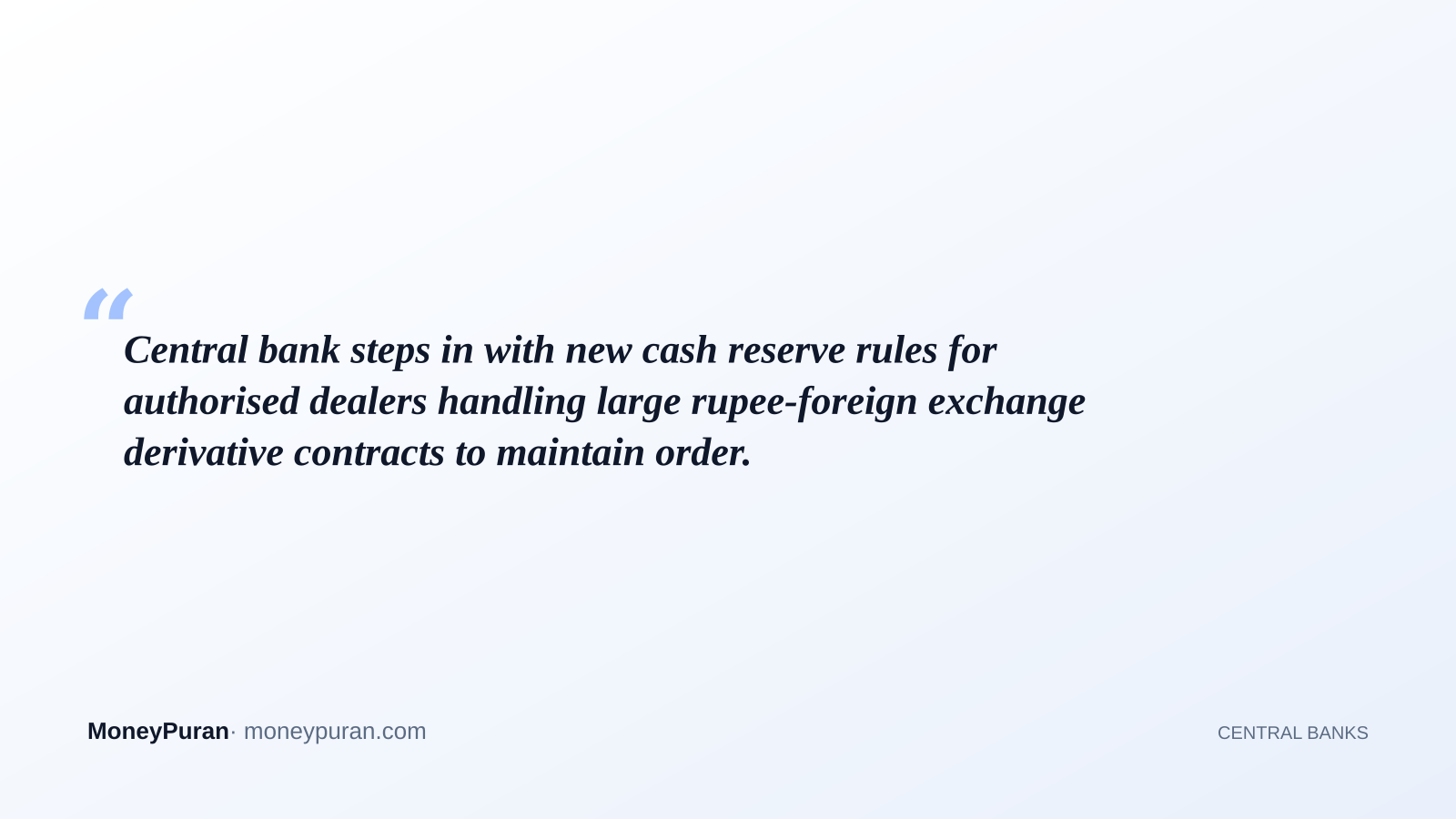
Central bank steps in with new cash reserve rules for authorised dealers handling large rupee-foreign exchange derivative contracts to maintain order.
Key points
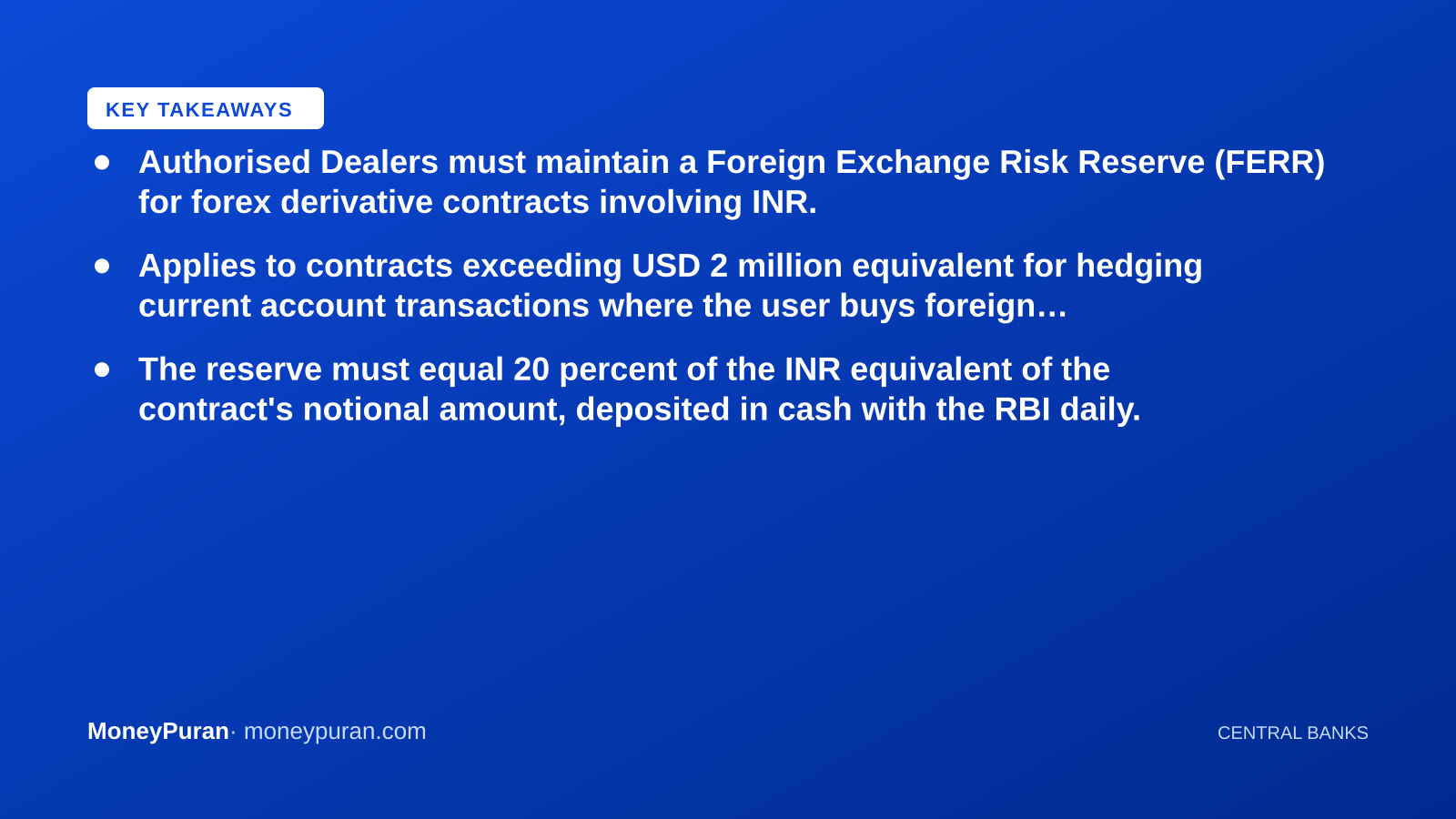
- Authorised Dealers must maintain a Foreign Exchange Risk Reserve (FERR) for forex derivative contracts involving INR.
- Applies to contracts exceeding USD 2 million equivalent for hedging current account transactions where the user buys foreign currency against INR.
- The reserve must equal 20 percent of the INR equivalent of the contract’s notional amount, deposited in cash with the RBI daily.
- Circumvention through multiple transactions is considered a violation of the new directives issued under FEMA and RBI Act.
The Reserve Bank of India has introduced stringent new compliance norms for the domestic foreign exchange market, directing authorised dealers to maintain a Foreign Exchange Risk Reserve for specific rupee-linked derivative contracts. According to a circular issued by the central bank under the signature of Chief General Manager Dimple Bhandia, the regulatory shift aims to secure the orderly functioning of the foreign exchange market amid growing derivative volumes.
Under the updated framework, the reserve requirement applies directly to foreign exchange derivative contracts involving the Indian rupee with a notional value exceeding USD two million equivalent. The regulation targets contracts undertaken to hedge current account transactions where the underlying user purchases foreign currency in exchange for rupees. Authorised dealers are now required to set aside a cash reserve equal to 20 percent of the rupee equivalent of the contract’s notional amount.
Operational Rules and Daily Compliance
The newly mandated Foreign Exchange Risk Reserve must be deposited and maintained in cash within India directly with the Reserve Bank on a daily basis. This buffer must remain intact until the formal termination of the underlying derivative contract. Furthermore, the central bank explicitly cautioned market participants against splitting large exposures into smaller transactions across one or more authorised dealers to evade the reserve threshold, classifying any such evasion as a direct violation of the directives.
Authorised dealers are instructed to report the precise details of the daily FERR maintained through the central bank’s Centralised Information Management System. These directions took effect immediately upon publication, backed by statutory powers under Sections 10(4) and 11(1) of the Foreign Exchange Management Act (FEMA) of 1999, alongside Section 45W of the Reserve Bank of India Act of 1934.
What this means for investors
For corporate treasuries, importers, and financial market participants utilizing complex hedging tools, the new RBI mandate introduces a higher capital cost for large-scale currency risk management. Because institutions must lock up 20 percent of a contract’s notional value in cash with the central bank, pricing on large hedging structures may reflect these carrying costs. Indian companies relying heavily on derivative overlays for current account exposures will need to factor the daily liquidity impact into their treasury operations.
For market observers and investors tracking banking stocks and broader macroeconomic stability, the move signals the central bank’s proactive stance in curbing speculative volatility and ensuring that currency derivatives are backed by sufficient liquidity buffers. Monitoring daily reporting compliance through the CIMS platform will be key as authorised dealers adjust to the immediate enforcement of the rules.
Frequently asked questions
Who is affected by the RBI foreign exchange risk reserve? The directive applies to all authorised dealers handling foreign exchange derivative contracts involving the Indian rupee for users executing transactions above USD two million.
How much cash must be deposited with the RBI? Dealers must deposit cash equal to 20 percent of the INR equivalent of the notional amount of each qualifying derivative contract on a daily basis.
When do the new rules take effect? The Reserve Bank of India announced that these directives come into force with immediate effect.
This article is for information only and is not investment advice. Do your own research or consult a licensed adviser before investing.
Based on information published by Reserve Bank of India (RBI) — notifications. Source: Reserve Bank of India (RBI) — notifications. Spotted an error? corrections@moneypuran.com