 Money
Money
The Reserve Bank of India has initiated the 75th round of its flagship manufacturing survey, collecting vital data on factory orders, inventory levels, and capacity utilisation for the July-September 2026 quarter.
Key points
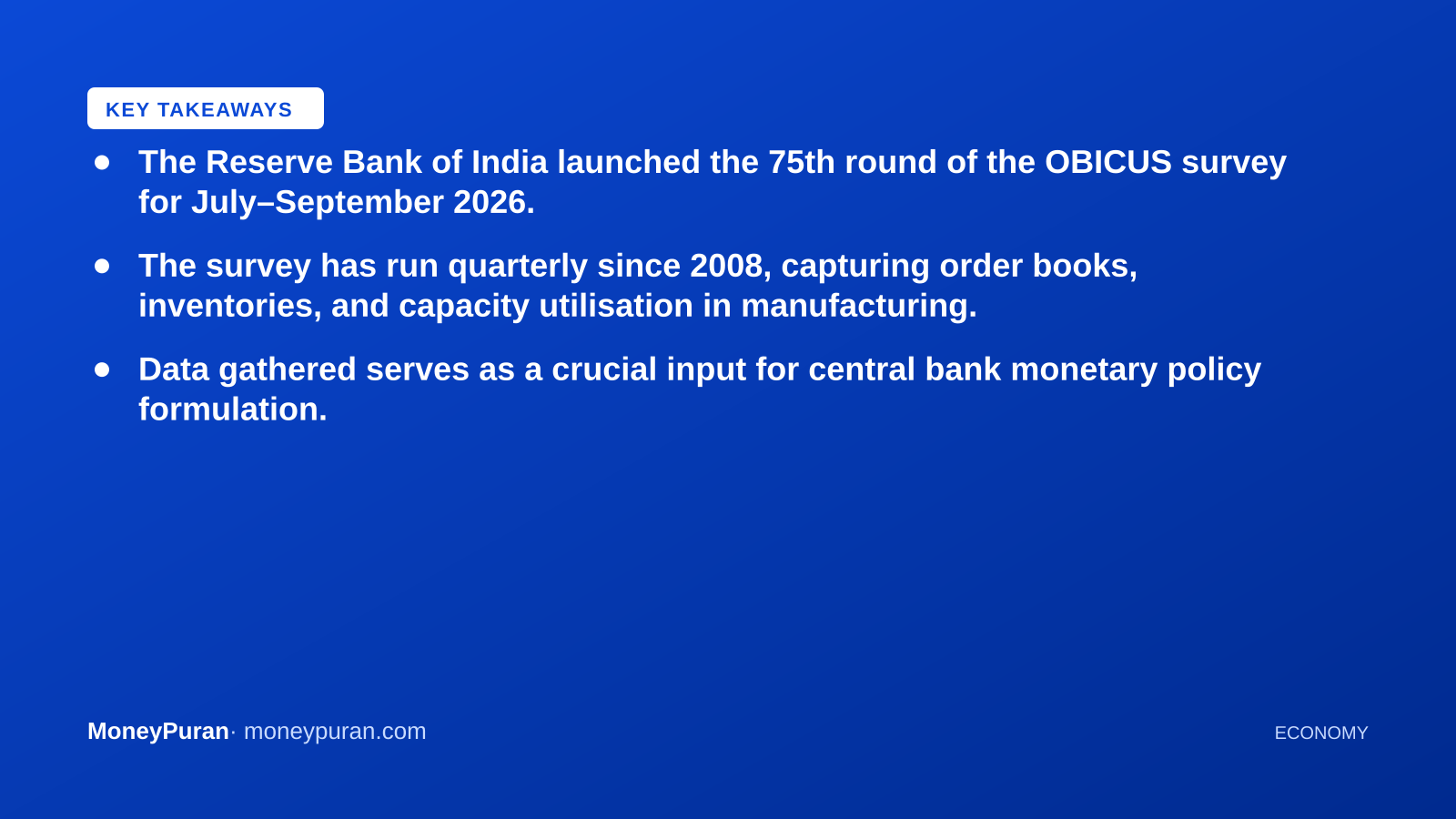
- The Reserve Bank of India launched the 75th round of the OBICUS survey for July–September 2026.
- The survey has run quarterly since 2008, capturing order books, inventories, and capacity utilisation in manufacturing.
- Data gathered serves as a crucial input for central bank monetary policy formulation.
- Selected manufacturing companies will be approached, while others can download forms directly from the RBI website.
The Reserve Bank of India has kicked off the 75th round of its Order Books, Inventories and Capacity Utilisation Survey, known as OBICUS, covering the second quarter of the 2026-27 financial year from July to September 2026. This long-running quarterly exercise serves as a core diagnostic tool for the central bank, capturing the operational pulse of the country’s manufacturing sector to help guide monetary policy decisions.
What the RBI manufacturing survey tracks
Conducted regularly since 2008, the OBICUS framework gathers detailed quantitative metrics from targeted manufacturing enterprises across India. Participating firms provide figures on new orders captured during the quarter, order backlogs at the start and end of the period, and comprehensive inventory breakdowns encompassing finished goods, work-in-progress, and raw materials. Additionally, companies report item-wise production volumes and values against installed capacities, alongside explanations for any fluctuations.
These operational inputs allow the Reserve Bank to calculate capacity utilisation levels accurately. The resulting dataset offers policymakers a transparent view of industrial demand, inventory cycles, and slack or pressure within factory production lines.
Key details of the 75th survey round
- Reference period: July – September 2026 (Q2:2026-27).
- Survey round: 75th edition of the OBICUS series.
- Target group: Selected manufacturing companies across India, with voluntary participation open to other domestic manufacturers via the RBI website.
- Data confidentiality: Individual company-level submissions remain strictly confidential under regulatory safeguards.
What this means for investors
For investors tracking Indian equities and macroeconomic trends, the findings of the OBICUS survey offer vital clues regarding industrial health and corporate earnings momentum. Capacity utilisation is a leading indicator of capital expenditure cycles; as factories exhaust slack and push higher utilisation rates, companies typically signal new expansion phases and stronger pricing power. Monitoring these trends helps market participants gauge demand pressures across cyclical manufacturing sectors listed on the NSE and BSE.
While individual responses are kept confidential, aggregate survey results published by the central bank feed directly into broader assessments of economic slack. This directly influences interest rate decisions and liquidity measures by the Monetary Policy Committee, affecting borrowing costs for businesses and broader market valuations.
Frequently asked questions
Who is required to participate in the OBICUS survey? Selected manufacturing companies are approached directly by the Reserve Bank of India, though other domestic manufacturing firms can voluntarily download and submit the questionnaire from the official RBI web portal.
How is company data protected during the survey? The Reserve Bank guarantees that all company-level financial and operational data collected during the survey remains strictly confidential and is never disclosed individually.
How do survey results affect the broader economy? The aggregated metrics on order books and factory capacity act as core inputs for central bank monetary policy formulation, shaping interest rates and broader economic management.
This article is for information only and is not investment advice. Do your own research or consult a licensed adviser before investing.
Based on information published by Reserve Bank of India (RBI). Source: Reserve Bank of India (RBI). Spotted an error? corrections@moneypuran.com