 Money
Money
India’s total external debt climbed by $15.4 billion in the first quarter of fiscal 2026-27, driven largely by non-financial corporations and government borrowings, according to central bank figures.
Key points
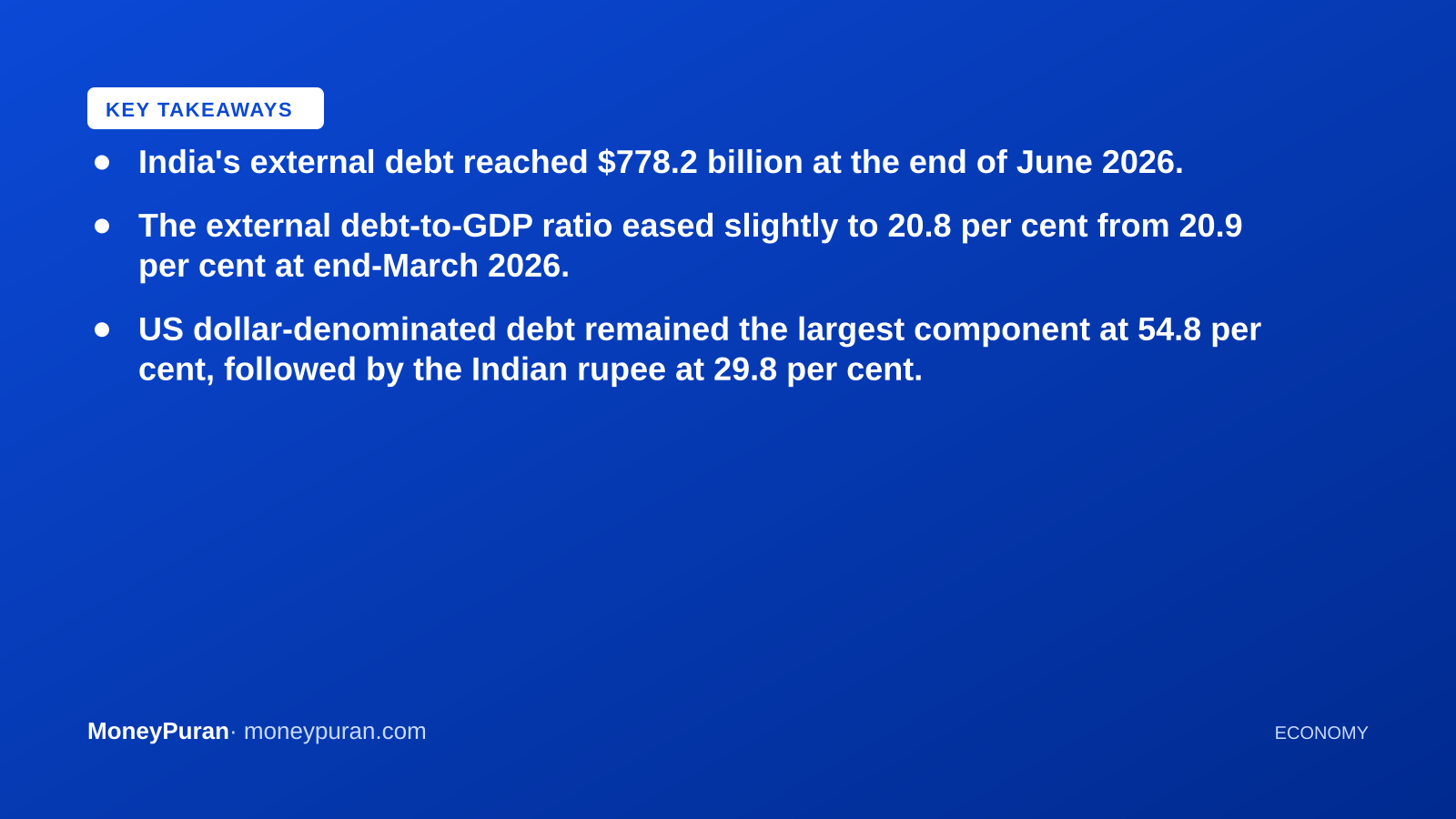
- India’s external debt reached $778.2 billion at the end of June 2026.
- The external debt-to-GDP ratio eased slightly to 20.8 per cent from 20.9 per cent at end-March 2026.
- US dollar-denominated debt remained the largest component at 54.8 per cent, followed by the Indian rupee at 29.8 per cent.
India’s total external debt stood at $778.2 billion at the end of June 2026, marking an increase of $15.4 billion compared to the previous quarter ending in March 2026, according to data released by the Reserve Bank of India (RBI). Despite the absolute rise in liabilities, the country’s external debt-to-GDP ratio moderated marginally to 20.8 per cent, down from 20.9 per cent in March, reflecting continued broad economic expansion.
The central bank noted that valuation gains resulting from the appreciation of the US dollar against major currencies such as the Japanese yen and the euro contributed $0.9 billion. Without this valuation effect, the external debt would have expanded by $16.4 billion over the quarter. Long-term debt instruments, carrying an original maturity of more than one year, accounted for the bulk of the liabilities at $624.7 billion.
Composition of Borrowings and Currency Breakdown
Data compiled by the RBI shows that non-financial corporations held the largest share of outstanding external debt at 36.1 per cent, followed by deposit-taking corporations excluding the central bank at 26.2 per cent, and the general government at 22.4 per cent. Loans remained the most common instrument category, capturing 34.3 per cent of total liabilities.
In terms of currency denomination, US dollar-denominated debt continued to dominate at 54.8 per cent of the total stock. Liabilities denominated in the Indian rupee formed the second-largest segment at 29.8 per cent, followed by the Japanese yen at 6.9 per cent, Special Drawing Rights (SDR) at 4.1 per cent, and the euro at 3.5 per cent.
- Total external debt: $778.2 billion at end-June 2026.
- External debt-to-GDP ratio: 20.8 per cent.
- Short-term debt share by original maturity: 19.7 per cent.
- Debt service ratio: 5.6 per cent of current receipts.
What this means for investors
For domestic investors and market participants, the stable debt-to-GDP ratio and moderate short-term debt levels signal manageable macroeconomic risk regarding external obligations. A debt service ratio of 5.6 per cent of current receipts indicates that foreign exchange earnings comfortably cover current repayment obligations, reducing immediate vulnerability to external shocks or currency depreciation.
Furthermore, the substantial share of rupee-denominated external debt helps insulate parts of the economy from sharp foreign exchange volatility. However, the rising share of short-term debt relative to foreign exchange reserves—rising to 23.0 per cent—warrants continued monitoring by fixed-income investors tracking macroeconomic stability and sovereign risk indicators.
Frequently asked questions
What is India’s current external debt? India’s external debt was placed at $778.2 billion at the end of June 2026, according to RBI provisional figures.
How does the debt-to-GDP ratio look? The external debt-to-GDP ratio moderated slightly to 20.8 per cent at the end of June 2026, compared to 20.9 per cent at the end of March 2026.
Which currency dominates India’s external debt? US dollar-denominated debt is the largest component at 54.8 per cent, with Indian rupee-denominated debt following at 29.8 per cent.
This article is for information only and is not investment advice. Do your own research or consult a licensed adviser before investing.
Based on information published by Reserve Bank of India (RBI). Source: Reserve Bank of India (RBI). Spotted an error? corrections@moneypuran.com