 Money
Money

Indian benchmark indices recorded sharp losses at the close of September 30, 2026, with the Nifty 50 falling nearly two percent.
Key points
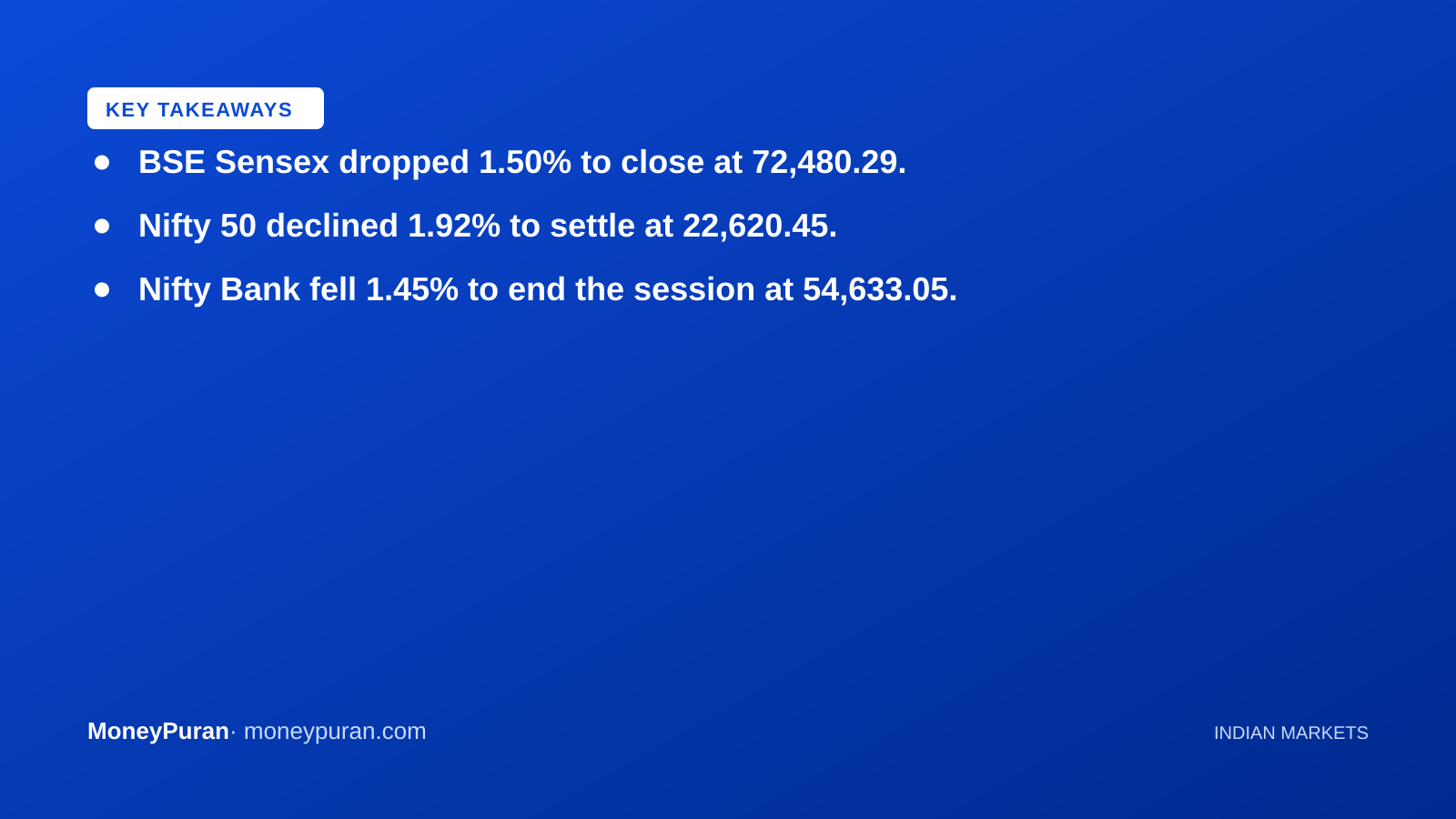
- BSE Sensex dropped 1.50% to close at 72,480.29.
- Nifty 50 declined 1.92% to settle at 22,620.45.
- Nifty Bank fell 1.45% to end the session at 54,633.05.
- USD/INR edged up slightly to 95.82, a gain of 0.08%.
Indian equity markets experienced a severe downturn during the trading session on September 30, 2026, as headline benchmarks suffered steep losses. Investors tracking the why the market moved today data will note that selling pressure was broad-based across major sectors, pulling both the BSE Sensex and the Nifty 50 down substantially from their previous closes.
The BSE Sensex dropped 1,100.25 points, or 1.50 percent, to finish the day at 72,480.29. Throughout the session, the 30-share index fluctuated within a day range of 72,366.44 and 73,062.23, failing to hold any ground above the 73,000 threshold.
Nifty 50 and Banking Sector Performance
The broader Nifty 50 index bore the brunt of the selling, sliding 1.92 percent or 442.65 points to close at 22,620.45. The index moved between an intraday low of 22,595.20 and a high of 22,809.35, reflecting aggressive liquidation as trading progressed towards the closing bell.
Financials also retreated, with the Nifty Bank index giving up 805.45 points, or 1.45 percent, to settle at 54,633.05. The banking gauge traded in a relatively wide band between 54,174.30 and 55,135.50 as institutional and retail participants reassessed exposures.
Foreign Exchange Movement
In the currency market, the Indian rupee saw a mild depreciation against the US dollar. The USD/INR exchange rate edged higher by 0.08 percent to trade at 95.82 at the close, moving within a tight daily range of 95.73 to 95.99.
What this means for investors
A sharp market correction of this magnitude often prompts portfolio rebalancing and heightens risk awareness among market participants. When headline indices like the Sensex and Nifty 50 drop by over one to two percent in a single session, margin requirements and volatility metrics typically adjust to reflect the higher turbulence.
Investors generally monitor institutional flow data, currency fluctuations, and macroeconomic triggers following such steep declines to gauge underlying market sentiment. Maintaining a diversified asset allocation and reviewing risk tolerance parameters remain standard practices during periods of heightened market volatility.
Frequently asked questions
What were the closing levels for Sensex and Nifty 50 on September 30, 2026? The BSE Sensex closed at 72,480.29 and the Nifty 50 settled at 22,620.45.
How did the banking sector perform during the session? The Nifty Bank index declined by 1.45 percent to close at 54,633.05.
This article is for information only and is not investment advice. Do your own research or consult a licensed adviser before investing.
Based on information published by MoneyPuran market data. Source: MoneyPuran market data. Spotted an error? corrections@moneypuran.com