 Money
Money

Federal regulators charge CMI Capital and its founder for allegedly misusing investor funds raised from retired and active law enforcement officers.
Key points
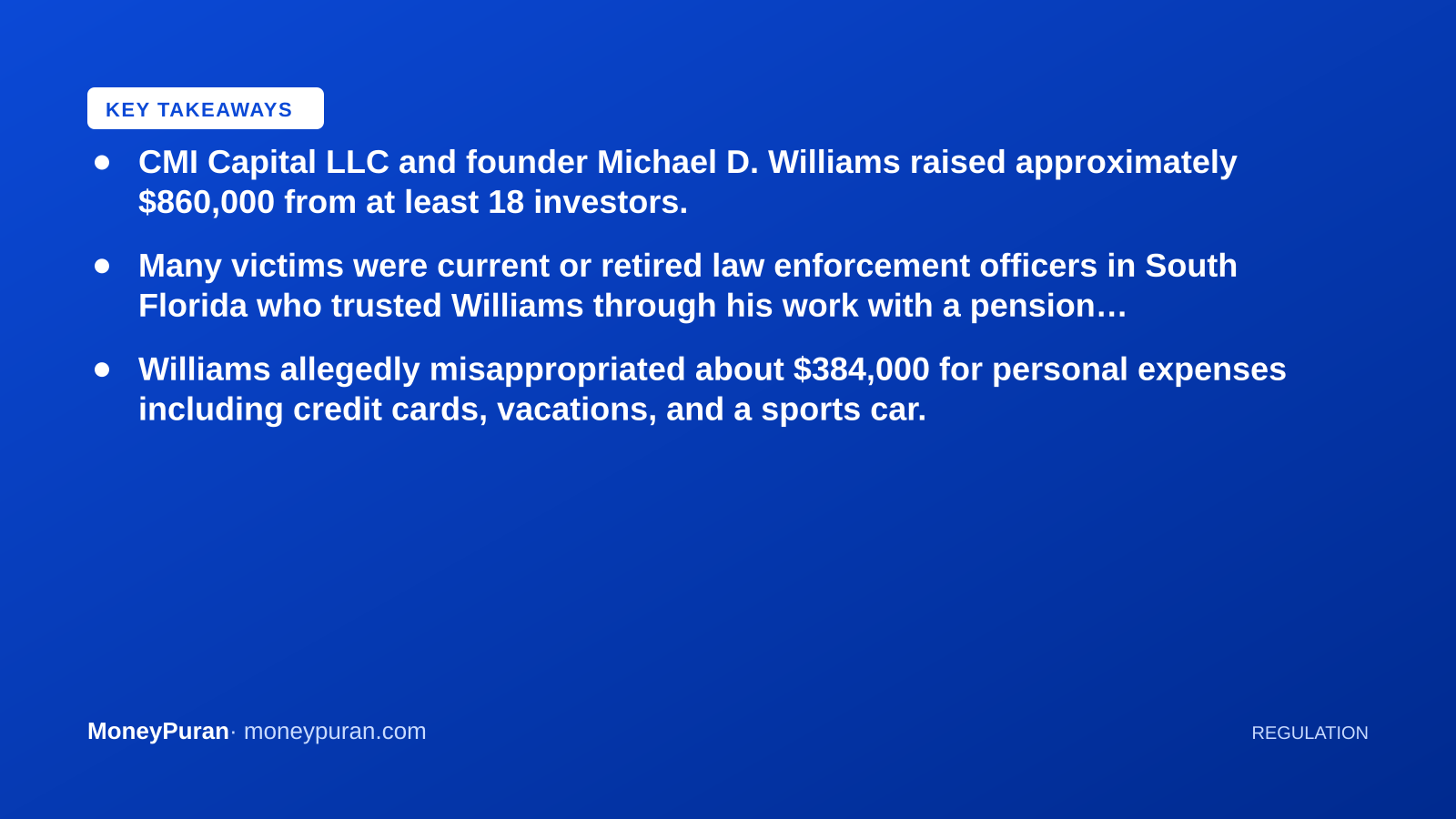
- CMI Capital LLC and founder Michael D. Williams raised approximately $860,000 from at least 18 investors.
- Many victims were current or retired law enforcement officers in South Florida who trusted Williams through his work with a pension plan administrator.
- Williams allegedly misappropriated about $384,000 for personal expenses including credit cards, vacations, and a sports car.
- The defendants have agreed to a bifurcated settlement subject to court approval, including permanent injunctions and future financial penalties.
The U.S. Securities and Exchange Commission has filed charges against a South Florida resident and his firm for operating an alleged fraudulent investment scheme that primarily targeted current and retired law enforcement officers. According to the regulatory agency, the defendants raised approximately $860,000 from at least 18 individual investors by promising outsized returns and fabricating portfolio values.
The enforcement action targets Michael D. Williams of Port St. Lucie, Florida, alongside his company, CMI Capital LLC, which also operated under the name Check Mate Investments. Regulators stated that the illicit activities took place between at least October 2023 and August 2024. Investigators noted that many of the affected investors placed their trust in Williams because of his professional association with a third-party police and firefighter pension plan administrator.
Tactics Used in the Alleged Scheme
According to the SEC complaint filed in the U.S. District Court for the Southern District of Florida, Williams utilized deceptive marketing tactics to lure clients into two funds under his control. Investors were allegedly fed false claims that one of the funds held a portfolio valued in excess of $5 million and boasted trading returns exceeding 140 percent.
- Victims included active and retired law enforcement personnel in South Florida.
- Investors were shown cropped screenshots depicting exorbitant trading profits to build false confidence.
- Out of the $860,000 raised, Williams allegedly diverted roughly $384,000 toward personal expenditures.
- Personal expenses funded by investor capital reportedly included credit card bills, luxury vacations, and a sports car.
The regulatory filing indicates that Williams began issuing repayments to certain investors starting in August 2024, returning over $375,000 to date. Despite these partial restitutions, the agency’s legal action moves forward to impose formal penalties and permanent restrictions.
Legal Fallout and Proposed Settlement
The SEC complaint accuses Williams and CMI Capital of violating core antifraud and registration provisions embedded within the Securities Act of 1933, the Securities Exchange Act of 1934, and the Investment Advisers Act of 1940. Without formally admitting or denying the allegations, the defendants have agreed to a bifurcated settlement framework pending final court approval.
The proposed judicial orders would permanently bar the defendants from future violations of federal securities laws. Furthermore, Williams would face a strict injunction prohibiting him from participating in any future issuance, purchase, offer, or sale of securities outside of designated personal trading accounts, alongside a forthcoming industry associational bar. The exact financial figures for disgorgement, prejudgment interest, and civil penalties will be determined by the court at a later date.
What this means for investors
This enforcement case highlights the persistent risks of investing with individuals who prey on tight-knit professional communities. Fraudsters frequently leverage shared affiliations—such as law enforcement or municipal employment—to manufacture artificial trust and bypass standard skepticism. When an investment opportunity claims to generate extraordinary returns with little to no associated risk, it serves as a primary warning sign for retail investors.
Regulatory bodies routinely advise market participants to verify the registration status of any individual or firm offering financial products through tools provided by the SEC or FINRA. Independent verification prevents investors from relying solely on personal recommendations or informal associations within professional networks.
Frequently asked questions
Who was charged by the SEC in this case? The SEC charged Michael D. Williams of Port St. Lucie, Florida, and his company, CMI Capital LLC.
How much money was raised from investors? The complaint states that the defendants raised approximately $860,000 from at least 18 investors, many of whom were law enforcement officers.
What penalties are the defendants facing? The proposed settlement includes permanent injunctions against securities law violations, a bar on Williams participating in future securities offerings, and court-determined financial penalties and disgorgement.
This article is for information only and is not investment advice. Do your own research or consult a licensed adviser before investing.
Based on information published by U.S. Securities and Exchange Commission (SEC). Source: U.S. Securities and Exchange Commission (SEC). Spotted an error? corrections@moneypuran.com