 Money

Regulators allege overseas fraudsters used fake SEC certificates and messaging group chats to trick retail traders out of tens of millions of dollars.
Key points
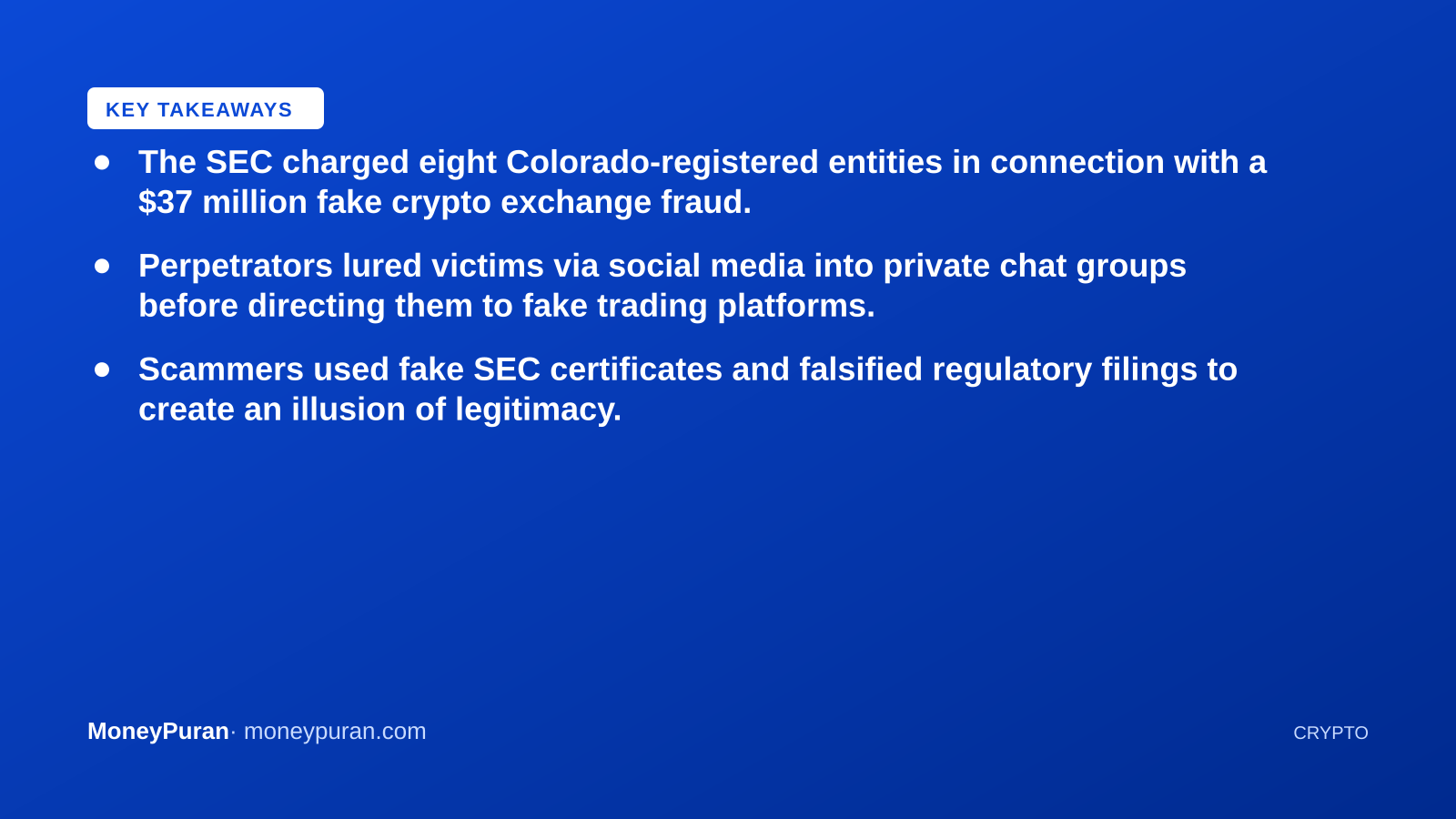
- The SEC charged eight Colorado-registered entities in connection with a $37 million fake crypto exchange fraud.
- Perpetrators lured victims via social media into private chat groups before directing them to fake trading platforms.
- Scammers used fake SEC certificates and falsified regulatory filings to create an illusion of legitimacy.
- International regulators from Hong Kong, Singapore, China, and Switzerland assisted the U.S. investigation.
The U.S. Securities and Exchange Commission has filed fraud charges against eight entities accused of orchestrating an elaborate scheme that stole more than $37 million from retail market participants. The enforcement action targets a sophisticated operation that used fake advisory firms and phony online trading platforms to siphon funds, highlighting the risks posed by modern messaging-based investment fraud.
Anatomy of the fake trading operation
According to the SEC complaint filed in the U.S. District Court for the District of Colorado, the fraudulent scheme operated through four distinct adviser-platform pairs between August 2024 and May 2026. The perpetrators routinely abandoned one platform identity for another after operating each for a few months to evade detection and law enforcement intervention.
The fraudsters initially targeted victims through social media advertisements that directed interested individuals into private and group messaging chats. Organizers in these chat groups initially provided advice on trading public stocks in U.S. equity markets to build trust with participants. Once credibility was established, the operators coaxed victims into transferring maximum capital to designated web platforms, fraudulently claiming investors were purchasing real crypto assets.
Fake certificates and regulatory filings used to deceive traders
To overcome investor skepticism, the defendants employed several tactics to simulate legitimacy. The operators created fake SEC registration certificates and submitted misleading regulatory filings to federal institutions, including the SEC, the Financial Industry Regulatory Authority (FINRA), and the Financial Crimes Enforcement Network (FinCEN).
When investors questioned the safety of their funds, the scheme operators directed them to these forged certificates and falsified filings. Following the filing of the complaint, the SEC confirmed that a Form D submitted by Tech Brokerage Asset Alliance Ltd. and Forms ADV submitted by Convergent Wealth Advisors Inc. and Essential Crypto Exchange have been removed from the agency website.
Key specifics of the enforcement action
- Entities Charged: Advisor WeChat Capital, Tech Brokerage Asset Alliance Ltd., HB Wealth Advisors, IdeaCrypto Exchange LLC, Convergent Wealth Advisors Inc., RealSimple Crypto Exchange Inc., Associated Wealth Advisors Ltd., and Essential Crypto Exchange.
- Total Fraud Losses: Exceeded $37 million across multiple adviser-platform pairs.
- Legal Charges: Section 10(b) and Rule 10b-5 of the Securities Exchange Act of 1934, alongside Sections 206(1), 206(2), and 207 of the Investment Advisers Act of 1940.
- Relief Sought: Permanent injunctions, conduct-based injunctions, disgorgement of ill-gotten profits with prejudgment interest, and civil money penalties.
- International Coordination: Assistance was provided by the Hong Kong Securities and Futures Commission, the Monetary Authority of Singapore, the China Securities Regulatory Commission, and the Swiss Financial Market Supervisory Authority.
What this means for investors
For retail investors across global markets, including those in India navigating international trading avenues, this case underscores the growing prevalence of cross-border financial scams rooted in private messaging applications. Fraudsters frequently register corporate entities in recognized jurisdictions while conducting illicit operations remotely through overseas channels.
Investors should exercise extreme caution whenever investment opportunities or asset management advice are pitched inside group messaging environments. Even when promoters produce documentation or point to database entries with regulatory bodies, secondary independent verification through official tools such as Investor.gov or SEBI verification portals remains vital before transmitting funds to unverified platforms.
Frequently asked questions
How did the scammers convince victims that the trading platforms were legitimate? The perpetrators forged official SEC certificates and submitted deceptive filings to regulatory agencies, using these documents to reassure hesitant investors.
What legal remedies is the SEC pursuing in this lawsuit? The SEC is seeking permanent injunctions, conduct-based restrictions, full disgorgement of ill-gotten gains with interest, and civil financial penalties against all eight entities.
This article is for information only and is not investment advice. Do your own research or consult a licensed adviser before investing.
Based on information published by U.S. Securities and Exchange Commission (SEC). Source: U.S. Securities and Exchange Commission (SEC). Spotted an error? corrections@moneypuran.com