 Money

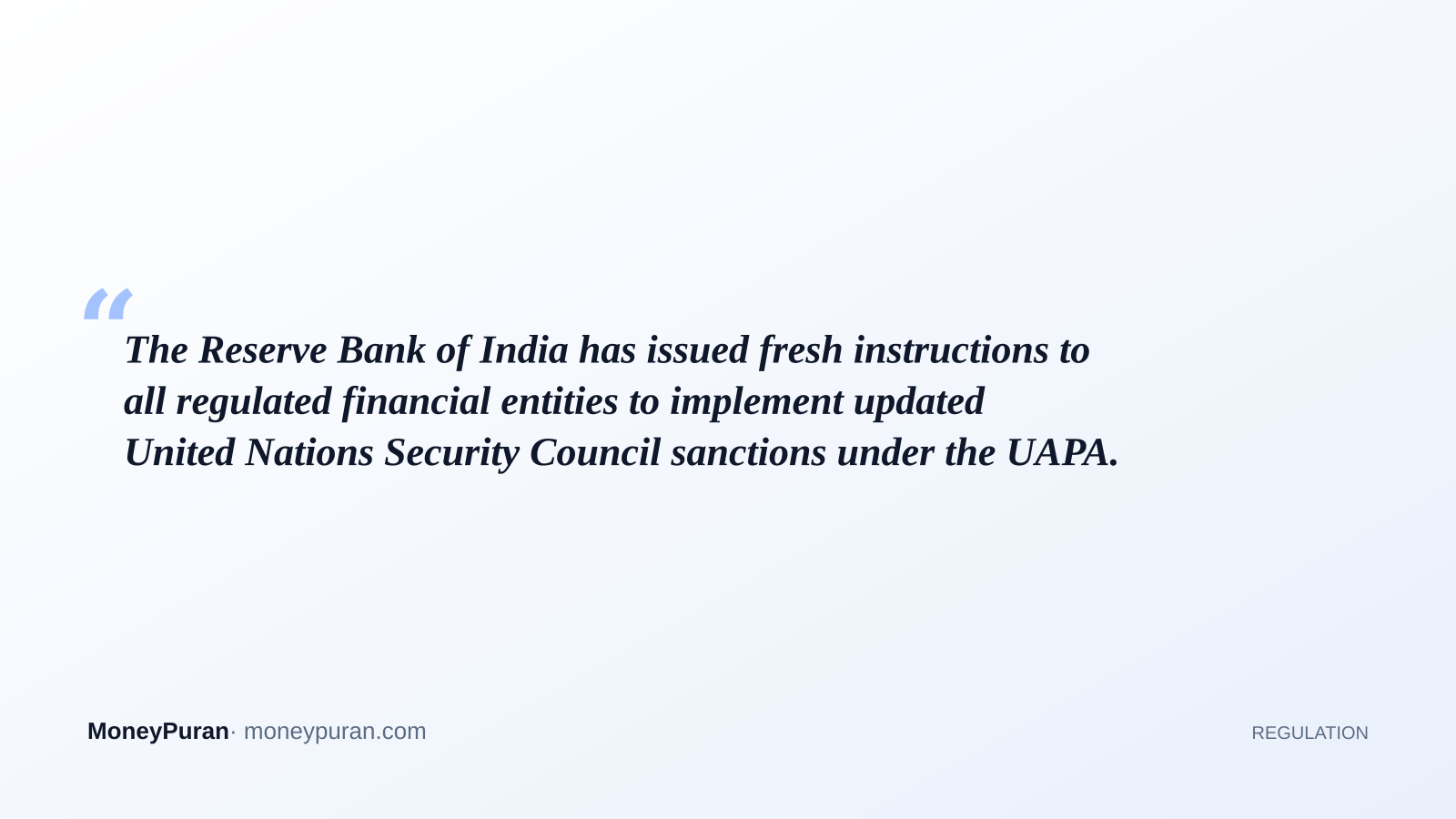
The Reserve Bank of India has issued fresh instructions to all regulated financial entities to implement updated United Nations Security Council sanctions under the UAPA.
Key points
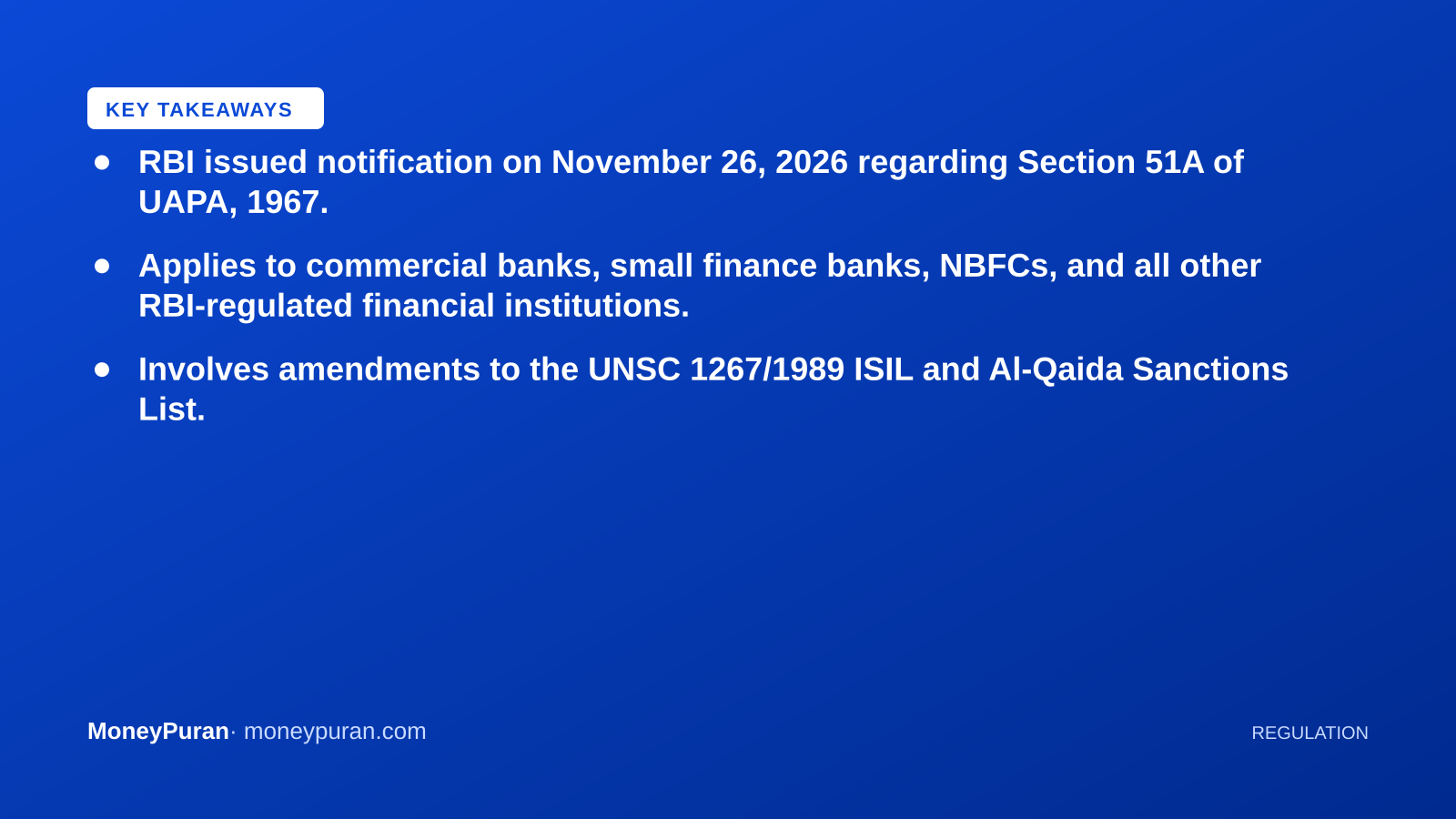
- RBI issued notification on November 26, 2026 regarding Section 51A of UAPA, 1967.
- Applies to commercial banks, small finance banks, NBFCs, and all other RBI-regulated financial institutions.
- Involves amendments to the UNSC 1267/1989 ISIL and Al-Qaida Sanctions List.
- Regulated entities must ensure no accounts are held by listed individuals or entities.
The Reserve Bank of India (RBI) has issued a directive instructing all commercial banks, small finance banks, non-banking financial companies (NBFCs), and other regulated entities to update their databases in accordance with recent amendments to the United Nations Security Council (UNSC) sanctions lists. The communication, issued by Chief General Manager R Sathish on November 26, 2026, reinforces India’s adherence to international counter-terrorism financing protocols under Section 51A of the Unlawful Activities (Prevention) Act (UAPA), 1967.
Under the updated guidelines, financial institutions must cross-verify their existing customer accounts against the latest revisions to the UNSC 1267/1989 ISIL (Da’esh) and Al-Qaida Sanctions List. The specific update involves modifications to the entry of individual Hani Al-Sayyid Al-Sebai Yusif, following press releases from the United Nations Security Council and communications from India’s Ministry of External Affairs.
Compliance Obligations for Indian Financial Institutions
All regulated lenders and financial intermediaries are required to maintain rigorous screening mechanisms to prevent designated entities or individuals from accessing the formal financial system. The central bank’s directive emphasizes strict adherence to Chapter IX of the RBI Know Your Customer (KYC) Directions, 2025, which outlines mandatory protocols for dealing with communications from international agencies.
- Institutions must instantly freeze any assets or accounts linked to names appearing on the revised sanctions lists.
- Banks and NBFCs must refer to the updated database provided via official UN and Ministry of Home Affairs (MHA) channels.
- Any formal de-listing requests received by financial institutions must be forwarded electronically to the Joint Secretary (CTCR) of the MHA.
The directive ensures that domestic financial institutions remain aligned with global asset-freezing mandates, travel bans, and arms embargoes established under Chapter VII of the United Nations Charter.
What this means for investors
For investors and institutions operating in the Indian financial sector, strict compliance with RBI KYC and UAPA mandates is a foundational requirement for operational licensing and risk management. While routine administrative updates do not impact broader market liquidity or stock valuations, failure to maintain robust compliance frameworks can lead to regulatory penalties and heightened operational scrutiny from the central bank.
Financial institutions continuously invest in automated transaction-monitoring and name-screening software to process these periodic UNSC updates efficiently. For everyday banking customers, these background regulatory checks mean occasional requests for updated KYC documentation to ensure ongoing account compliance.
Frequently asked questions
What is the purpose of the RBI UAPA notification? The notification ensures that Indian banks and financial institutions comply with Section 51A of the UAPA by enforcing asset freezes and restrictions against individuals and entities linked to terrorism as mandated by the UN Security Council.
Which financial institutions must follow these rules? The directive applies universally across the Indian regulated financial sector, including commercial banks, small finance banks, payment banks, cooperative banks, NBFCs, asset reconstruction companies, and all-India financial institutions.
How can listed individuals seek removal from the sanctions list? Individuals or groups seeking delisting can submit formal requests to an independent and impartial Ombudsperson appointed by the United Nations Secretary-General, or route requests through India’s Ministry of Home Affairs.
This article is for information only and is not investment advice. Do your own research or consult a licensed adviser before investing.
Based on information published by Reserve Bank of India (RBI) — notifications. Source: Reserve Bank of India (RBI) — notifications. Spotted an error? corrections@moneypuran.com