 Money
Money
The central bank penalises The Monghyr-Jamui Central Co-operative Bank Limited for failing to upload customer KYC records to the central registry on time.
Key points
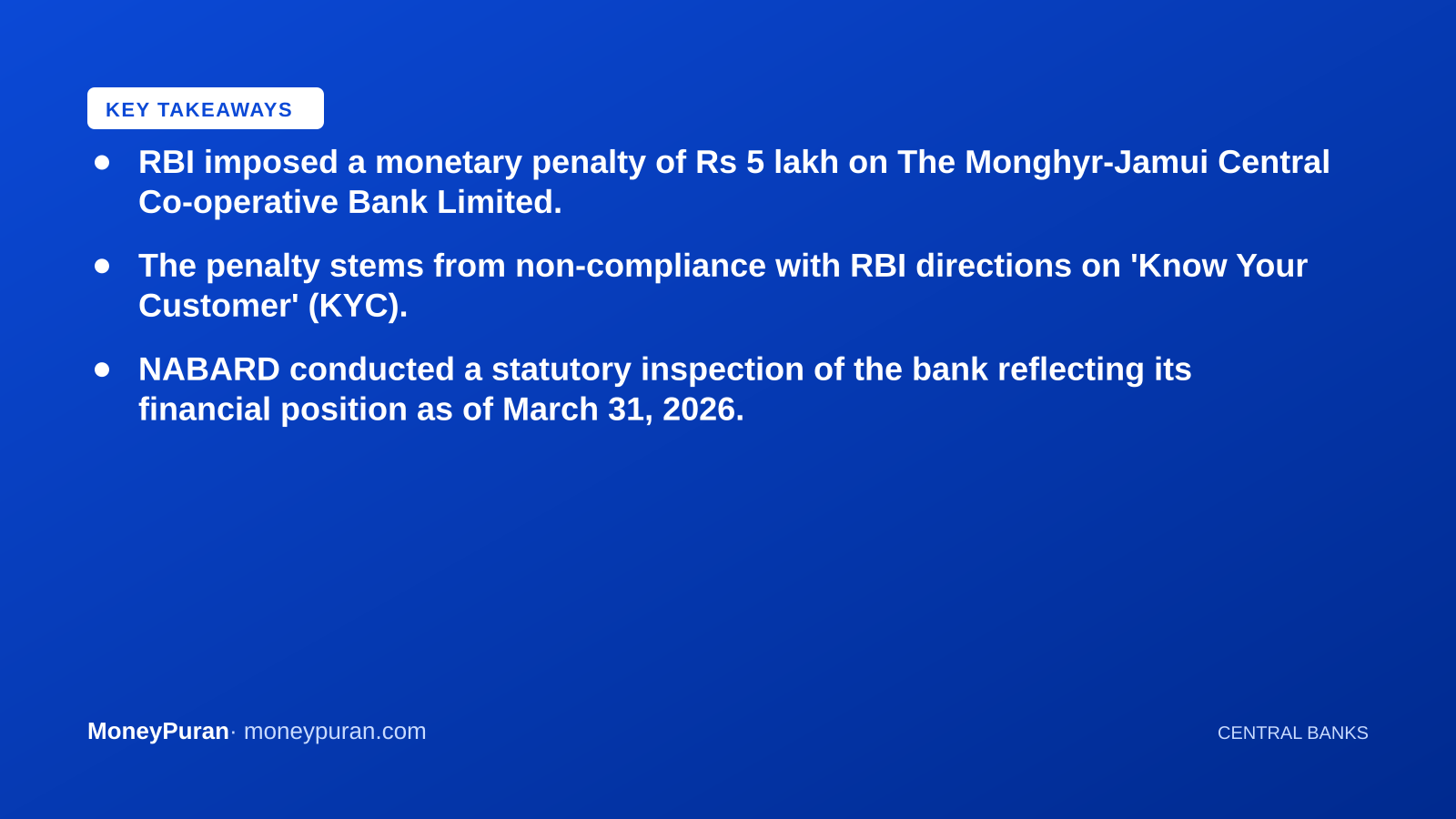
- RBI imposed a monetary penalty of Rs 5 lakh on The Monghyr-Jamui Central Co-operative Bank Limited.
- The penalty stems from non-compliance with RBI directions on ‘Know Your Customer’ (KYC).
- NABARD conducted a statutory inspection of the bank reflecting its financial position as of March 31, 2026.
- The specific violation involved failing to upload customer KYC records onto the Central KYC Records Registry (CKYCR) within the prescribed timeline.
The Reserve Bank of India (RBI) has announced a monetary penalty of Rs 5 lakh on The Monghyr-Jamui Central Co-operative Bank Limited, Bihar, for failing to adhere to regulatory norms regarding customer verification. According to the central bank’s order dated September 25, 2026, the financial penalty was enacted due to the co-operative bank’s shortcomings in uploading mandatory customer onboarding data onto the national repository within the designated timeframe.
The penalty follows a statutory inspection of the institution carried out by the National Bank for Agriculture and Rural Development (NABARD). The inspection evaluated the bank’s financial position as of March 31, 2026. Following supervisory findings that pointed to regulatory lapses, the RBI issued a show-cause notice to the lender. After reviewing the bank’s written replies, supplementary paperwork, and oral presentations during a personal hearing, the central bank concluded that the charge regarding delayed Central KYC Records Registry (CKYCR) uploads was substantiated.
Understanding the CKYCR Mandate
The Central KYC Records Registry acts as a centralized repository of customer KYC records intended to streamline the verification process for financial institutions across India. Regulated entities, including co-operative banks and commercial lenders, are legally mandated to upload customer identification documents and profile data promptly after onboarding. Timely compliance ensures that financial crime monitoring mechanisms remain robust and transparent across the banking ecosystem.
The RBI noted that the regulatory action is strictly based on deficiencies in compliance and does not question the legality or validity of any transactions or agreements conducted by the bank with its customer base. Furthermore, the penalty leaves room for potential future regulatory actions if deemed necessary by the central banking authority under the provisions of the Banking Regulation Act, 1949.
What this means for investors
For retail depositors and stakeholders associated with regional co-operative banks, regulatory enforcement actions serve as a reminder of the strict oversight maintained by the RBI over all tiers of India’s financial sector. While a penalty of Rs 5 lakh is relatively minor in financial terms, repeated compliance failures can trigger tighter supervisory scrutiny, operational restrictions, or additional capital requirements that affect day-to-day banking services.
Investors and account holders monitoring co-operative institutions should pay close attention to governance standards and administrative efficiency. Ensuring robust digital infrastructure for compliance reporting like CKYCR integration remains critical for smaller lenders as regulatory expectations around data management continue to tighten across the Indian banking landscape.
Frequently asked questions
Why was the penalty imposed on The Monghyr-Jamui Central Co-operative Bank? The RBI penalized the bank for failing to upload customer KYC records onto the Central KYC Records Registry (CKYCR) within the required timeline.
Does this affect customer transactions at the bank? No, the RBI clarified that the penalty addresses compliance deficiencies and does not invalidate existing transactions or agreements between the bank and its customers.
This article is for information only and is not investment advice. Do your own research or consult a licensed adviser before investing.
Based on information published by Reserve Bank of India (RBI). Source: Reserve Bank of India (RBI). Spotted an error? corrections@moneypuran.com