 Money
Money

The Reserve Bank of India has issued final directions on the Credit Valuation Adjustment Framework for commercial banks, introducing updated risk capital charges and hedge recognitions effective April 2027.

Key points
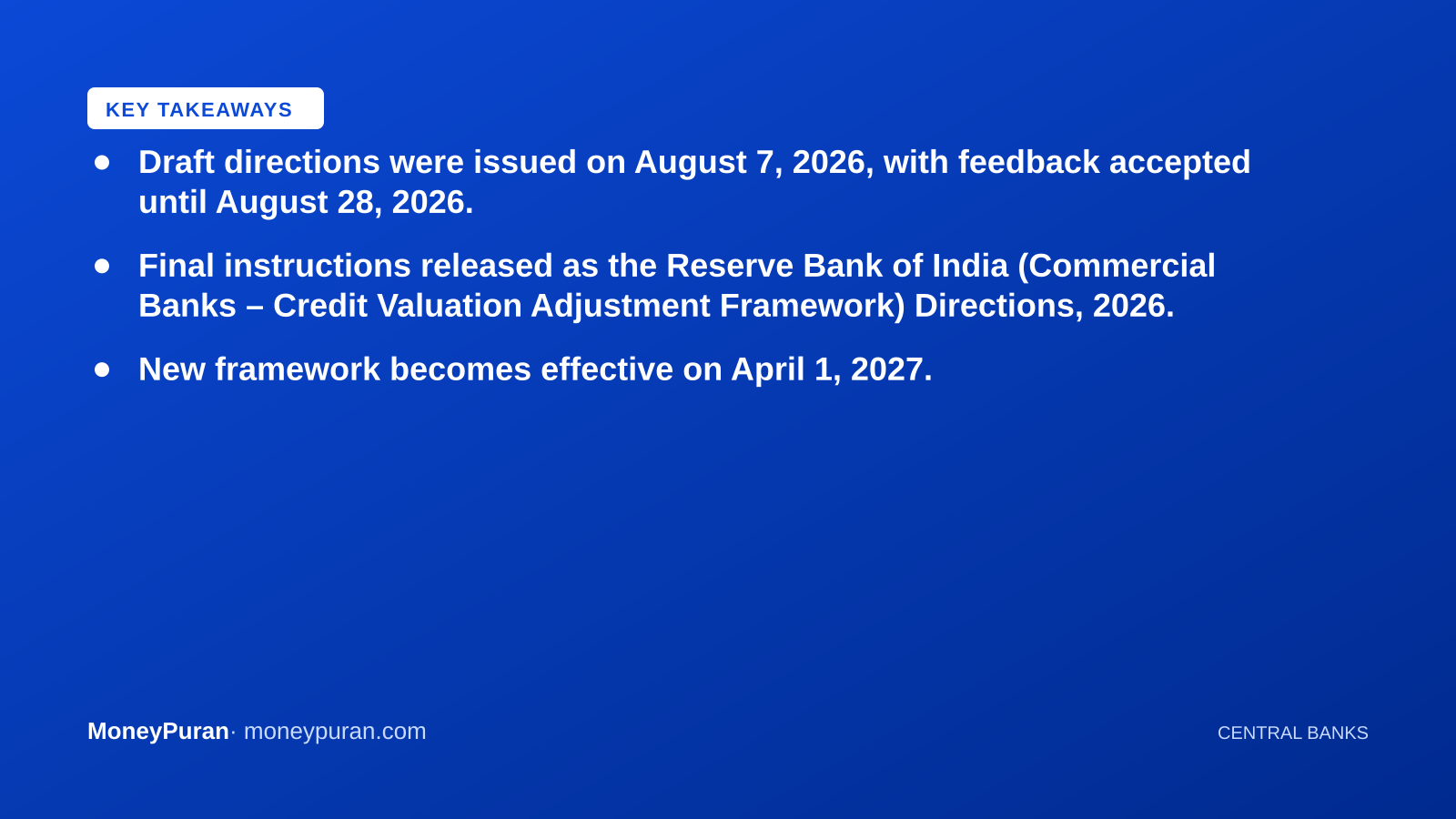
- Draft directions were issued on August 7, 2026, with feedback accepted until August 28, 2026.
- Final instructions released as the Reserve Bank of India (Commercial Banks – Credit Valuation Adjustment Framework) Directions, 2026.
- New framework becomes effective on April 1, 2027.
- Key revisions include simpler approaches for eligible banks and refined risk weight sensitivities.
The Reserve Bank of India (RBI) has officially released the final directions on the Credit Valuation Adjustment (CVA) Framework for commercial banks, following a period of stakeholder consultation. The updated guidelines stem from draft proposals originally published on August 7, 2026, which sought industry feedback through late August. After reviewing the submissions, the central bank incorporated appropriate modifications into the final regulatory text.
The newly minted framework introduces crucial structural updates regarding capital charges for CVA risk across the banking sector. Among the principal revisions are provisions allowing eligible lenders to adopt a simpler calculation approach, alongside heightened sensitivity in supervisory risk weights based on specific counterparty sectors and credit ratings. Furthermore, the instructions clarify the eligibility parameters for recognizing CVA hedges and segment systematic and idiosyncratic risk components within the full Basic Approach calculations to account for imperfectly aligned indirect hedges.
Key Details of the New Framework
- Draft directions introduced: August 7, 2026
- Feedback window closed: August 28, 2026
- Final directions released: October 7, 2026
- Implementation date: April 1, 2027
Commercial banks operating in India will now have until the implementation date to fully align their internal risk management systems, capital adequacy computations, and hedging strategies with the final statutory stipulations. The phased runway gives institutions adequate time to adjust operational models to the more granular risk-weight methodologies introduced by the central bank.
What this means for investors
For investors holding shares in Indian commercial banks, the formalization of the CVA Framework represents a step toward more robust, internationally aligned risk management practices. Because CVA risk charges directly influence how much capital lenders must set aside against potential counterparty credit losses in derivative transactions, these revised rules could incrementally impact capital efficiency.
Lenders that make extensive use of complex derivative books or indirect hedging structures will need to evaluate how the separation of systematic and idiosyncratic risk components affects their regulatory capital requirements ahead of the April 2027 rollout. While the introduction of simpler approaches offers relief for smaller or eligible institutions, investors should monitor upcoming bank disclosures for estimates on capital impact and hedging adjustments.
Frequently asked questions
Question? When do the new CVA directions take effect for commercial banks?
Answer. The Reserve Bank of India has set the implementation date for the final CVA Framework directions as April 1, 2027.
Question? Were changes made to the original draft proposals?
Answer. Yes, the RBI reviewed stakeholder feedback submitted between August 7 and August 28, 2026, and suitably incorporated modifications into the final framework.
This article is for information only and is not investment advice. Do your own research or consult a licensed adviser before investing.
Based on information published by Reserve Bank of India (RBI). Source: Reserve Bank of India (RBI). Spotted an error? corrections@moneypuran.com