 Money
Money

A comprehensive guide breaking down active and passive real estate strategies, essential return metrics, and practical steps for investors in the US and India.

Key points
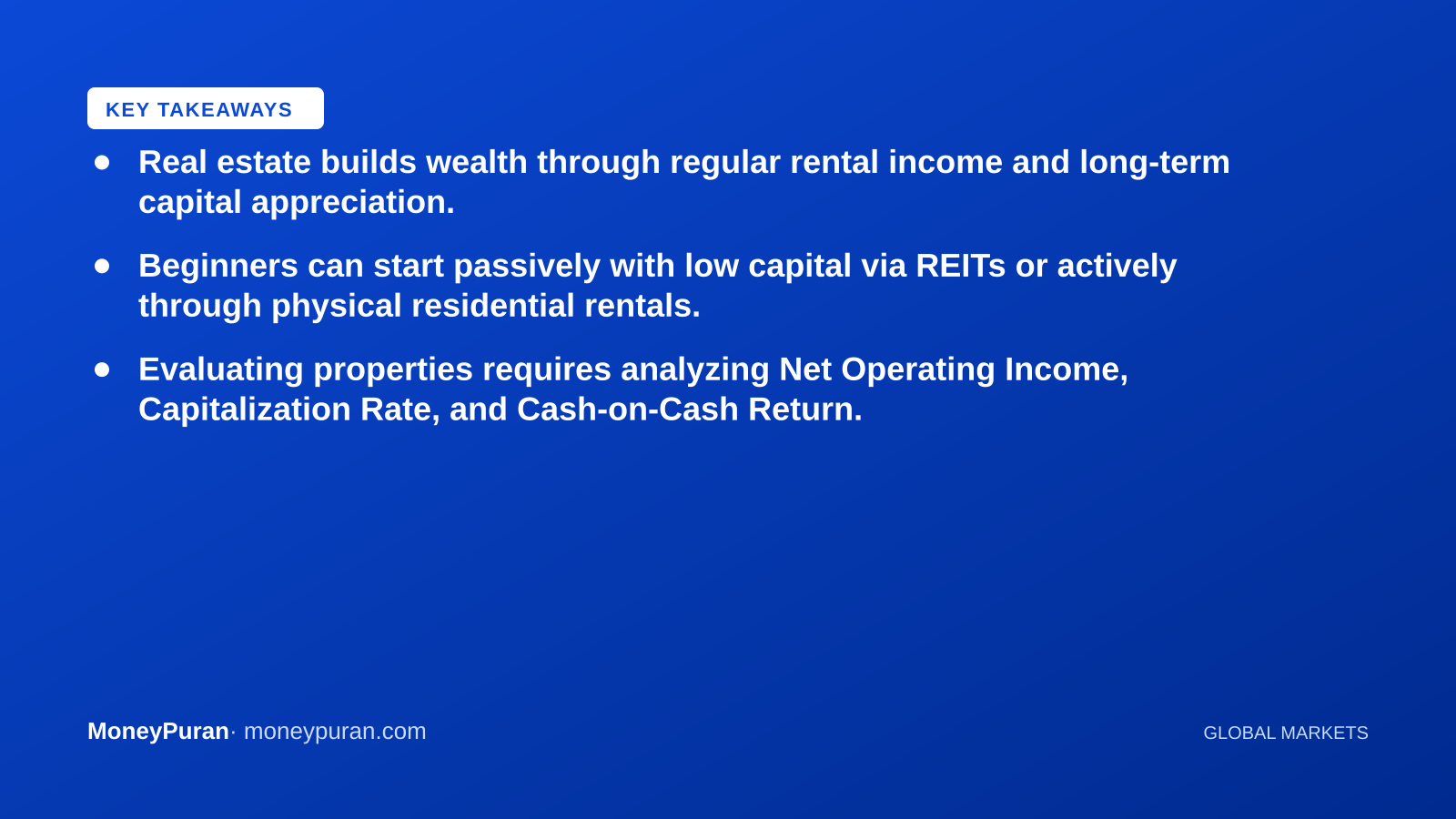
- Real estate builds wealth through regular rental income and long-term capital appreciation.
- Beginners can start passively with low capital via REITs or actively through physical residential rentals.
- Evaluating properties requires analyzing Net Operating Income, Capitalization Rate, and Cash-on-Cash Return.
- Regulatory frameworks and financing structures differ significantly between the US and Indian property markets.
Learning how to start investing in real estate does not require millions of dollars in capital or decades of landlord experience. Today, investors can enter the property market through accessible passive instruments like Real Estate Investment Trusts (REITs) or direct paths such as purchasing rental homes and house hacking. The key to long-term success lies in matching your available capital, time commitment, and risk tolerance to the right real estate vehicle.
Selecting Your Real Estate Strategy
Before buying a single property or purchasing shares in a real estate fund, you must determine whether an active or passive strategy fits your lifestyle and financial plan. Both approaches can build wealth, but they demand vastly different levels of effort and capital.
Passive Investing: For those who prefer a hands-off approach, publicly traded REITs and real estate mutual funds offer instant diversification without management headaches. REITs own and operate income-generating commercial or residential properties and are legally required to distribute the majority of their taxable income to shareholders as dividends. Real estate crowdfunding platforms also allow accredited and non-accredited investors to pool money into specific projects with lower capital requirements.
Active Investing: Active investors buy physical property directly. This includes long-term residential rentals, small multi-family units, or commercial spaces. Another popular entry strategy for beginners is “house hacking,” where an owner lives in one unit of a multi-unit property (like a duplex or triplex) while renting out the remaining units to cover the mortgage and operating costs.
Essential Metrics Every Investor Must Master
Evaluating real estate requires looking beyond simple listing prices. To determine if a deal makes financial sense, investors rely on standard performance metrics to compare properties across different markets.
- Net Operating Income (NOI): Calculated by taking total Gross Operating Income and subtracting all necessary operating expenses (such as property management, insurance, taxes, and maintenance). NOI measures the fundamental profitability of a property before mortgage payments or taxes.
- Capitalization Rate (Cap Rate): Calculated by dividing the property’s annual NOI by its current market value or purchase price. Cap rate provides a benchmark for comparing expected returns on different properties, independent of financing terms.
- Cash-on-Cash Return: Calculated by dividing the annual pre-tax cash flow by the total cash invested (down payment, closing costs, and immediate repairs). This metric reveals the actual yield earned on the physical cash put into the deal.
Step by Step: Launching Your First Investment
If you are ready to transition from research to action, following a systematic process helps minimize risk and prevents costly mistakes during your first transaction.
- Assess your finances: Review your current savings, credit history, and debt-to-income ratio. Determine how much capital you can allocate to a down payment, reserves, or REIT purchases without compromising your emergency fund.
- Select your target niche: Decide whether you will focus on passive stock-market-based real estate instruments, local residential rentals, or fractional online platforms.
- Analyze your local market: Research job growth, population trends, tenant demand, and average rental yields in target neighborhoods. Look for areas with stable economic fundamentals.
- Secure financing or pre-approval: If purchasing physical property, meet with lenders to explore mortgage options, interest rates, and loan terms. Having a formal pre-approval letter strengthens your offer when negotiating.
- Perform rigorous due diligence: Before closing on a property, conduct physical inspections, review historical financial statements, verify tax obligations, and draft reliable lease agreements.
US vs India: Key Differences in Real Estate Markets
While the core principles of property investment remain similar worldwide, regulatory environments, financing instruments, and structural mechanics vary significantly between countries.
In the United States, investors benefit from localized Multiple Listing Services (MLS) for transparent property pricing, standard 30-year fixed-rate mortgages, and tax-deferral tools like 1031 exchanges. Regulatory oversight is managed primarily by agencies like the Securities and Exchange Commission (SEC) for publicly traded funds and state-level real estate commissions for physical sales.
In India, the market relies heavily on Tier-1 and Tier-2 urban residential expansion alongside pre-leased commercial assets. Regulatory protections are governed by the Real Estate (Regulation and Development) Act (RERA) to ensure developer accountability and project timelines. While domestic REIT frameworks regulated by the Securities and Exchange Board of India (SEBI) have grown rapidly, traditional physical investments often require higher upfront equity due to shorter loan tenures and varying bank interest rates.
Managing Real Estate Risks and Cash Flow
Every real estate strategy carries inherent risks, including property vacancies, unexpected maintenance costs, rising interest rates, and illiquidity. Physical properties cannot be sold overnight to access cash, meaning investors must maintain dedicated cash reserves to cover mortgage payments during tenant transitions or emergency repairs.
To protect your portfolio, practice conservative underwriting. Always account for realistic vacancy rates and ongoing capital expenditures when calculating projected cash flow. Diversifying across property types or combining physical investments with liquid REITs can also cushion against market downturns.
Frequently Asked Questions
How much money do I need to start investing in real estate?
You can start investing in real estate with less than $100 by purchasing shares of publicly traded REITs or participating in micro-funding platforms. Direct physical property purchases typically require a down payment ranging from 10% to 25% of the purchase price, plus closing costs and cash reserves.
What is the safest way for a beginner to start?
For most beginners, investing in publicly traded REITs or index funds focused on real estate offers the lowest risk entry point. These assets provide immediate diversification, high liquidity, and professional management without the operational risks of owning physical buildings.
Is real estate better than stock market investing?
Neither asset class is inherently superior; they serve different roles in a portfolio. Real estate provides tangible asset backing, direct leverage opportunities, and tax advantages, while the stock market generally offers higher liquidity, zero property management responsibilities, and lower capital barriers.
This article is for general education and is not investment, tax or financial advice. Rules and figures change — check the official source or a licensed adviser before acting.
Official information: https://www.investor.gov
This explainer is published by the MoneyPuran desk for general awareness. Rules, limits and rates change over time — please confirm with the official source. Corrections: corrections@moneypuran.com