 Money

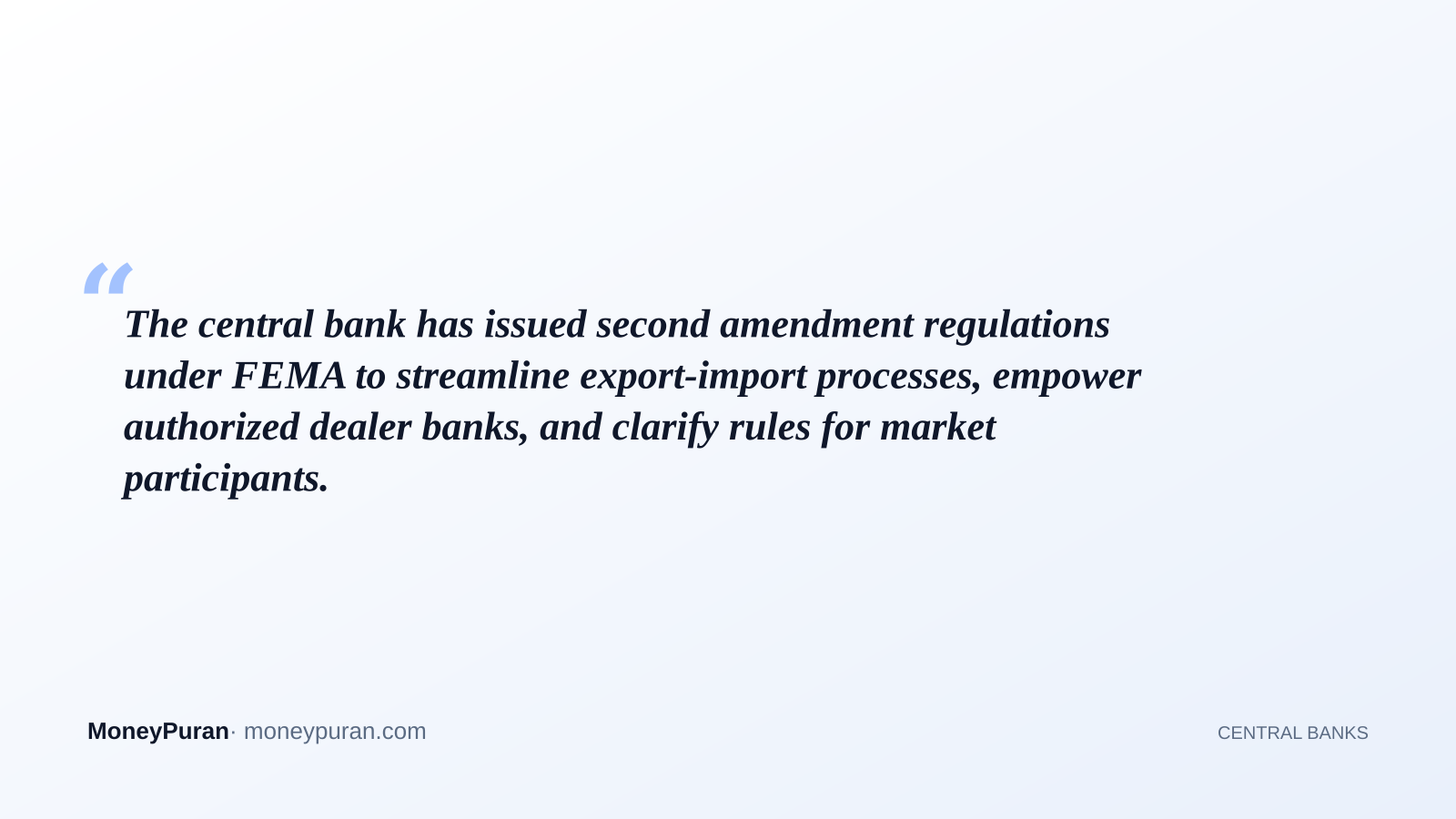
The central bank has issued second amendment regulations under FEMA to streamline export-import processes, empower authorized dealer banks, and clarify rules for market participants.
Key points
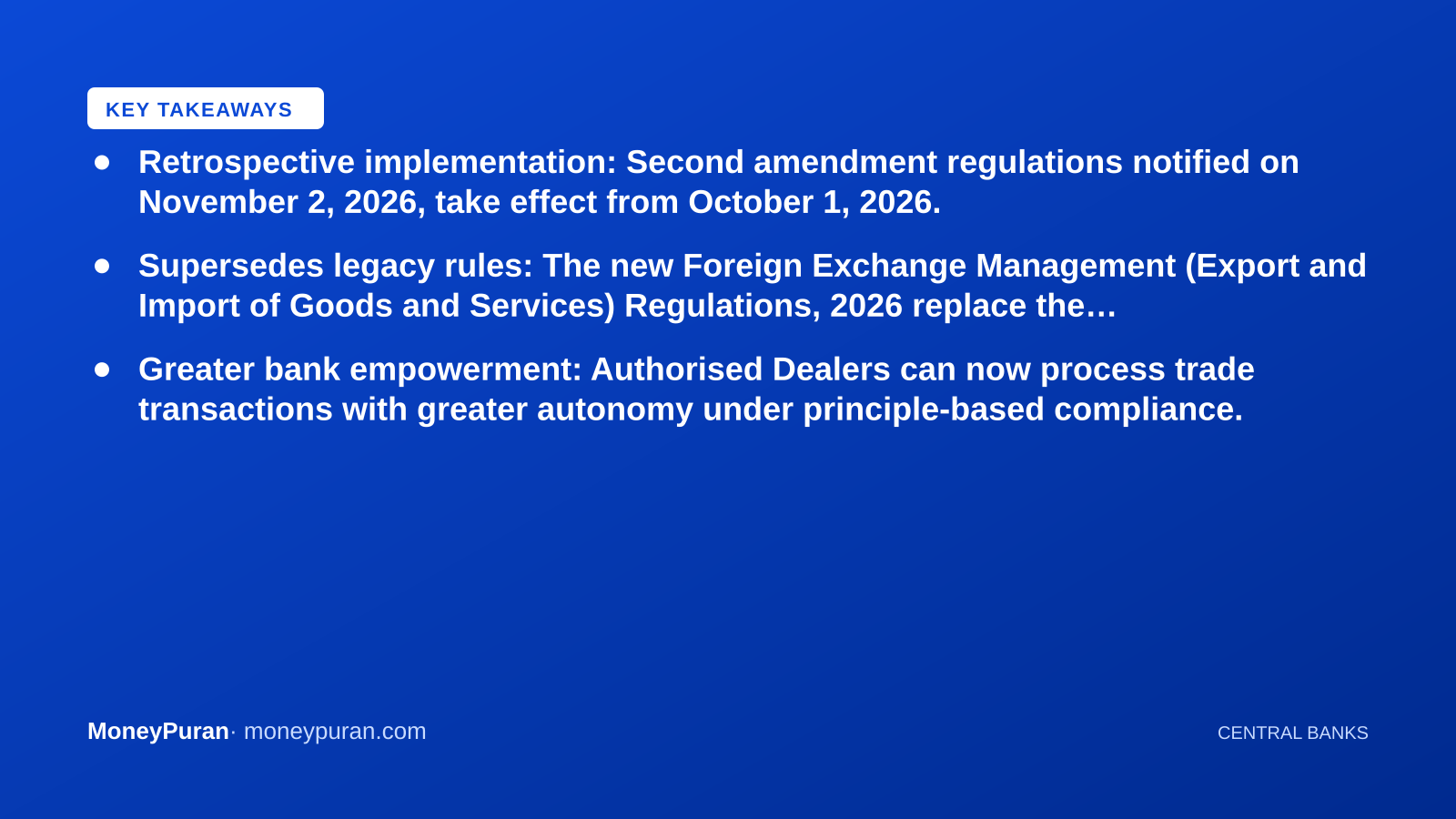
- Retrospective implementation: Second amendment regulations notified on November 2, 2026, take effect from October 1, 2026.
- Supersedes legacy rules: The new Foreign Exchange Management (Export and Import of Goods and Services) Regulations, 2026 replace the 2015 framework.
- Greater bank empowerment: Authorised Dealers can now process trade transactions with greater autonomy under principle-based compliance.
- Focus on MSMEs: Designed to improve the ease of doing business for small exporters and importers across India.
- Clarificatory FAQs: RBI has released comprehensive guidance on its website to assist trade stakeholders.
The Reserve Bank of India has issued updated guidelines under the RBI trade regulations framework to streamline cross-border trade operations for Indian businesses. The central bank announced second amendment regulations to the Foreign Exchange Management (Export and Import of Goods and Services) Regulations, 2026, which took effect retrospectively from October 1, 2026. To aid compliance, the RBI has also published a detailed set of Frequently Asked Questions on its official portal.
Shift to Principle-Based Regulation
The updated rules mark a structural shift from the legacy Foreign Exchange Management (Export of Goods and Services) Regulations, 2015. Originally issued on January 13, 2026, the updated 2026 regulations formally came into force on October 1, 2026. The framework moves away from rigid prescriptive checks toward principle-based compliance, allowing businesses to execute foreign exchange transactions with reduced administrative friction.
By shifting the supervisory approach, the regulator intends to foster an environment conducive to international business growth. Micro, small, and medium enterprises (MSMEs), which frequently face delays during cross-border trade settlements, are expected to benefit significantly from reduced documentation burdens and simpler processing steps.
Key Details of the RBI Trade Notification
- Original Notification Date: January 13, 2026, with an effective date of October 1, 2026.
- Amendment Notification: Published on November 2, 2026, applying retrospectively from October 1, 2026.
- Preceding Rulebook: Foreign Exchange Management (Export of Goods and Services) Regulations, 2015.
- Administrative Entity: Chief General Manager Brij Raj issued the notification via RBI Press Release 2026-2027/1531.
- Implementation Channel: Authorised Dealers (Category-I Banks) empowered to facilitate trade execution.
Empowering Authorised Dealers and Small Businesses
A central pillar of the revised RBI trade regulations is the expanded authority granted to Authorised Dealers (ADs)—primarily commercial banks licensed to deal in foreign exchange. Under the updated framework, AD banks have greater freedom to make operational decisions and handle trade settlements without requiring explicit, step-by-step regulatory approvals for routine matters.
Following feedback from industry associations, exporters, and banking entities after the initial October launch, the central bank notified the Second Amendment Regulations on November 2, 2026. Retrospective application to October 1 ensures seamless continuity for transactions conducted since the beginning of the fourth quarter, eliminating regulatory gaps for ongoing trade contracts.
What this means for investors
For market participants and equity investors tracking Indian commercial sectors, streamlined foreign exchange rules provide a positive macro backdrop. Companies engaged in high-volume export and import activities, such as textiles, pharmaceuticals, auto components, and IT services, stand to gain from faster trade settlement cycles and reduced operational overheads. Lower operational friction typically translates into improved cash flow predictability for trade-oriented firms.
Banking sector investors should note that increased delegation to Authorised Dealer banks puts greater operational responsibilities on commercial lenders. Banks with robust trade-finance infrastructure and digital cross-border transaction platforms are well positioned to capture higher fee-based income by serving export-import clients more efficiently. However, financial institutions must maintain strong internal risk management and compliance audit trails under the principle-based setup.
From a broader economic perspective, procedural easing under the Foreign Exchange Management Act (FEMA) reinforces India’s push to boost merchant exports and integrate small domestic producers into global supply chains. A resilient trade ecosystem supports stable foreign exchange inflows, which ultimately underpins currency stability and investor confidence in domestic financial markets.
Frequently asked questions
Question? What are the new RBI trade regulations?
The Foreign Exchange Management (Export and Import of Goods and Services) Regulations, 2026 replace the older 2015 framework. They introduce principle-based compliance to speed up foreign exchange handling for Indian exporters and importers.
Question? When do the retrospective amendments take effect?
The second amendment regulations, notified by the RBI on November 2, 2026, take effect retrospectively from October 1, 2026.
Question? How do these changes affect small businesses?
Small exporters and importers benefit from reduced procedural delays and less documentation, as Authorised Dealer banks now possess broader powers to approve and settle routine trade transactions directly.
This article is for information only and is not investment advice. Do your own research or consult a licensed adviser before investing.
Based on information published by Reserve Bank of India (RBI). Source: Reserve Bank of India (RBI). Spotted an error? corrections@moneypuran.com