 Money


The central bank penalizes Fusion Finance for regulatory lapses involving customer onboarding documentation and grievance handling.
Key points
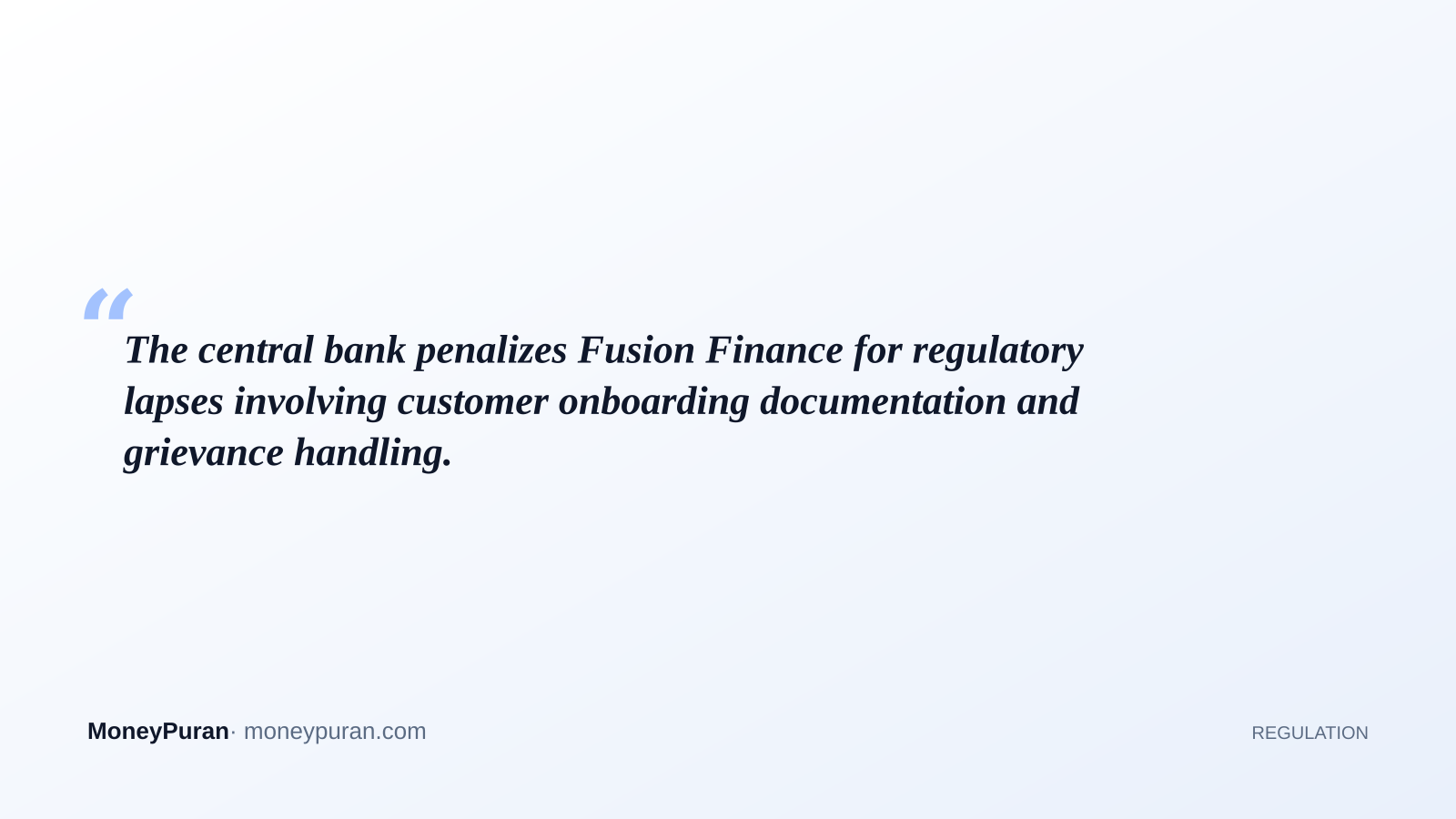
- RBI imposed a monetary penalty of ₹7.50 lakh on Fusion Finance Limited.
- The penalty order is dated November 17, 2026.
- Infractions include failing to obtain PAN or Form 60 during customer onboarding.
- The lender also failed to escalate rejected customer complaints to its Internal Ombudsman on time.
The Reserve Bank of India (RBI) has penalized Fusion Finance Limited ₹7.50 lakh for failing to adhere to regulatory directions governing customer onboarding and grievance redressal. According to an official notification released by the central bank, the punitive action stems from statutory inspections that uncovered critical gaps in how the lender manages customer documentation and complaint escalations.
The central bank stated that its statutory inspection evaluated the financial position of Fusion Finance Limited as of March 31, 2026. Following the supervisory findings, the regulator issued a show-cause notice to the company, asking why financial penalties should not be applied for non-compliance. After reviewing the company’s written replies, additional submissions, and oral representations during a personal hearing, the RBI concluded that the charges against the lender were substantiated.
Details of Regulatory Breaches
The penalty order highlights two distinct areas where Fusion Finance fell short of established regulatory frameworks. First, the lender failed to collect mandatory identification documents—specifically Permanent Account Number (PAN), equivalent e-documents, or Form 60—from customers when establishing new account-based relationships. Proper documentation forms the bedrock of customer verification protocols designed to prevent financial crimes.
Second, the company breached norms regarding customer grievance mechanisms. The investigation revealed that Fusion Finance failed to escalate partly or wholly rejected customer complaints to its Internal Ombudsman for final review within the mandated timeframe. The central bank emphasized that regulatory penalties address compliance deficiencies directly and do not invalidate any transactions or agreements conducted by the company with its customers.
What this means for investors
Regulatory penalties imposed by the central bank serve as a crucial signal for shareholders and prospective investors regarding an institution’s internal governance and compliance culture. While a monetary fine of ₹7.50 lakh is financially minor for a commercial lender, recurring supervisory interventions or compliance failures can point to broader operational risks within customer onboarding and risk management systems.
Investors monitoring non-banking financial companies (NBFCs) should watch how institutions remediate audit findings and tighten operational controls. Compliance failures regarding ‘Know Your Customer’ guidelines and grievance handling can invite stricter regulatory oversight, higher compliance costs, and potential reputational damage over the long term.
Frequently asked questions
Why was Fusion Finance penalized by the RBI? The lender faced a penalty for non-compliance with RBI guidelines concerning Know Your Customer (KYC) documentation and Internal Ombudsman procedures.
What specific compliance failures were noted? Fusion Finance failed to obtain PAN or Form 60 from customers during account opening and missed deadlines for escalating rejected complaints to its Internal Ombudsman.
This article is for information only and is not investment advice. Do your own research or consult a licensed adviser before investing.
Based on information published by Reserve Bank of India (RBI). Source: Reserve Bank of India (RBI). Spotted an error? corrections@moneypuran.com