 Money

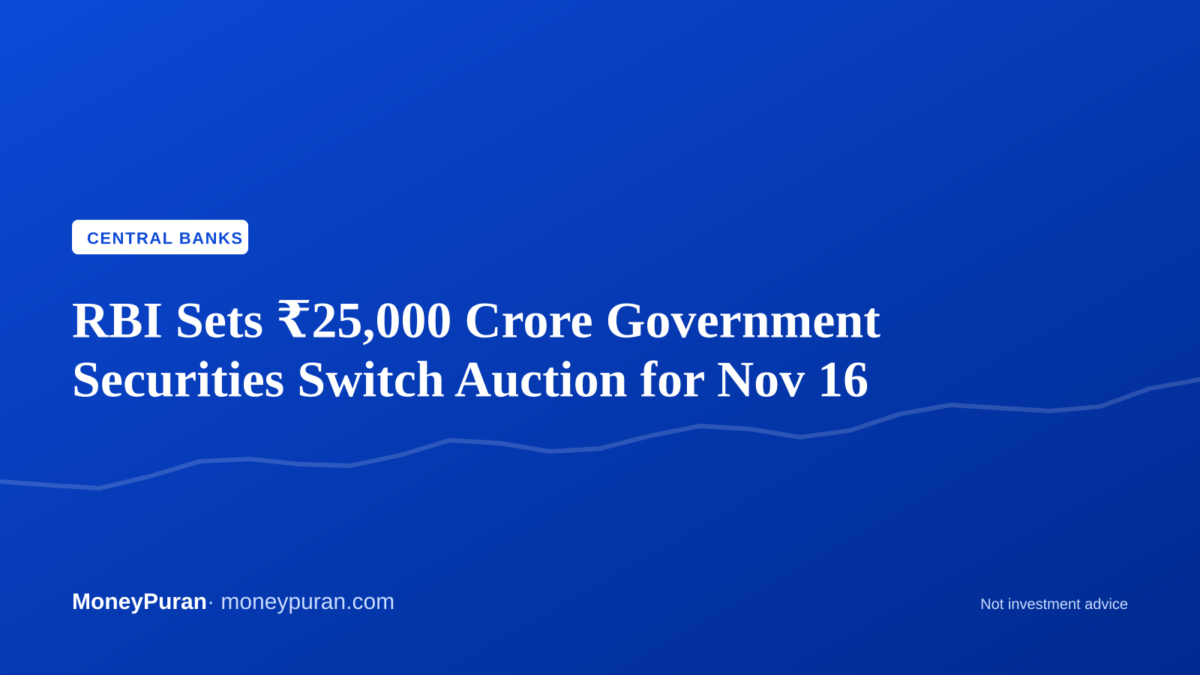
The Government of India is offering to swap near-term maturing sovereign paper for long-dated bonds maturing between 2034 and 2062 to smooth out its redemption profile.
Key points
- Government of India to switch government securities worth ₹25,000 crore aggregate face value.
- Auction scheduled for November 16, 2026, between 10:30 AM and 11:30 AM on the RBI e-Kuber portal.
- Swaps involve six short-term source securities maturing between 2027 and 2029 into destination bonds maturing between 2034 and 2062.
- The auction will follow a multiple-price structure with settlement on a T+1 basis on November 17, 2026.
- Source security prices will be anchored to the previous day’s FBIL closing prices.
The Government of India, in consultation with the Reserve Bank of India (RBI), has announced a major debt management exercise involving the conversion and switch of sovereign bonds worth ₹25,000 crore in aggregate face value. The electronic auction will take place on November 16, 2026, on the central bank’s e-Kuber platform, allowing market participants to exchange near-term maturing paper for longer-dated government securities.
Debt switches are routine liability management operations conducted by central banks globally. By offering market participants the option to roll short-duration government paper into longer maturities, the Ministry of Finance effectively spreads out redemption obligations, alleviating concentration risk in immediate fiscal years while extending the overall duration of national debt.
Breakdown of the ₹25,000 Crore Security Switch
The upcoming transaction covers six distinct source securities maturing between June 2027 and June 2029. Each source bond is paired with a specific destination security maturing between 2034 and 2062. The notified amounts and paper combinations are structured as follows:
- 7.38% GS 2027 (Maturing Jun 20, 2027; ₹5,000 crore) to be switched into 7.18% GS 2037 (Maturing Jul 24, 2037).
- 8.26% GS 2027 (Maturing Aug 02, 2027; ₹2,000 crore) to be switched into 7.40% GS 2062 (Maturing Sep 19, 2062).
- 7.37% GS 2028 (Maturing Oct 23, 2028; ₹4,000 crore) to be switched into 6.83% GS 2039 (Maturing Jan 19, 2039).
- 7.26% GS 2029 (Maturing Jan 14, 2029; ₹4,000 crore) to be switched into 7.73% GS 2034 (Maturing Dec 19, 2034).
- 7.10% GS 2029 (Maturing Apr 18, 2029; ₹5,000 crore) to be switched into 6.64% GS 2035 (Maturing Jun 16, 2035).
- 7.04% GS 2029 (Maturing Jun 03, 2029; ₹5,000 crore) to be switched into 7.41% GS 2036 (Maturing Dec 19, 2036).
Auction Structure and Operational Guidelines
According to the RBI press notification, market participants must submit bids through the Switch Transaction module on the e-Kuber system on November 16, 2026, between 10:30 AM and 11:30 AM. Results will be declared on the same day, with fund and security settlement scheduled for November 17, 2026 (T+1 basis).
The central bank specified that the auction will be multiple-price based, meaning successful bidders will receive allocations at their respective quoted prices for both source and destination bonds. Bids for the source paper must strictly match the Financial Benchmarks India Private Ltd (FBIL) closing price of the source security as of the previous working day; bids non-compliant with this requirement will be rejected outright. The auction cut-off will be determined based on the quoted prices for the destination securities, with pro-rata allotment applicable in case of competitive bidding at the cut-off level.
The minimum bid size is fixed at ₹10,000, with increments in multiples of ₹10,000 thereafter. Although the core swap remains broadly cash-neutral, fund settlement will take place to account for net accrued interest differences between the source and destination holdings, along with any cash adjustments arising from fractional rounding of destination securities.
What this means for investors
For institutional market participants—including commercial banks, primary dealers, insurance companies, and provident funds—the RBI bond switch offers an official, liquid venue to adjust portfolio duration without creating open-market price disruption. Banks seeking to align their Statutory Liquidity Ratio (SLR) portfolios or insurance funds looking to lock in long-term yields can transition out of short-dated paper into 10-year to 36-year sovereign bonds.
For retail investors and fixed-income mutual fund unit holders, debt switch operations signal proactive fiscal management by the Indian government. By deferring principal repayments out to 2034–2062, the government reduces its immediate refinancing pressure. This disciplined debt profile supports market stability across the Indian yield curve and helps maintain orderly conditions in secondary bond markets.
While individual retail investors holding physical G-Secs through RBI Retail Direct are not required to participate in such institutional switch auctions, the resulting shifts in secondary market supply and liquidity across specific benchmark tenors can subtly influence yield movements across short- and long-term debt funds.
Frequently asked questions
What is an RBI debt switch auction? A debt switch auction is an operation where the Reserve Bank of India, acting for the Government of India, buys back short-term government bonds from institutions and simultaneously issues long-term bonds in exchange to manage future debt maturity timelines.
When will the ₹25,000 crore bond switch take place? Bidding opens on November 16, 2026, from 10:30 AM to 11:30 AM on the RBI e-Kuber portal, with settlement occurring on November 17, 2026.
How does this affect bond market yields? By replacing short-term paper with long-term paper, the government avoids heavy cash redemptions in 2027–2029. This active liability management tends to support bond market stability by preventing supply bottlenecks in specific maturity buckets.
This article is for information only and is not investment advice. Do your own research or consult a licensed adviser before investing.
Based on information published by Reserve Bank of India (RBI). Source: Reserve Bank of India (RBI). Spotted an error? corrections@moneypuran.com