 Money


Following the creation of three new administrative districts in Delhi, the Reserve Bank of India has assigned lead bank responsibilities to major public sector lenders.
Key points
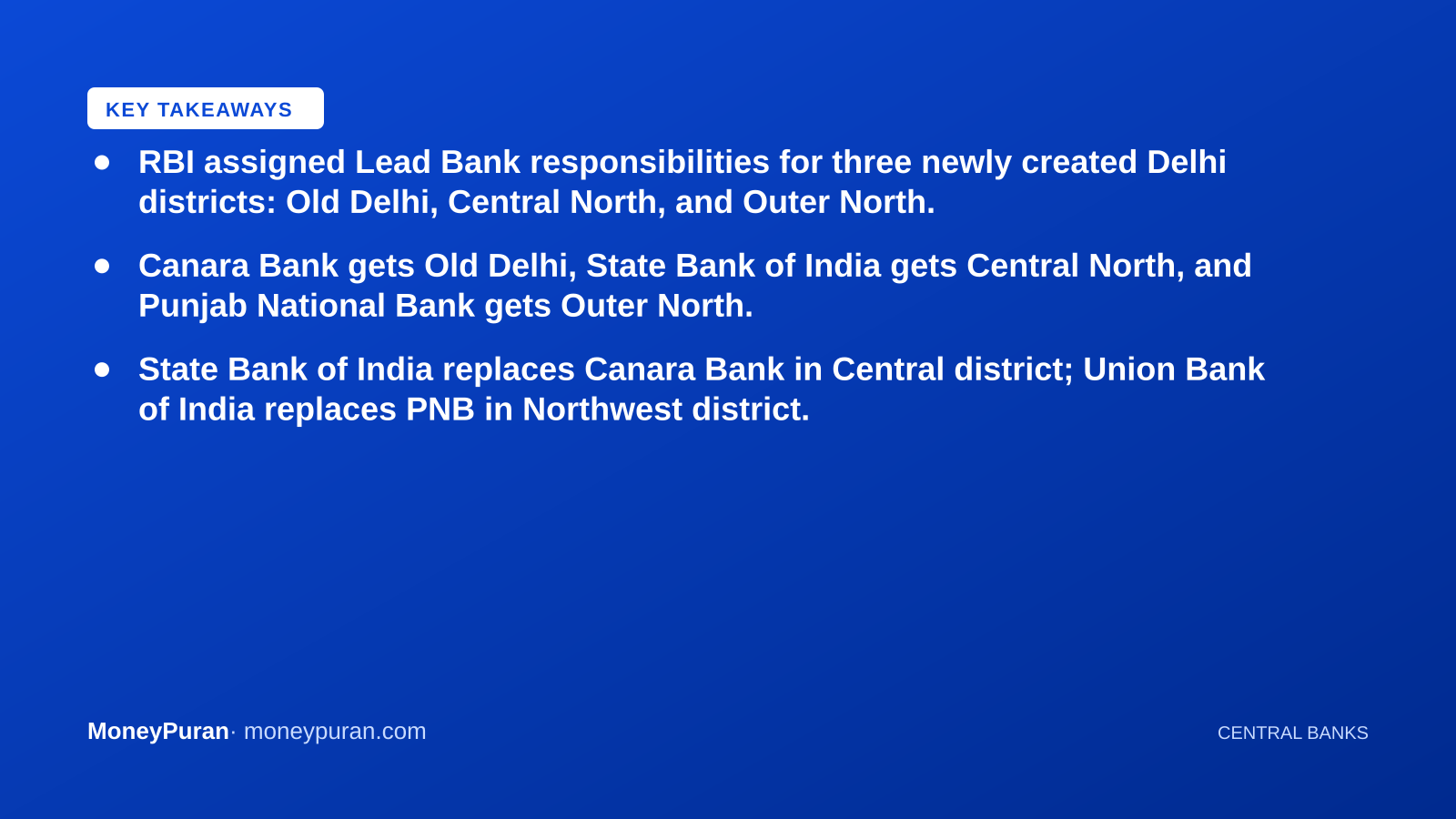
- RBI assigned Lead Bank responsibilities for three newly created Delhi districts: Old Delhi, Central North, and Outer North.
- Canara Bank gets Old Delhi, State Bank of India gets Central North, and Punjab National Bank gets Outer North.
- State Bank of India replaces Canara Bank in Central district; Union Bank of India replaces PNB in Northwest district.
- Lead Bank responsibility for the erstwhile Shahdara district, previously held by Bank of Baroda, has been revoked.
The Reserve Bank of India (RBI) has issued updated instructions regarding Delhi lead bank responsibilities across the National Capital Territory (NCT) of Delhi following an administrative reorganisation of the region’s districts. In a official notification issued to chief executives of designated commercial lenders on October 26, 2026, the central bank allocated lead bank duties for three newly formed districts and revised existing assignments for two others.
The administrative updates follow a Gazette notification by the Government of NCT of Delhi issued on December 25, 2025. The territorial realignment led to the creation of three new administrative units—Old Delhi, Central North, and Outer North—while the Shahdara district ceased to exist as a standalone administrative division.
New Lead Bank Assignments Across Delhi
Under the revised framework announced by the central bank, public sector lenders have been assigned specific coverage areas to coordinate district-level banking services and credit delivery. Canara Bank has been assigned lead bank responsibility for the newly created Old Delhi district under district working code 03E. State Bank of India (SBI) will take charge of the Central North district under code 03F, while Punjab National Bank (PNB) has been designated as the lead bank for the Outer North district under code 03G.
In addition to assigning roles for the new territories, the RBI reviewed and updated lead bank responsibilities for existing districts affected by boundary shifts. State Bank of India has replaced Canara Bank as the lead lender for the Central district (code 358). Meanwhile, Union Bank of India has taken over lead bank duties for the Northwest district (code 362), replacing Punjab National Bank.
Because Shahdara district was abolished during the administrative reorganisation, the RBI formally revoked the lead bank responsibility previously assigned to Bank of Baroda in July 2013 under district code 369. The central bank confirmed that lead bank arrangements in all remaining Delhi districts remain unchanged.
Key Lead Bank Responsibilities at a Glance
The RBI circular establishes specific district working codes and lead bank assignments across Delhi’s updated administrative boundaries:
- Old Delhi (New District): Canara Bank assigned as Lead Bank (District Working Code: 03E).
- Central North (New District): State Bank of India assigned as Lead Bank (District Working Code: 03F).
- Outer North (New District): Punjab National Bank assigned as Lead Bank (District Working Code: 03G).
- Central District: Responsibility transferred to State Bank of India from Canara Bank (District Working Code: 358).
- Northwest District: Responsibility transferred to Union Bank of India from Punjab National Bank (District Working Code: 362).
- Shahdara District: Lead bank designation for Bank of Baroda revoked following district dissolution.
Understanding the Role of the Lead Bank Scheme
The Lead Bank Scheme was established by the Reserve Bank of India to ensure coordinated banking development across administrative districts in India. Under this framework, a designated commercial bank acts as a coordinator for a given district to survey local financial requirements, identify credit gaps, and draft District Credit Plans (DCP) in consultation with state government authorities and development agencies.
The designated lead bank convenes District Consultative Committee (DCC) and State Level Bankers’ Committee (SLBC) meetings, acting as a crucial administrative bridge between government machinery and commercial financial institutions. While lead banks do not hold a monopoly over retail or commercial banking business within their assigned districts, they carry primary responsibility for driving financial inclusion drives, opening branches in underbanked areas, and monitoring priority sector lending targets.
What this means for investors
For investors tracking public sector banks such as State Bank of India, Punjab National Bank, Canara Bank, Union Bank of India, and Bank of Baroda, the RBI notification represents an administrative alignment rather than a direct earnings driver. Lead bank designations do not restrict commercial branch expansion by competing banks within a district, nor do they grant exclusive commercial lending rights to the assigned bank.
However, holding lead bank status involves administrative commitments and social sector coordination. Assigned banks must deploy administrative resources to prepare annual credit plans, coordinate government-sponsored social security schemes, and manage multi-bank district committees. In rapidly expanding industrial belts like Outer North or heavily populated commercial markets like Old Delhi, serving as the lead bank allows institutions to establish strong relationships with local civic authorities and trade associations.
Over time, designated lead banks frequently benefit from closer ties with local administrative bodies, which can support institution-level goodwill and priority banking flows. Equity investors should view these administrative changes as operational realignments that support broader priority sector lending and branch distribution without altering the underlying fundamental valuation of the involved state-owned banks.
Frequently asked questions
What is the Lead Bank Scheme in India? The Lead Bank Scheme is an RBI administrative framework that assigns a specific commercial bank to coordinate credit delivery, priority sector lending, and financial inclusion initiatives within a designated district.
Which banks received new lead bank mandates in Delhi? State Bank of India, Punjab National Bank, Canara Bank, and Union Bank of India were assigned lead roles across newly created and modified districts in Delhi.
Does a lead bank have exclusive commercial rights in a district? No. Any licensed bank can open branches and conduct business in any district. The lead bank’s role is focused on administrative coordination, planning, and financial inclusion initiatives.
This article is for information only and is not investment advice. Do your own research or consult a licensed adviser before investing.
Based on information published by Reserve Bank of India (RBI) — notifications. Source: Reserve Bank of India (RBI) — notifications. Spotted an error? corrections@moneypuran.com