 Money
Money

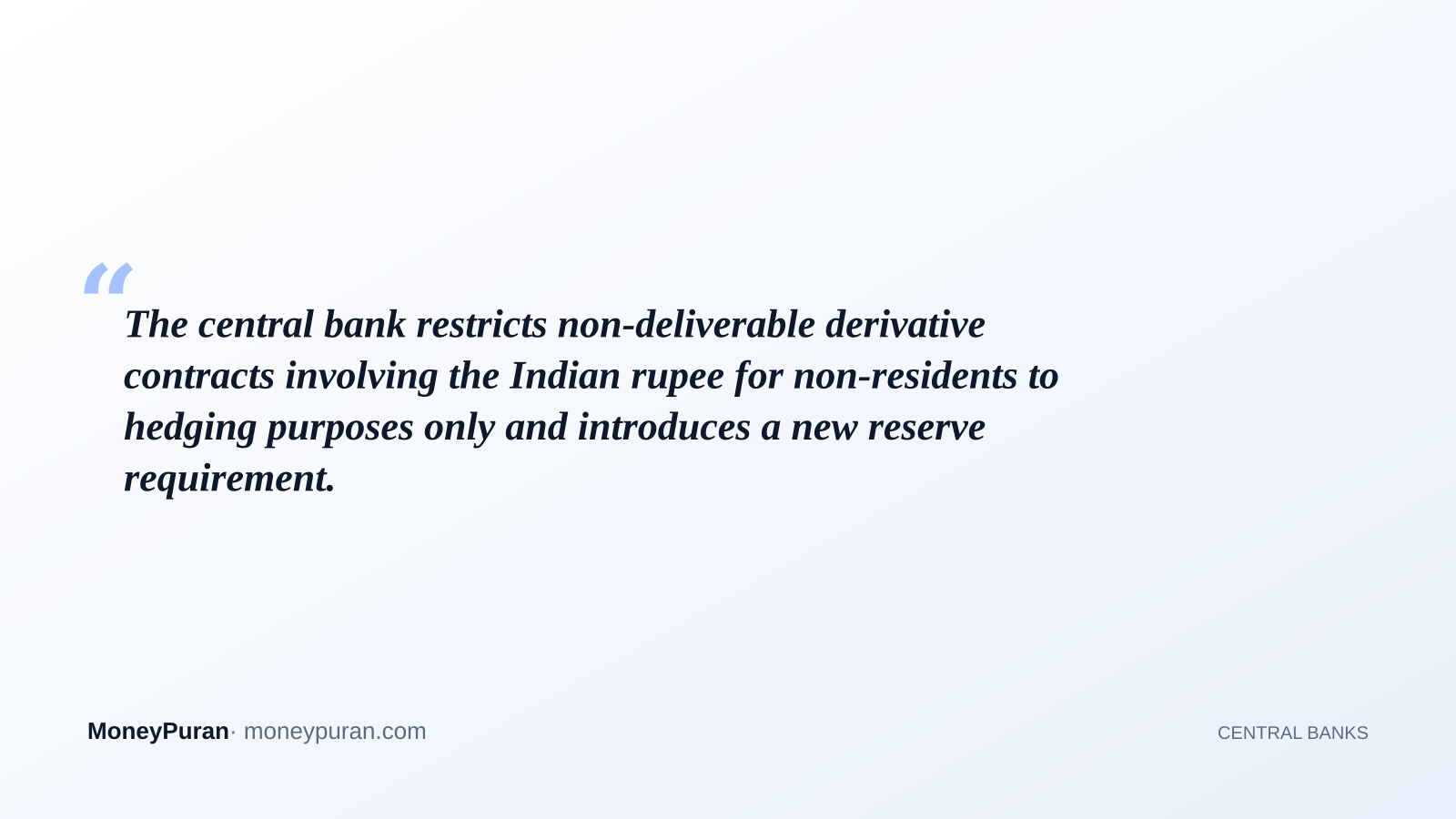
The central bank restricts non-deliverable derivative contracts involving the Indian rupee for non-residents to hedging purposes only and introduces a new reserve requirement.
Key points
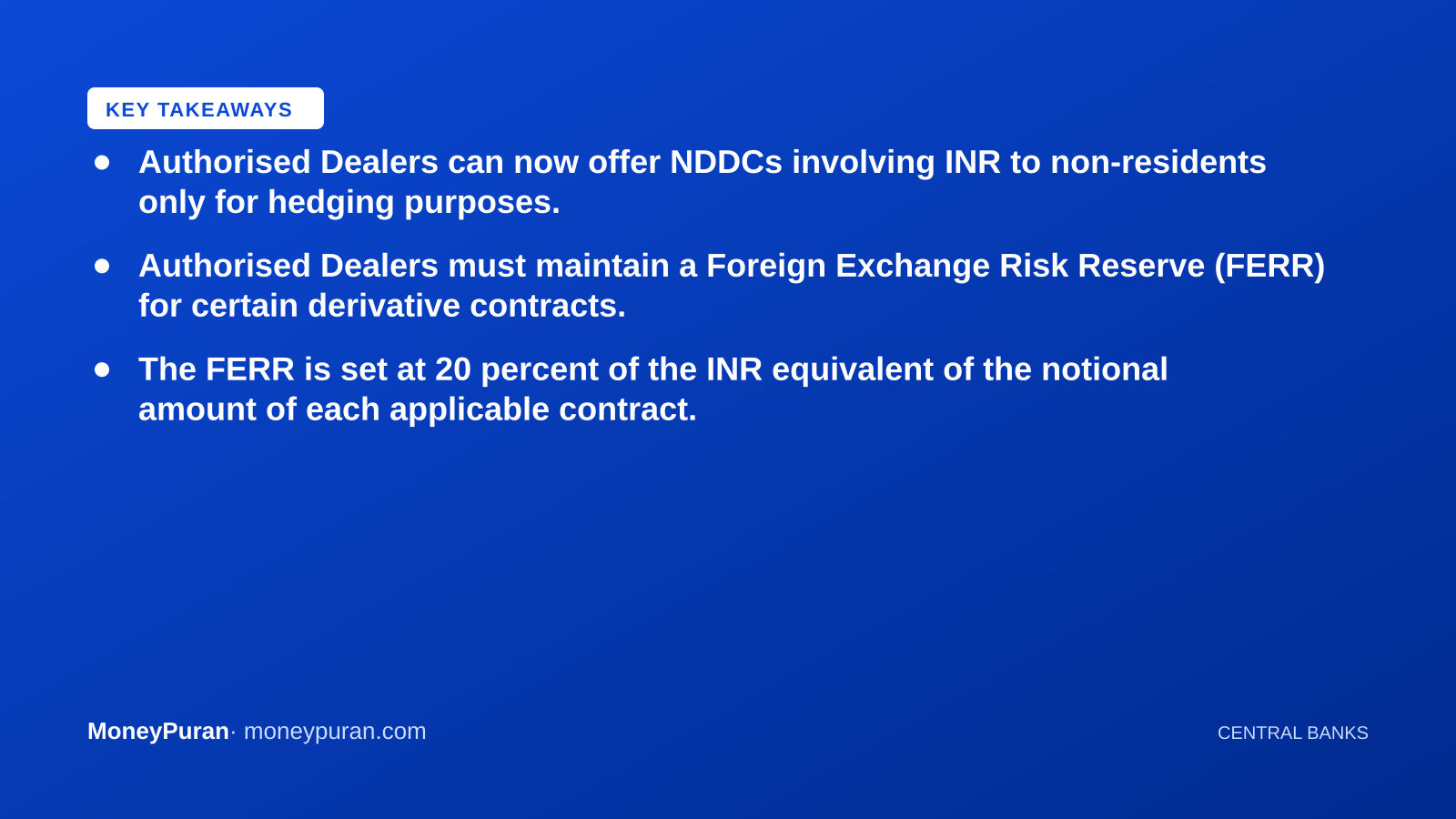
- Authorised Dealers can now offer NDDCs involving INR to non-residents only for hedging purposes.
- Authorised Dealers must maintain a Foreign Exchange Risk Reserve (FERR) for certain derivative contracts.
- The FERR is set at 20 percent of the INR equivalent of the notional amount of each applicable contract.
- Reserves must be deposited in cash daily with the Reserve Bank of India until contract termination.
The Reserve Bank of India (RBI) has issued a fresh circular tightening the regulatory framework around risk management and inter-bank dealings. In a directive directed to all Authorised Dealers, the central bank announced major modifications concerning non-deliverable derivative contracts (NDDCs) involving the Indian rupee (INR) and introduced mandatory reserve requirements for foreign exchange derivatives.
Previously, specific Authorised Dealer Category-I banks operating in IFSC Banking Units and Standalone Primary Dealers could offer INR-involving NDDCs to non-resident users without any purpose restrictions. Under the updated guidelines issued via circular RBI/2026-27/293, these financial institutions must now offer NDDCs to non-residents strictly for hedging purposes. The move aims to streamline offshore-onshore currency dynamics and curb speculative activities involving the local currency.
New Foreign Exchange Risk Reserve Mandated
Alongside the hedging restriction, the central bank has introduced a structural liquidity safeguard. Authorised Dealers are now required to maintain a Foreign Exchange Risk Reserve (FERR) for foreign exchange derivative contracts involving the rupee undertaken to hedge the currency risk of their own assets and liabilities.
According to the notification signed by Chief General Manager Dimple Bhandia, this reserve applies to all foreign exchange derivative contracts involving INR where the Authorised Dealer purchases foreign currency against the rupee. The required FERR amount is fixed at 20 per cent of the INR equivalent of the notional amount of each relevant derivative contract.
- FERR must be deposited and maintained in cash within India.
- Deposits must be managed on a daily basis with the Reserve Bank.
- The reserve must be held continuously until the final termination of the underlying contract.
What this means for investors
For Indian market participants, banks, and institutional investors, these regulatory adjustments mark a deliberate effort by the central bank to tighten control over offshore rupee derivatives and speculative flows. By confining non-resident NDDC participation strictly to genuine hedging needs, the RBI reduces potential volatility driven by speculative bets on the rupee in offshore financial hubs.
Furthermore, the requirement for banks and dealers to lock up a 20 percent cash reserve against specific foreign exchange derivative contracts changes capital allocation considerations for institutions managing currency risk. While it safeguards domestic financial stability, it also increases the operational cost of structuring certain hedging transactions for authorized dealers, which could influence pricing and liquidity in the forward and derivative segments.
Frequently asked questions
Who is affected by the new RBI circular? The circular applies directly to all Authorised Dealers, including banks operating IFSC Banking Units and Standalone Primary Dealers.
Are existing derivative contracts impacted? No, the new directions apply specifically to foreign exchange derivative contracts undertaken after the issuance of the directives on October 12, 2026.
This article is for information only and is not investment advice. Do your own research or consult a licensed adviser before investing.
Based on information published by Reserve Bank of India (RBI) — notifications. Source: Reserve Bank of India (RBI) — notifications. Spotted an error? corrections@moneypuran.com