 Money
Money
Understand the mechanics of passive market tracking, see concrete examples of portfolios, and learn how fees impact long-term returns in both the US and India.

Key points
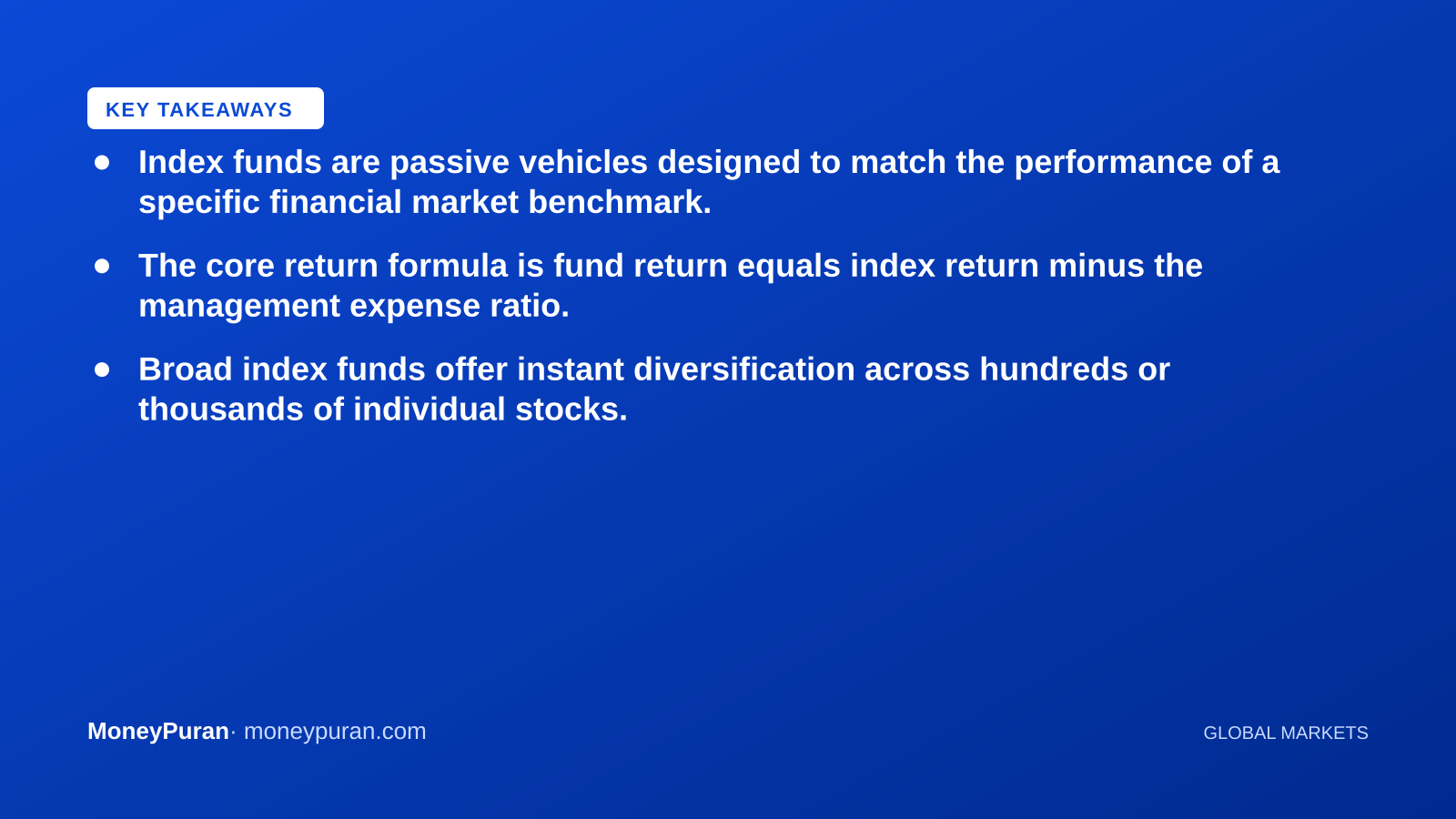
- Index funds are passive vehicles designed to match the performance of a specific financial market benchmark.
- The core return formula is fund return equals index return minus the management expense ratio.
- Broad index funds offer instant diversification across hundreds or thousands of individual stocks.
- Expense ratios vary by region, with US broad funds typically lower than direct plans in India.
An index fund is a type of mutual fund or exchange-traded fund built to track a specific financial market benchmark, rather than relying on a human manager to handpick individual stocks. By holding a representative basket of the securities that make up an index, these funds aim to deliver the overall return of that market segment minus a small management fee.
Defining the Core Mechanics
When you buy shares in an index fund, you purchase a tiny slice of an entire portfolio designed to mirror a target index. The performance equation is straightforward: $R_{fund} = R_{index} – \text{Expense Ratio}$. Because there is no active research team trying to beat the market, operational costs stay remarkably low.
This passive approach eliminates the risk of human error or poor stock selection by a manager. Instead of trying to find a needle in a haystack, an index fund simply buys the whole haystack.
A Concrete Portfolio Breakdown
To understand what is an index fund example in practice, look at a fund tracking the S&P 500 in the United States or the Nifty 50 in India. If you invest in a fund tracking the S&P 500, your money is automatically distributed across roughly 500 of the largest publicly traded American corporations spanning technology, healthcare, finance, and consumer goods.
If a particular company grows and enters the index, or shrinks and is removed, the fund adjusts its holdings to match. You achieve instant diversification with a single transaction, reducing the risk tied to any single corporate failure.
Comparing Fees Across Regions
Cost is one of the most vital factors when evaluating passive portfolios. For broad US index funds, expense ratios typically range from $0.03\%$ to $0.20\%$. In contrast, direct plans in India generally range from $0.10\%$ to $1.00\%$ due to differing market structures, distribution models, and regulatory caps set by authorities like SEBI.
Over decades of compounding, even a small difference in fees can significantly impact total accumulated wealth. Always review the scheme document to confirm the exact ongoing costs before investing.
US versus India Regulatory Frameworks
While the underlying philosophy of passive tracking is identical globally, structural details differ between regions. In the United States, investors utilize platforms and accounts like IRAs and 401(k)s subject to limits set annually by the IRS. In India, investors use mutual funds or ETFs via Demat accounts, keeping tax rules aligned with domestic capital gains frameworks updated by the Ministry of Finance.
Both jurisdictions enforce strict regulatory oversight to ensure transparency, but the specific tax slabs, holding periods, and account contributions must be checked against official guidelines.
Frequently asked questions
Do index funds guarantee a positive return? No. While they offer broad diversification, their value fluctuates with the overall market. If the underlying index drops, the fund drops as well.
How often do index funds trade their holdings? They only rebalance when the underlying benchmark adjusts its constituents, which is usually done quarterly or annually, keeping turnover extremely low.
Can I lose all my money in an index fund? Total loss is virtually impossible unless every single company in a major benchmark goes bankrupt simultaneously, which would represent a catastrophic global economic failure.
This article is for general education and is not investment, tax or financial advice. Rules and figures change — check the official source or a licensed adviser before acting.
Official information: https://www.investor.gov
This explainer is published by the MoneyPuran desk for general awareness. Rules, limits and rates change over time — please confirm with the official source. Corrections: corrections@moneypuran.com