 Money
Money
The Reserve Bank of India has restricted withdrawals and fresh deposit acceptance at The Tiruvalla Urban Co-operative Bank due to its deteriorating liquidity position, while assuring eligible account holders of DICGC insurance coverage up to ₹5 lakh.
Key points
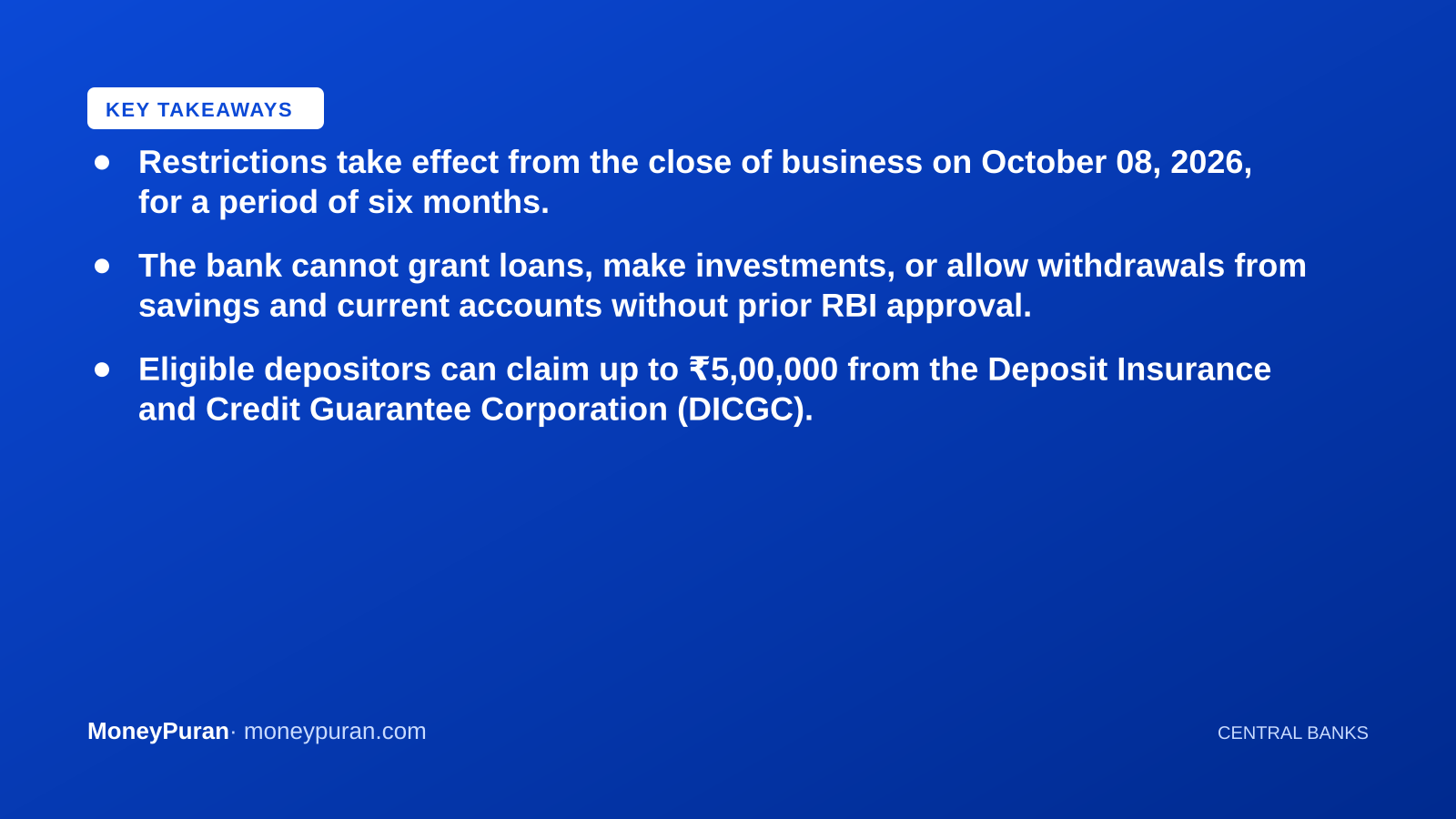
- Restrictions take effect from the close of business on October 08, 2026, for a period of six months.
- The bank cannot grant loans, make investments, or allow withdrawals from savings and current accounts without prior RBI approval.
- Eligible depositors can claim up to ₹5,00,000 from the Deposit Insurance and Credit Guarantee Corporation (DICGC).
- Essential expenses such as employee salaries, rent, and utility bills are permitted under the directive.
The Reserve Bank of India (RBI) has issued strict regulatory directions against The Tiruvalla Urban Co-operative Bank Ltd., located in Pathanamthitta, halting major banking operations and placing a total freeze on customer withdrawals. Announced via a press release on October 8, 2026, the supervisory action stems from the lender’s weak liquidity position and a persistent failure by its management to address prior regulatory concerns flagged by the central bank over the past few years.
Under the directive issued pursuant to Section 35A read with Section 56 of the Banking Regulation Act, 1949, the cooperative lender is barred from granting or renewing loans, acquiring investments, or accepting fresh deposits. Furthermore, the bank cannot disburse any payments or dispose of its assets without explicit written permission from the RBI. Crucially, account holders are currently prohibited from withdrawing funds from their savings, current, or other deposit accounts, though the institution is permitted to offset loans against existing deposits under specific conditions.
Impact on Depositors and Insurance Coverage
For ordinary savers holding money in the institution, the regulatory intervention brings immediate liquidity stress, as cash withdrawals are frozen. However, the central bank clarified that eligible account holders are entitled to claim insurance payouts on their deposits up to a monetary ceiling of ₹5,00,000. These claims are processed through the Deposit Insurance and Credit Guarantee Corporation (DICGC) under the DICGC Act, 1961, subject to formal willingness submissions and verification checks.
- Effective date: Close of business on October 8, 2026
- Duration of directions: Six months initially, subject to ongoing review
- DICGC insurance limit: Up to ₹5,00,000 per eligible depositor
- Permitted expenses: Essential operational costs including employee salaries and utility bills
The central bank emphasized that placing these constraints does not mean the institution’s banking license has been cancelled. The lender is permitted to continue conducting banking business under the strict oversight of the specified limitations while financial conditions are evaluated. The regulatory authority will continue monitoring the institution and may modify or relax the directives depending on future improvements in its financial health.
What this means for investors
For Indian retail investors and depositors holding funds in cooperative banks, actions like this highlight the distinct risk profile associated with smaller co-operative lenders compared to larger scheduled commercial banks. While cooperative institutions often offer competitive deposit interest rates, they can face localized liquidity strains if loan recoveries falter or governance falls short of regulatory expectations.
Depositors must remember that funds held in cooperative banks are backed by DICGC insurance, but this coverage is strictly capped at ₹5 lakh per depositor per bank (inclusive of principal and interest). If your total deposits across savings and fixed accounts exceed this threshold in a single distressed institution, the excess amount remains vulnerable during liquidation or restructuring. Diversifying savings across larger commercial banks and keeping co-operative bank exposure within insured limits is a standard risk-mitigation practice for cautious savers.
Frequently asked questions
Can I withdraw any money from my account at Tiruvalla Urban Co-operative Bank? No, general withdrawals from savings, current, or other deposit accounts are currently not allowed, except for specific loan-to-deposit adjustments permitted under the RBI guidelines.
How do I claim my insured money through DICGC? Eligible depositors can receive their deposit insurance claim up to ₹5 lakh from the DICGC by submitting their formal willingness and completing verification procedures through the bank or the official DICGC portal.
Does this mean the bank is permanently closed? Not necessarily. The directions are in force for six months and represent a corrective supervisory step, not an outright cancellation of the banking license.
This article is for information only and is not investment advice. Do your own research or consult a licensed adviser before investing.
Based on information published by Reserve Bank of India (RBI). Source: Reserve Bank of India (RBI). Spotted an error? corrections@moneypuran.com