 Money
Money

Indian benchmark indices closed lower on October 2, 2026, with the Sensex falling over one percent and the rupee sliding against the US dollar.
Key points
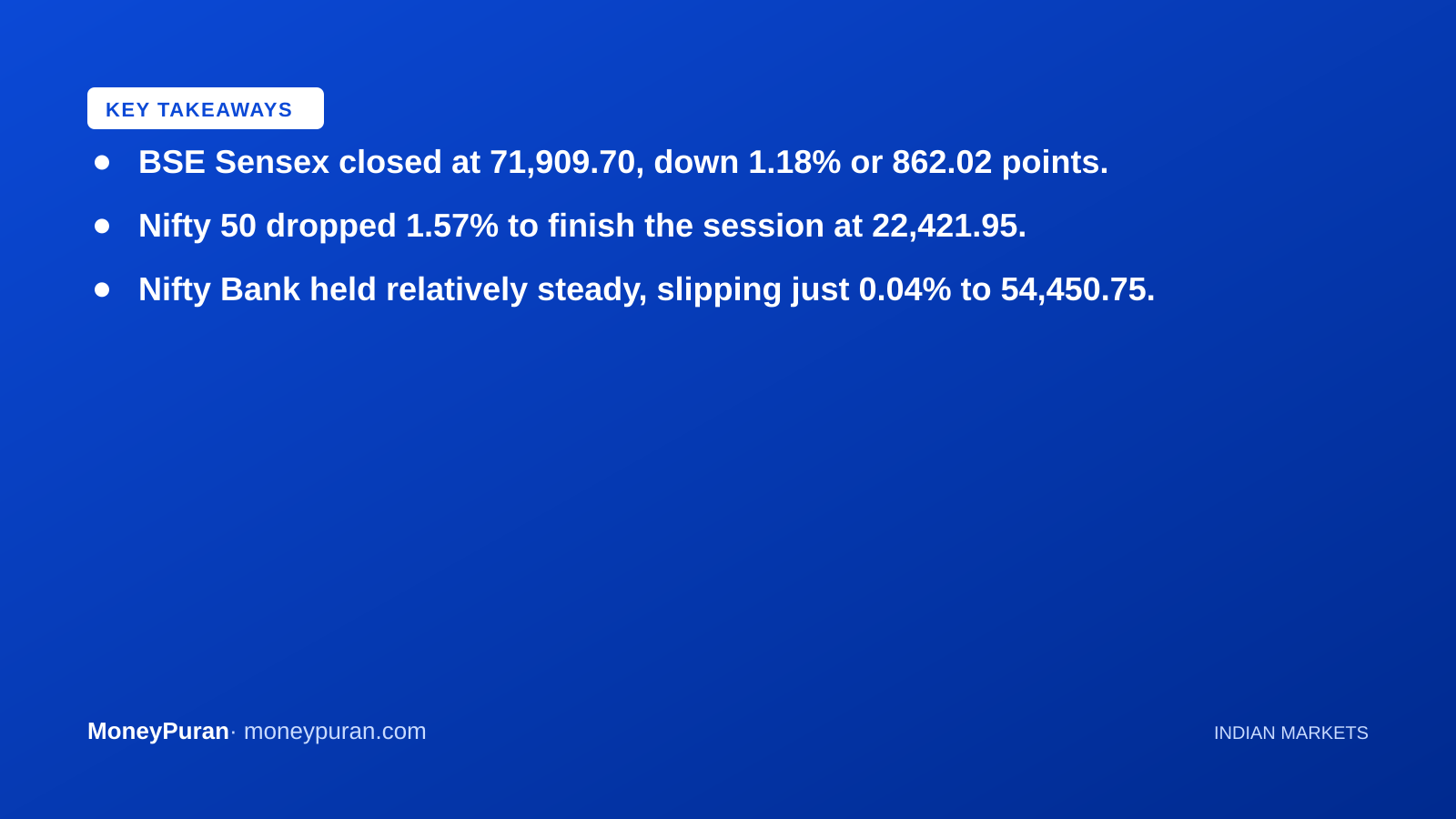
- BSE Sensex closed at 71,909.70, down 1.18% or 862.02 points.
- Nifty 50 dropped 1.57% to finish the session at 22,421.95.
- Nifty Bank held relatively steady, slipping just 0.04% to 54,450.75.
- USD/INR exchange rate rose 0.53% to settle at 96.30.
Indian benchmark stock indices recorded sharp losses during the trading session on October 2, 2026, as selling pressure swept across major counters. The Bombay Stock Exchange BSE Sensex and the National Stock Exchange NSE Nifty 50 both finished deep in the red, mirroring broader risk-off sentiment in domestic equities. Investors tracking why the market moved today will note the convergence of falling index values alongside a weakening local currency against the greenback.
How the Indices Performed at the Closing Bell
The BSE Sensex shed 1.18% to close at 71,909.70, dropping from its previous close of 72,771.72. Throughout the session, the benchmark traded within a daily range of 71,292.88 to 72,572.90. Meanwhile, the broader Nifty 50 index registered a steeper decline of 1.57%, losing 358.30 points to settle at 22,421.95 compared to its previous close of 22,780.25. The Nifty 50 experienced intraday volatility, touching a low of 22,217.30 and a high of 22,610.60.
Sector Performance and Currency Movements
While frontline equities faced heavy selling, the banking sector showed resilience. The Nifty Bank index ended almost flat, down a minimal 0.04% at 54,450.75 after swinging between 54,066.60 and 55,091.45 during the day. In the foreign exchange market, the USD/INR currency pair moved higher by 0.53%, ending the session at 96.30, compared to the previous close of 95.79.
What this means for investors
Sharp declines in headline indices like the Sensex and Nifty often prompt anxiety among retail participants, but sudden drops are a standard feature of equity market cycles. When indices correct by over one percent in a single session, it typically reflects broader institutional rebalancing or macroeconomic crosscurrents rather than the underlying fundamentals of individual companies. Investors examining their portfolios during such sell-offs should review their asset allocation rather than reacting impulsively to single-day price movements.
A rising USD/INR exchange rate also introduces distinct implications for market participants. While a weaker rupee can benefit export-oriented sectors such as IT services and pharmaceuticals by boosting foreign currency earnings in local terms, it simultaneously increases the cost of imported commodities like crude oil, which can pressure domestic inflation and corporate margins. Maintaining a diversified portfolio across sectors can help mitigate volatility during currency fluctuations.
Frequently asked questions
What were the closing levels for Sensex and Nifty 50? The BSE Sensex closed at 71,909.70, down 1.18%, while the Nifty 50 finished at 22,421.95, recording a drop of 1.57%.
How did the banking sector perform during the session? The Nifty Bank index remained relatively resilient, closing nearly unchanged down 0.04% at 54,450.75 despite broader market declines.
This article is for information only and is not investment advice. Do your own research or consult a licensed adviser before investing.
Based on information published by MoneyPuran market data. Source: MoneyPuran market data. Spotted an error? corrections@moneypuran.com