 Money
Money
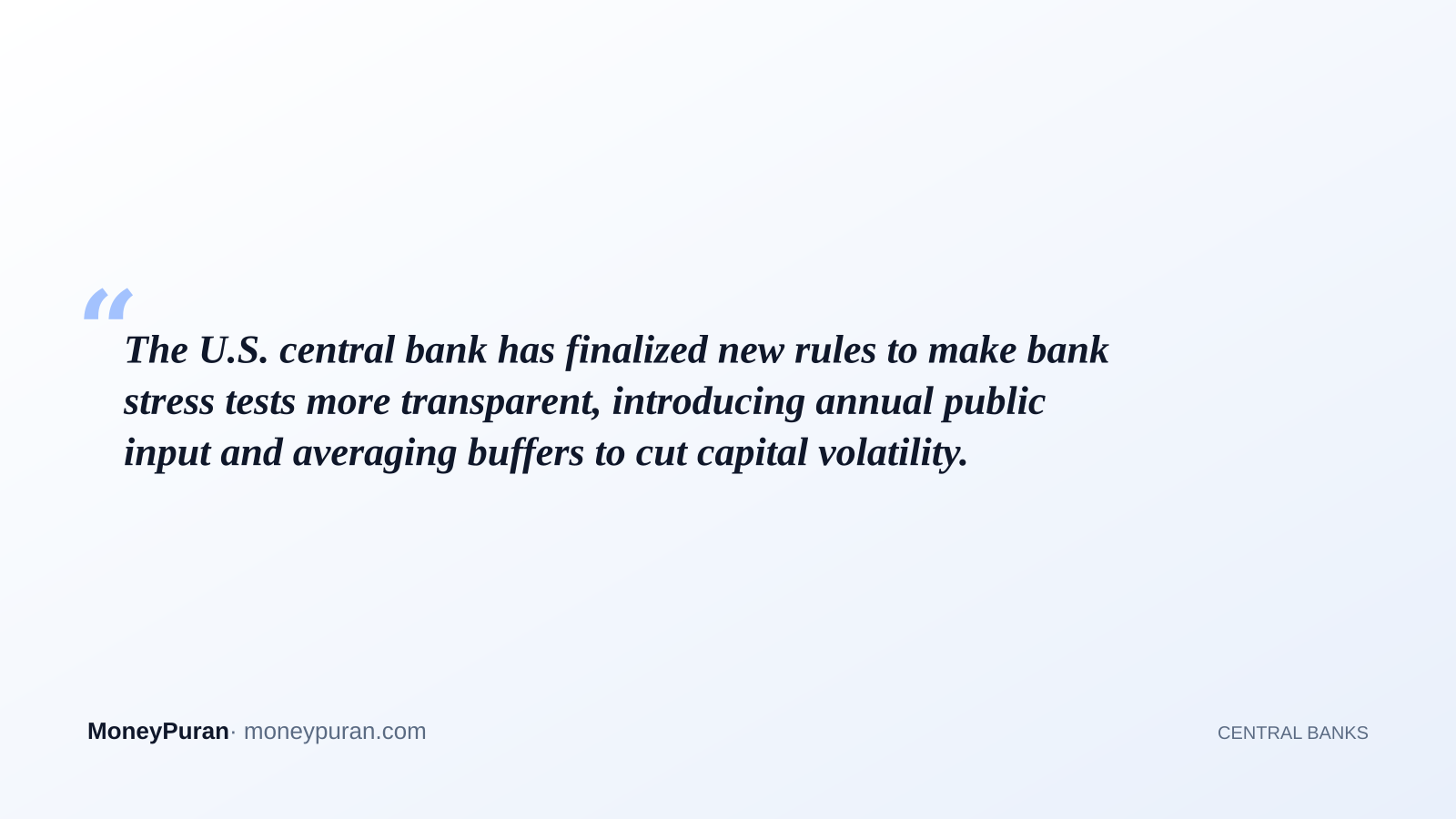
The U.S. central bank has finalized new rules to make bank stress tests more transparent, introducing annual public input and averaging buffers to cut capital volatility.
Key points
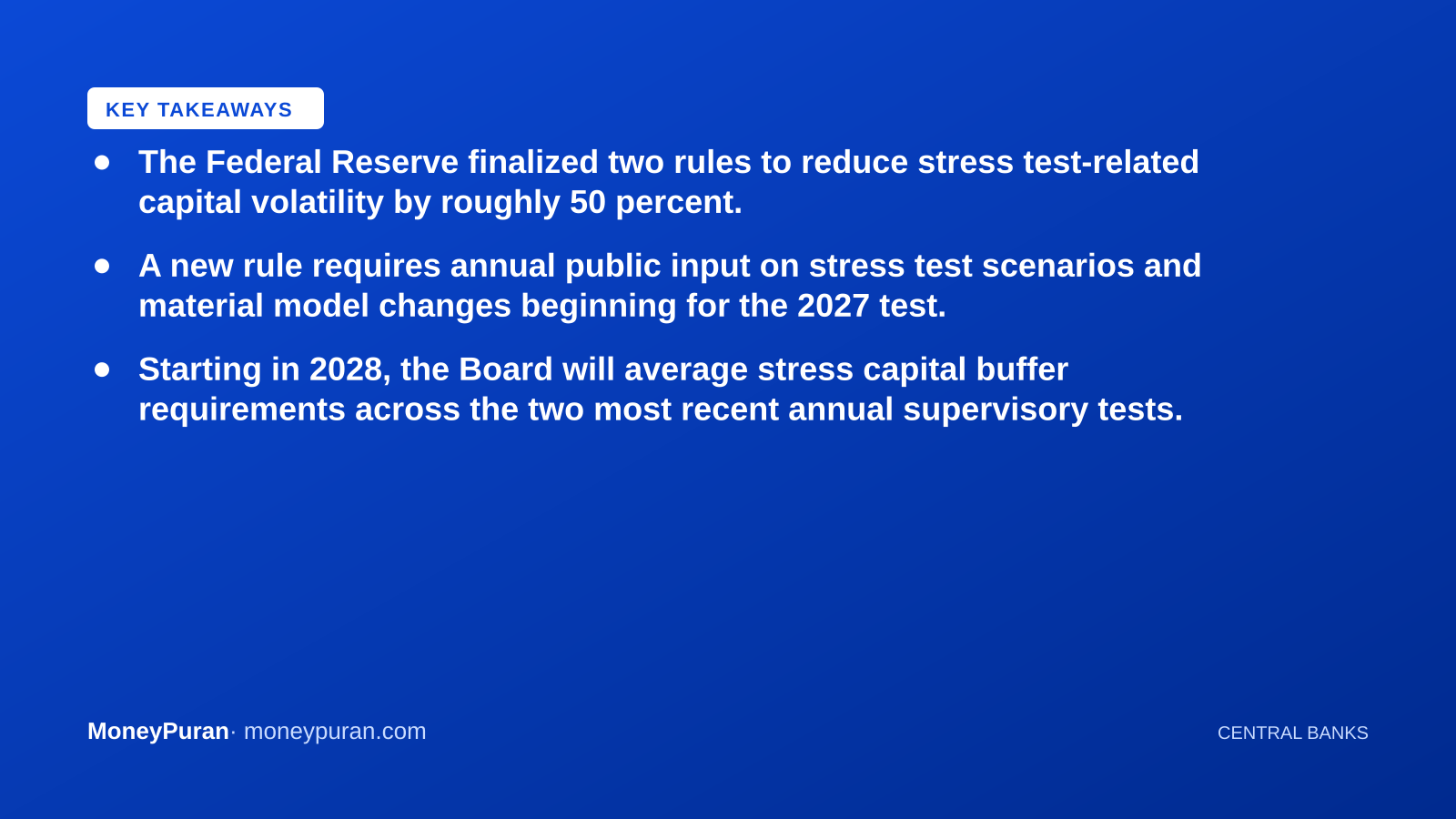
- The Federal Reserve finalized two rules to reduce stress test-related capital volatility by roughly 50 percent.
- A new rule requires annual public input on stress test scenarios and material model changes beginning for the 2027 test.
- Starting in 2028, the Board will average stress capital buffer requirements across the two most recent annual supervisory tests.
- The Board also proposed a revision to noninterest income models to better capture fee income and business model diversity.
The U.S. Federal Reserve Board has finalized major structural changes to its bank stress testing framework, aiming to slash year-over-year volatility in capital requirements by roughly 50 percent without altering aggregate capital demands. Announced by the central bank, the package includes two final rules designed to increase public accountability and transparency while modifying how banks calculate their stress capital buffers.
Vice Chair for Supervision Michelle W. Bowman stated that the updates preserve the core resilience of the regulatory capital framework by ensuring tests remain granular and risk-sensitive. The adjustments follow proposed rules introduced in 2025 and set the stage for updated supervisory models ahead of the 2027 stress test cycle.
Key changes to scenarios and capital buffers
The first final rule mandates that the Board solicit annual public input on hypothetical stress test scenarios and any material modifications to underlying models. It also updates the global market shock component for institutions with extensive trading books. These banks will face two global market shock components annually, with supervisors applying the one producing the largest losses to determine individual firm results.
Under the second final rule, the Board will begin averaging stress capital buffer requirements using the results from the two most recent annual supervisory stress tests. This averaging methodology will take effect in 2028, ensuring that buffer calculations rely exclusively on models that have incorporated public feedback. Additionally, the Fed issued a separate proposal seeking comment on a revised noninterest income model to better account for diverse business models and fee-generation strategies across large financial institutions.
What this means for investors
For investors monitoring large banking institutions, reduced capital volatility offers greater predictability in financial planning and capital return programs such as dividends and share buybacks. Sudden, sharp swings in capital requirements have historically forced banks to alter capital deployment strategies unexpectedly.
While aggregate capital requirements are not expected to change materially, the introduction of public comment periods and averaging mechanisms removes some of the opacity surrounding annual stress test outcomes. Investors should watch how individual institutions adapt to dual global market shock testing and whether the proposed fee-income adjustments alter specific bank buffers over the next few cycles.
Frequently asked questions
What is the main goal of the Fed’s new stress test rules? The primary objective is to enhance transparency, incorporate public input, and reduce year-over-year volatility in bank capital requirements by about 50 percent.
When will the new stress capital buffer averaging take effect? The Board will begin averaging stress capital buffer requirements across the two most recent annual supervisory stress tests starting in 2028.
This article is for information only and is not investment advice. Do your own research or consult a licensed adviser before investing.
Based on information published by U.S. Federal Reserve Board. Source: U.S. Federal Reserve Board. Spotted an error? corrections@moneypuran.com