 Money
Money

Benchmarks Sensex and Nifty 50 recorded sharp losses alongside the banking sector, while the rupee traded higher against the US dollar.
Key points
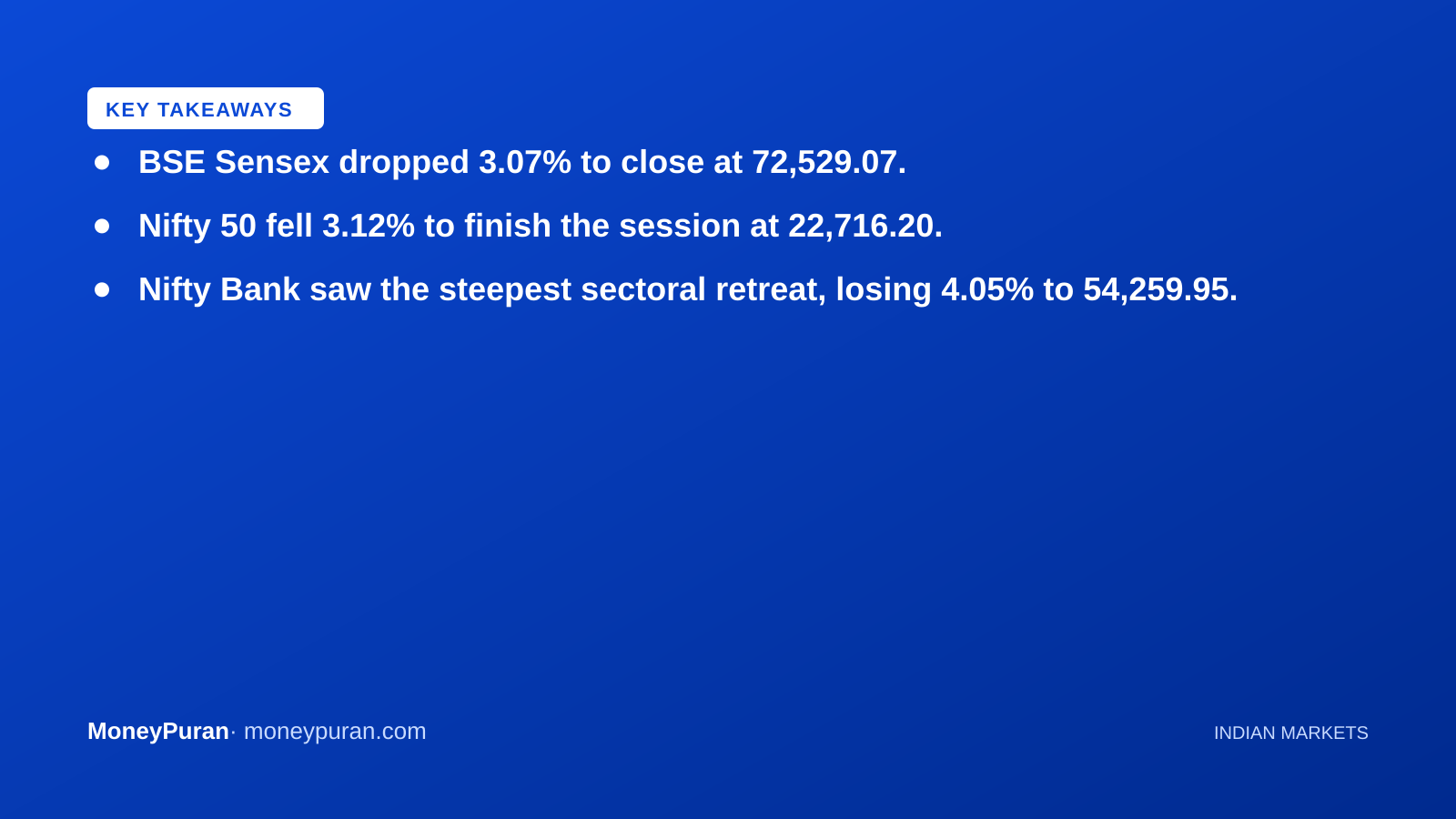
- BSE Sensex dropped 3.07% to close at 72,529.07.
- Nifty 50 fell 3.12% to finish the session at 22,716.20.
- Nifty Bank saw the steepest sectoral retreat, losing 4.05% to 54,259.95.
- USD/INR exchange rate rose 0.29% to settle at 95.97.
The Indian stock market suffered a heavy downturn during the trading session on September 29, 2026, with benchmark indices plunging over three percent amid broad-based selling pressure. Both retail and institutional participants navigated a turbulent environment as indices touched intraday lows well below previous closing levels. To understand broader trends affecting domestic equities, investors often examine why the market moved today when assessing sudden volatility across key indices.
Benchmark Index Closing Figures
The BSE Sensex retreated 2,299.18 points, or 3.07 percent, to settle at 72,529.07. Throughout the session, the 30-share gauge moved within a wide daily range of 72,064.00 and 72,684.90, failing to hold earlier support levels. Similarly, the broader Nifty 50 index dropped 730.60 points, or 3.12 percent, to close at 22,716.20. The 50-stock index touched an intraday low of 22,569.65 before finding tentative stabilization near the closing bell.
- BSE Sensex close: 72,529.07 (down 3.07%)
- Nifty 50 close: 22,716.20 (down 3.12%)
- Nifty Bank close: 54,259.95 (down 4.05%)
- USD/INR exchange rate: 95.97 (up 0.29%)
Banking Sector and Currency Movements
Financial stocks bore the brunt of the selling activity during the session. The Nifty Bank index recorded the steepest decline among major sectoral gauges, plunging 4.05 percent, or 2,288.95 points, to finish at 54,259.95. The banking index traded between an intraday low of 53,785.70 and a high of 54,405.30. In the foreign exchange market, the USD/INR currency pair edged higher, gaining 0.29 percent to trade at 95.97, reflecting mild downward pressure on the domestic currency against the US dollar.
What this means for investors
A sharp correction of over three percent in the Indian stock market serves as a stark reminder of the volatility inherent in equities. For long-term investors, sudden market-wide drawdowns often prompt a re-evaluation of asset allocation and risk tolerance rather than reactive decision-making. Watching how indices behave around key support levels in subsequent sessions can provide better clarity on near-term market direction.
Market participants should monitor upcoming macroeconomic data releases, institutional flow trends, and global cues that typically influence domestic sentiment. Maintaining diversification across asset classes remains a standard approach for managing portfolio risk during periods of heightened market turbulence.
Frequently asked questions
What were the closing levels for the Sensex and Nifty 50? The BSE Sensex closed at 72,529.07, down 3.07 percent, while the Nifty 50 finished at 22,716.20, dropping 3.12 percent.
Which sector saw the heaviest losses during the session? The Nifty Bank index led the decline among major sectors, falling 4.05 percent to close at 54,259.95.
This article is for information only and is not investment advice. Do your own research or consult a licensed adviser before investing.
Based on information published by MoneyPuran market data. Source: MoneyPuran market data. Spotted an error? corrections@moneypuran.com