 Money
Money

Indian benchmark indices suffered steep losses as the BSE Sensex and Nifty 50 dropped more than two percent amid heavy selling pressure across sectors.
Key points
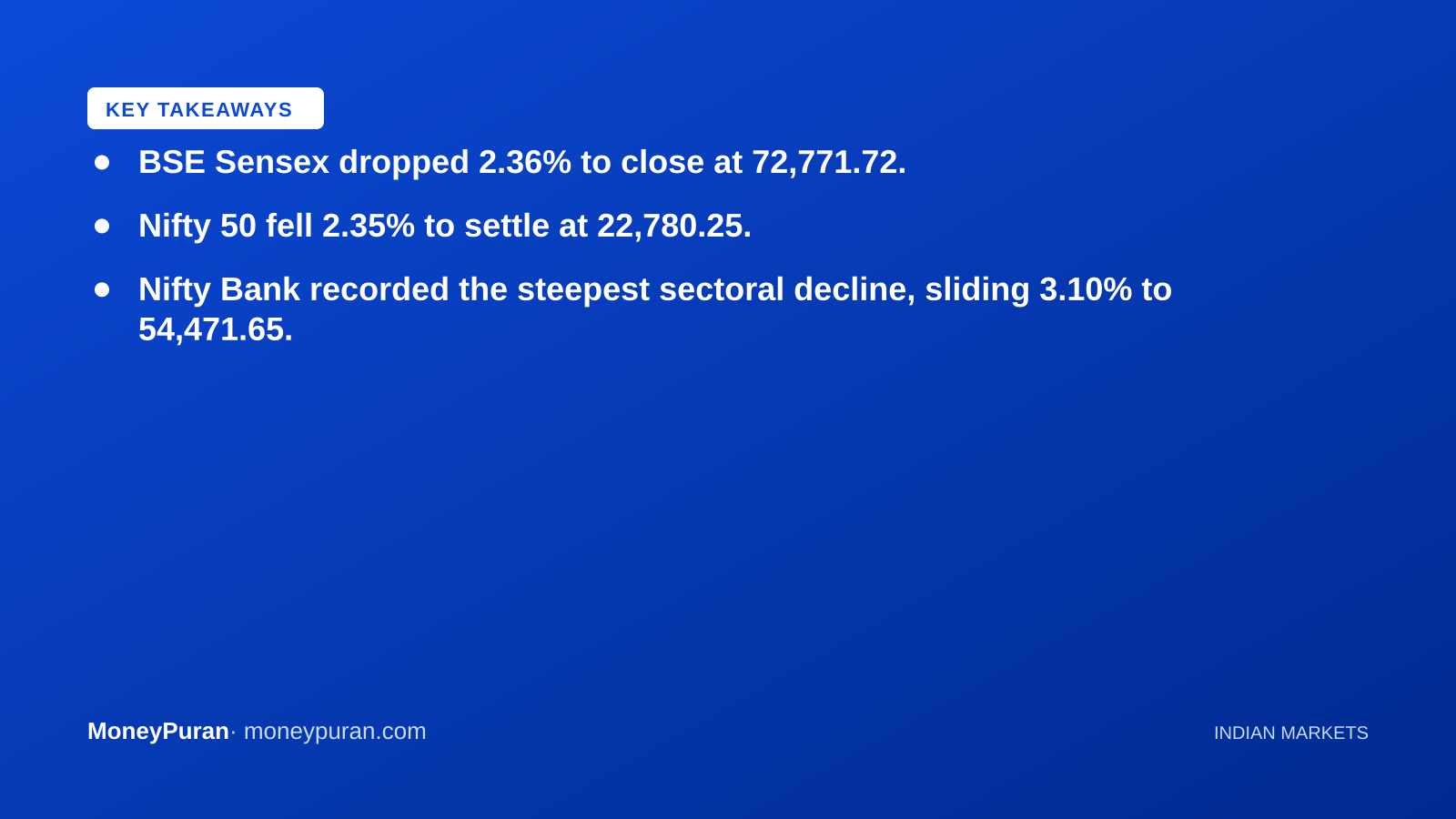
- BSE Sensex dropped 2.36% to close at 72,771.72.
- Nifty 50 fell 2.35% to settle at 22,780.25.
- Nifty Bank recorded the steepest sectoral decline, sliding 3.10% to 54,471.65.
- USD/INR edged up 0.27% to close at 95.97.
Indian equity benchmarks faced heavy selling pressure during the trading session, resulting in a sharp correction across major indices. The BSE Sensex tumbled 1,757.36 points, or 2.36 percent, to end the day at 72,771.72. Similarly, the broader Nifty 50 index declined 548.75 points, or 2.35 percent, closing at 22,780.25 as selling swept through large-cap counters.
Market breadth remained weak throughout the session, reflecting widespread risk-off sentiment among investors. Understanding why the market moved today requires looking at the broader macroeconomic backdrop and foreign capital flows affecting domestic sentiment. Both indices hovered near the lower ends of their intraday trading ranges, signaling sustained downward momentum.
Banking Sector Leads the Decline
The financial services sector bore the brunt of the selling pressure. The Nifty Bank index fell sharply by 3.10 percent, or 1,743.90 points, to finish the session at 54,471.65. Weakness in heavyweight banking stocks heavily dragged down both the Sensex and the Nifty 50, as traders unwound positions across private and public sector lenders.
Intraday volatility spiked significantly as indices breached key technical supports. The Sensex traded between a low of 72,716.23 and a high of 73,740.85, while the Nifty 50 ranged from 22,762.20 to 23,080.25. Currency markets also reflected cautious trading, with the US dollar strengthening slightly against the Indian rupee by 0.27 percent to settle at 95.97.
What this means for investors
For everyday investors, sharp market corrections of over two percent can trigger anxiety, but sudden volatility is a standard part of equity market cycles. When indices like the Sensex and Nifty experience broad-based sell-offs, it typically reflects shifting institutional flows, global macroeconomic pressures, or rebalancing activities rather than a permanent loss of fundamental value in underlying companies.
During high-volatility sessions, experts advise against panic selling or making impulsive portfolio adjustments. Reviewing your long-term asset allocation and ensuring your portfolio remains diversified across different asset classes is a more prudent approach than reacting to single-day market drops. Watch for upcoming macroeconomic data releases and institutional trading patterns to gauge the near-term direction of domestic equities.
Frequently asked questions
What were the closing levels for Sensex and Nifty 50? The BSE Sensex closed down 2.36% at 72,771.72, while the Nifty 50 settled 2.35% lower at 22,780.25.
Which sector suffered the biggest loss? The Nifty Bank index registered the steepest sectoral decline, falling 3.10% to close at 54,471.65.
This article is for information only and is not investment advice. Do your own research or consult a licensed adviser before investing.
Based on information published by MoneyPuran market data. Source: MoneyPuran market data. Spotted an error? corrections@moneypuran.com