 Money

Blue-chip stocks led a powerful Wall Street surge as the Dow Jones Industrial Average added over 1,600 points, while small-cap shares outperformed tech giants and market volatility plunged.
Key points
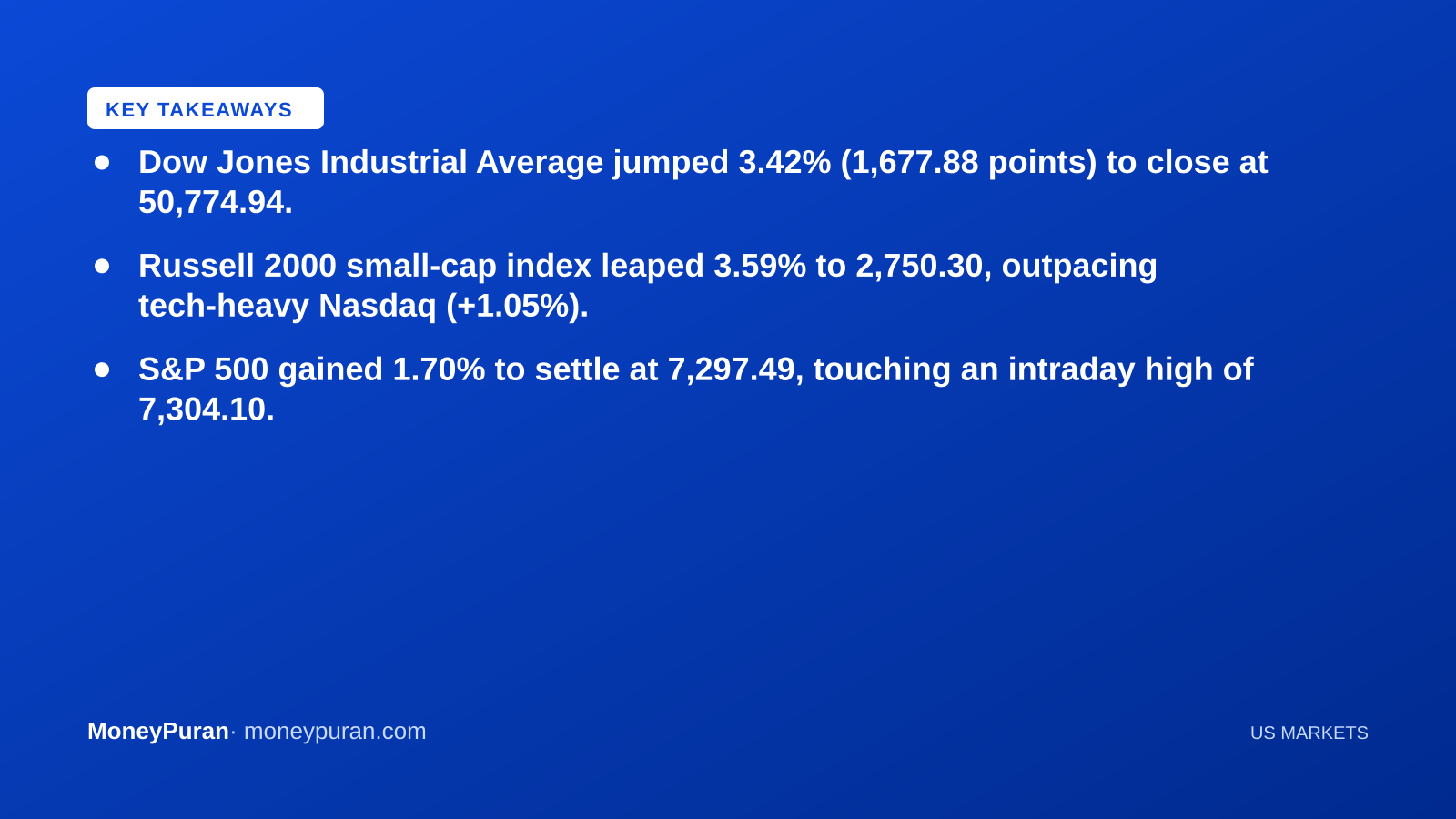
- Dow Jones Industrial Average jumped 3.42% (1,677.88 points) to close at 50,774.94.
- Russell 2000 small-cap index leaped 3.59% to 2,750.30, outpacing tech-heavy Nasdaq (+1.05%).
- S&P 500 gained 1.70% to settle at 7,297.49, touching an intraday high of 7,304.10.
- CBOE Volatility Index (VIX) plunged 10.56% to 23.81, reflecting sharply reduced market anxiety.
- US 10-year Treasury yield rose slightly by 0.49% to finish at 4.94%.
The US stock market today registered a robust across-the-board rally, driven by heavy buying in traditional blue-chip equities and small-cap stocks. The Dow Jones Industrial Average spearheaded the gains, vaulting more than 1,670 points or 3.42% to close at 50,774.94. Meanwhile, the broader S&P 500 advanced 1.70% to finish at 7,297.49 after touching an intraday peak of 7,304.10, demonstrating strong investor appetite across major industry sectors.
Dow and Small Caps Lead Broad Wall Street Expansion
In a notable shift from recent tech-dominated advances, cyclical and small-capitalization companies took the driver seat during the session. The Russell 2000 index, which tracks smaller domestic US businesses, jumped 3.59% to 2,750.30. This outpaced the technology-focused Nasdaq Composite, which posted a solid but more moderate gain of 1.05% to end at 24,129.50.
The sharp rotation into value and small-cap names indicates a widening market breadth. Analysts often view broad participation across non-tech sectors as a sign of underlying market health, reducing dependence on a handful of mega-cap technology companies to pull benchmark indices higher.
Volatility Plunges while Treasury Yields Edge Upwards
Investor anxiety cooled significantly during the session, with the CBOE Volatility Index (VIX)—frequently referred to as Wall Street’s fear gauge—falling 10.56% to close at 23.81. The drop in VIX suggests that options market participants are pricing in lower short-term market turbulence following the surge in equity prices.
In fixed-income markets, the benchmark 10-year US Treasury yield ticked moderately higher, adding 0.49% to reach 4.94%. The 10-year yield traded within a daily range of 4.88% to 4.94%, staying near recent elevated levels even as risk assets found strong support from equity buyers.
Session Highlights and Key Market Numbers
- Dow Jones Industrial Average: 50,774.94 (+3.42% / +1,677.88 points; range 50,398.29–50,830.19)
- S&P 500 Index: 7,297.49 (+1.70% / +121.66 points; range 7,211.46–7,304.10)
- Nasdaq Composite: 24,129.50 (+1.05% / +250.30 points; range 23,690.60–24,149.09)
- Russell 2000: 2,750.30 (+3.59% / +95.19 points; range 2,721.39–2,751.42)
- CBOE Volatility Index (VIX): 23.81 (-10.56%; range 23.81–27.52)
- US 10-Year Treasury Yield: 4.94% (+0.49%; range 4.88%–4.94%)
Global Read-Through and Indian Market Angle
The strong momentum on Wall Street typically sets a positive tone for Asian markets, including India’s benchmark Nifty 50 and BSE Sensex. A sharp rally in US industrial and small-cap stocks can boost global growth sentiment, benefiting export-oriented sectors in emerging markets.
However, Indian market participants must keep a close eye on US bond yields. With the 10-year US Treasury yield standing at 4.94%, high US interest rates could continue to exert pressure on foreign institutional investor (FII) flows into Indian equities and put mild downward pressure on the Indian rupee relative to the US dollar. Indian IT stocks may see mixed reactions as investors weigh US economic strength against higher long-term capital costs.
What this means for investors
The clear leadership of the Dow Jones and Russell 2000 indicates that equity market strength is expanding beyond mega-cap technology firms. For diversified investors, broader market participation historically reduces concentration risk, making equity portfolios less vulnerable to sharp pullbacks in a few large tech names.
At the same time, the drop in the VIX signals easing immediate concern among institutional traders. However, with the 10-year Treasury yield lingering close to 5%, borrowing costs remain elevated. Investors should remain mindful that sustained higher bond yields can eventually create competition for equities, making disciplined asset allocation essential.
Frequently asked questions
Why did the Dow Jones outperform the Nasdaq in today’s session? Investor demand rotated strongly toward blue-chip industrial and value-oriented companies, allowing the Dow to gain 3.42% while tech-heavy Nasdaq advanced by a more modest 1.05%.
What does the drop in the VIX volatility index mean? A 10.56% decline in the VIX indicates that demand for portfolio downside protection has decreased, reflecting lower anticipated short-term market volatility among options traders.
This article is for information only and is not investment advice. Do your own research or consult a licensed adviser before investing.
Based on information published by MoneyPuran market data. Source: MoneyPuran market data. Spotted an error? corrections@moneypuran.com