 Money


The central bank has prolonged restrictions on the Uttar Pradesh-based lender, citing public interest considerations under the Banking Regulation Act.
Key points
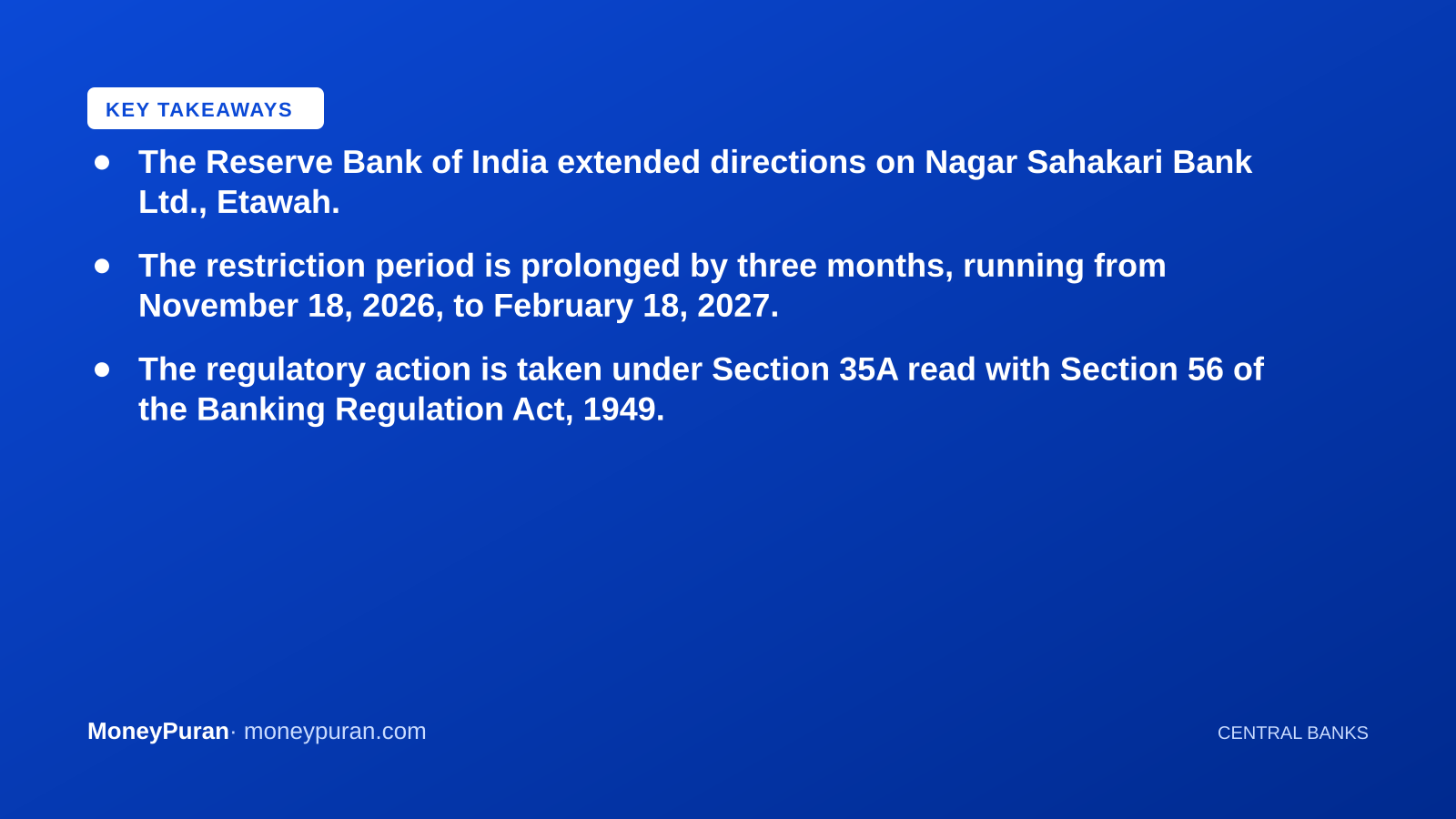
- The Reserve Bank of India extended directions on Nagar Sahakari Bank Ltd., Etawah.
- The restriction period is prolonged by three months, running from November 18, 2026, to February 18, 2027.
- The regulatory action is taken under Section 35A read with Section 56 of the Banking Regulation Act, 1949.
- The central bank noted that the extension does not imply an endorsement of the bank’s financial health.
The Reserve Bank of India (RBI) has prolonged operational restrictions on Uttar Pradesh-based Nagar Sahakari Bank Ltd., Etawah, extending its existing regulatory directions for an additional three months. According to a press release issued by the central bank, the directives will remain in force until the close of business on February 18, 2027.
Initially placed under regulatory oversight on May 15, 2026, for a six-month duration, the cooperative lender continues to operate under strict central bank supervision. The RBI stated that it is satisfied in the public interest that keeping the restrictions in place is necessary.
Understanding RBI Supervisory Directives
Under Section 35A of the Banking Regulation Act, 1949, the RBI holds sweeping powers to issue directions to commercial and cooperative banks when it finds it necessary to prevent affairs from being conducted in a manner detrimental to the interests of depositors or prejudicial to the public interest. For cooperative lenders like Nagar Sahakari Bank, these powers are read alongside Section 56 of the same statute.
Such supervisory interventions typically involve placing caps on deposit withdrawals, restricting fresh loan disbursements, or halting capital expenditures without prior central bank approval. The regulatory framework ensures that troubled institutions do not face sudden liquidity runs while attempting to restructure their balance sheets.
- Initial Directive Date: May 15, 2026
- Extended Period: November 18, 2026, to February 18, 2027
- Governing Statute: Section 35A read with Section 56 of the Banking Regulation Act, 1949
- Issuing Authority: Reserve Bank of India
What this means for investors
For everyday depositors and retail investors interacting with cooperative banks in India, regulatory extensions serve as a reminder of the differing risk profiles between major commercial banks and smaller cooperative institutions. While deposits in scheduled cooperative banks enjoy insurance coverage up to a specified limit via the Deposit Insurance and Credit Guarantee Corporation (DICGC), prolonged restrictions can temporarily lock up liquidity.
The central bank explicitly clarified that extending these directions does not signal an official endorsement or satisfaction with the bank’s underlying financial position. Market participants and account holders should watch for subsequent periodic reviews by the regulator as the February 2027 deadline approaches to gauge whether asset quality or liquidity metrics have stabilized.
Frequently asked questions
Question? Does this extension mean Nagar Sahakari Bank is closing down?
Answer. No, an extension of regulatory directions means the bank continues to operate under restricted conditions supervised by the RBI, rather than an immediate liquidation.
Question? Are customer deposits safe during this period?
Answer. Customer deposits up to the statutory limit remain protected by deposit insurance regulations, though withdrawals may be subject to specific caps imposed under the RBI directive.
This article is for information only and is not investment advice. Do your own research or consult a licensed adviser before investing.
Based on information published by Reserve Bank of India (RBI). Source: Reserve Bank of India (RBI). Spotted an error? corrections@moneypuran.com